
Anthropic's Claude Code Security Wipes Billions Off Cybersecurity Stocks in a Single Afternoon
Anthropic announced Claude Code Security, an AI tool that found 500+ vulnerabilities missed for decades in open-source code. Within hours, JFrog lost 25%, CrowdStrike dropped 8%, and the cybersecurity ETF hit its lowest since November 2023.
 Updated
6 min read
Updated
6 min read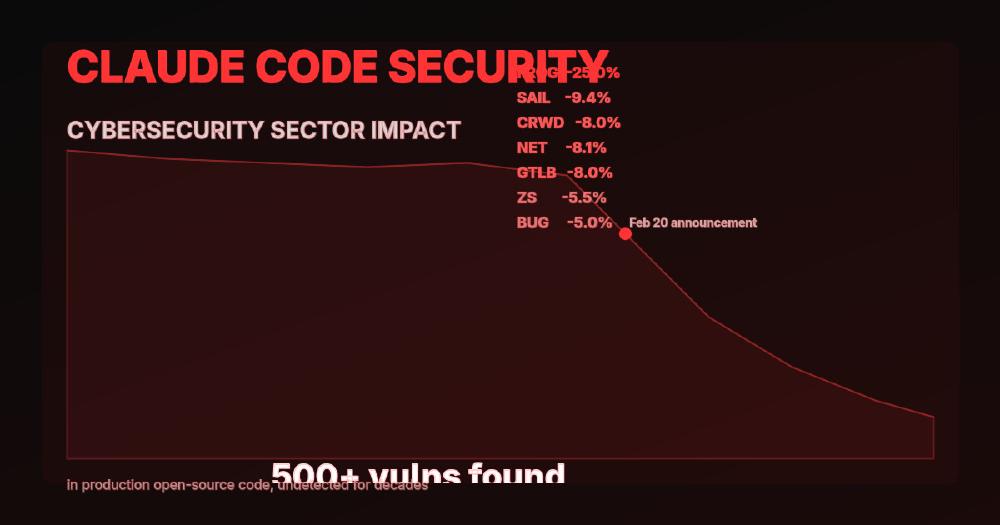
TL;DR
- Anthropic launched Claude Code Security in limited research preview on February 20 - an AI vulnerability scanner built into Claude Code that reasons about codebases like a human security researcher
- Using Claude Opus 4.6, Anthropic's Frontier Red Team found over 500 vulnerabilities in production open-source projects, some undetected for decades despite expert review
- JFrog stock plunged 25% in a single session, CrowdStrike fell 8%, Okta dropped 8%, SailPoint lost 9.4%, and the Global X Cybersecurity ETF (BUG) hit its lowest since November 2023
- Barclays analysts called the selloff "illogical," arguing Claude Code Security does not directly compete with the companies investors punished
- OpenAI launched a competing tool called Aardvark four months earlier - two of three major foundation model providers now treat code security as a built-in feature
One tweet from Anthropic. One limited research preview. Billions wiped off the cybersecurity sector in an afternoon.
On February 20, Anthropic announced Claude Code Security - a new capability built into Claude Code that scans codebases for vulnerabilities and suggests targeted patches for human review. The tool is available to Enterprise and Team customers, with expedited free access for open-source maintainers.
The market response was immediate and violent. JFrog lost 25% of its value in a single trading session. CrowdStrike dropped 8%. Cloudflare fell 8.1%. SailPoint shed 9.4%. GitLab lost 8%. The Global X Cybersecurity ETF (BUG) closed at its lowest level since November 2023.
All from a tool that's not even generally available yet.
What Claude Code Security Actually Does
Traditional static analysis tools work by pattern-matching against known exploit signatures. They catch common issues - SQL injection, XSS, buffer overflows - but struggle with anything that requires understanding how components interact across a codebase.
Claude Code Security takes a different approach. According to Anthropic, it "reads and reasons about your code the way a human security researcher would: understanding how components interact, tracing how data moves through your application." It catches business logic flaws, broken access control, authentication bypasses, and input validation gaps that rule-based scanners miss.
Every finding goes through multi-stage verification. Claude attempts to prove or disprove its own results to filter false positives. Findings receive severity ratings and confidence scores before reaching analysts. Nothing is applied without human approval.
Logan Graham, who leads Anthropic's Frontier Red Team, characterized the capability as "comparable to junior security researchers but at significantly faster speeds."
500 Vulnerabilities That Experts Missed for Decades
The headline number that spooked the market: using Claude Opus 4.6, Anthropic's team discovered over 500 vulnerabilities in production open-source codebases. These are projects with active maintainers, years of expert review, and millions of users. Some of the bugs had sat undetected for decades.
This is what separates Claude Code Security from existing tools. It's not finding known vulnerability patterns faster. It is finding vulnerability classes that traditional scanners were architecturally incapable of detecting - logic flaws that require reasoning about how data flows across multiple components.
For security teams, that's exciting. For investors in companies whose entire business model is selling vulnerability detection, it is terrifying.
The Market Carnage
Here is what happened to cybersecurity stocks on February 20:
| Company | Ticker | Drop |
|---|---|---|
| JFrog | FROG | -25.0% |
| SailPoint | SAIL | -9.4% |
| Okta | OKTA | -8.0% |
| CrowdStrike | CRWD | -8.0% |
| Cloudflare | NET | -8.1% |
| GitLab | GTLB | -8.0% |
| Zscaler | ZS | -5.5% |
| Palo Alto Networks | PANW | -1.5% |
| Global X Cyber ETF | BUG | -5.0% |
JFrog was hit hardest because its core business - software supply chain curation and package-level security controls - sits directly in Claude Code Security's crosshairs. Raymond James analyst Mark Cash explained that enterprises "may perceive reduced need for downstream package-level controls" if code quality improves at the generation stage. If the AI catches the bug before it enters the supply chain, why pay for downstream filtering?
The "Illogical" Selloff
Not everyone agrees the panic was warranted. Barclays analysts pushed back hard, calling the selloff "illogical" and arguing that Claude Code Security doesn't directly compete with most of the companies that got hammered.
They have a point. CrowdStrike sells endpoint protection and threat detection. Okta sells identity management. Palo Alto Networks sells network security. None of these are vulnerability scanners. The market treated "AI can find bugs in code" as "AI will replace all cybersecurity products," which is a massive logical leap.
The more accurate read: Claude Code Security threatens a specific slice of the market - static application security testing (SAST), software composition analysis (SCA), and developer security tooling. Companies like JFrog, Snyk, and parts of GitLab's security suite sit in the direct blast radius. CrowdStrike and Palo Alto don't.
But markets run on sentiment, and the sentiment was: AI just came for cybersecurity.
The Competitive Landscape
Anthropic isn't alone. OpenAI launched Aardvark roughly four months earlier - a competing tool that scans for vulnerabilities and tests them in isolated sandboxes. Two of three major foundation model providers now treat code security as a built-in model capability rather than something you buy separately.
This is the pattern that terrifies enterprise software investors: when a capability becomes a feature of the platform layer rather than a standalone product. It happened with databases (every cloud has one built in), monitoring (every cloud has one built in), and now it's happening with code security.
Jefferies analyst Joseph Gallo warned that model providers "will announce more products and compete for incremental cyber budget dollars." The question is not whether AI will transform security tooling. The question is how much of the existing security stack gets absorbed into the model layer versus remaining as a separate product.
What This Means
For security teams: Claude Code Security in its current form is a force multiplier, not a replacement. It finds bugs that your existing tools miss, but it operates at the code level. You still need endpoint protection, identity management, network security, and incident response. The "junior security researcher at machine speed" framing is accurate - useful, but not the full team.
For developers: If you maintain open-source projects, apply for the expedited access program. Free vulnerability scanning from a tool that found 500 bugs in projects maintained by experts is a genuine public good.
For investors: The market is pricing in disruption that hasn't happened yet for companies that aren't directly affected. The selloff in CrowdStrike and Palo Alto looks like collateral damage from a sector-wide panic. The JFrog decline, while painful, reflects a more legitimate competitive concern.
For the AI industry: This is the second time in a month that an Anthropic product announcement has moved markets (the first was Claude Cowork plugins in January). When a research preview - not even a GA product - can wipe billions off a sector, it signals how much the market believes AI is about to restructure enterprise software.
One announcement. One limited preview. Billions in market cap. The cybersecurity industry just got a preview of what AI disruption looks like - and the tool that triggered it isn't even finished yet.
Last updated

