
ChatGPT Gets Bank Access - Day After Data Lawsuit Filed
OpenAI launched ChatGPT Personal Finance on May 15, giving Pro users read access to 12,000+ banks via Plaid - one day after a class action alleged OpenAI shared user conversations with Meta and Google.
 Updated
6 min read
Updated
6 min read
TL;DR
- ChatGPT Personal Finance launched May 15 for US Pro subscribers ($200/month)
- Plaid integration connects 12,000+ institutions including Chase, Fidelity, and Schwab - read-only, can't move money
- Powered by GPT-5.5; financial data deleted within 30 days of disconnecting an account
- A class action filed May 14 alleges OpenAI embedded Meta Pixel and Google Analytics trackers that transmitted user conversation data without consent
- ChatGPT carries no fiduciary duty - it isn't a licensed financial advisor under US law
OpenAI launched its most intimate data product yet on May 15 - and it arrived one day after the company was sued in California federal court for allegedly channeling user conversations to Meta and Google without consent.
ChatGPT Personal Finance lets Pro subscribers link bank accounts, credit cards, and investment portfolios through a Plaid integration covering more than 12,000 US institutions. The timing of the class action and the product launch weren't coordinated, but the collision is hard to dismiss.
What ChatGPT Personal Finance Does
The Plaid Pipeline
Users access the feature through a "Finance" tab in the ChatGPT sidebar or by typing @Finances, connect my accounts. Plaid handles authentication - OpenAI never stores banking passwords, only a tokenized session credential. The connection supports checking, savings, investment, and crypto accounts at institutions including Chase, Fidelity, Schwab, Robinhood, American Express, Capital One, Citi, and Affirm.
Once connected, GPT-5.5 creates a spending dashboard covering portfolio performance, subscription tracking, upcoming payments, and liabilities. A "financial memory" feature stores unstructured notes - spending goals, financial context the model should carry across sessions.
Read Access, No Transactions
OpenAI is emphatic that the tool is read-only. ChatGPT can't move money, can't see full account numbers, and doesn't access data during temporary chats. If a user disconnects an account, synced data is removed within 30 days. The training data toggle is off by default, meaning connected account information doesn't feed model training unless users actively opt in.
Ty Geri, OpenAI's product lead, put it plainly in a joint statement with Plaid:
"ChatGPT's access to financial accounts is read-only, meaning moving money or taking other actions must still be done by the consumer."
OpenAI's internal benchmark - run with 50 finance professionals and not independently reproduced - put GPT-5.5 Thinking at 79 out of 100 and GPT-5.5 Pro at 82.5 on financial reasoning tasks.
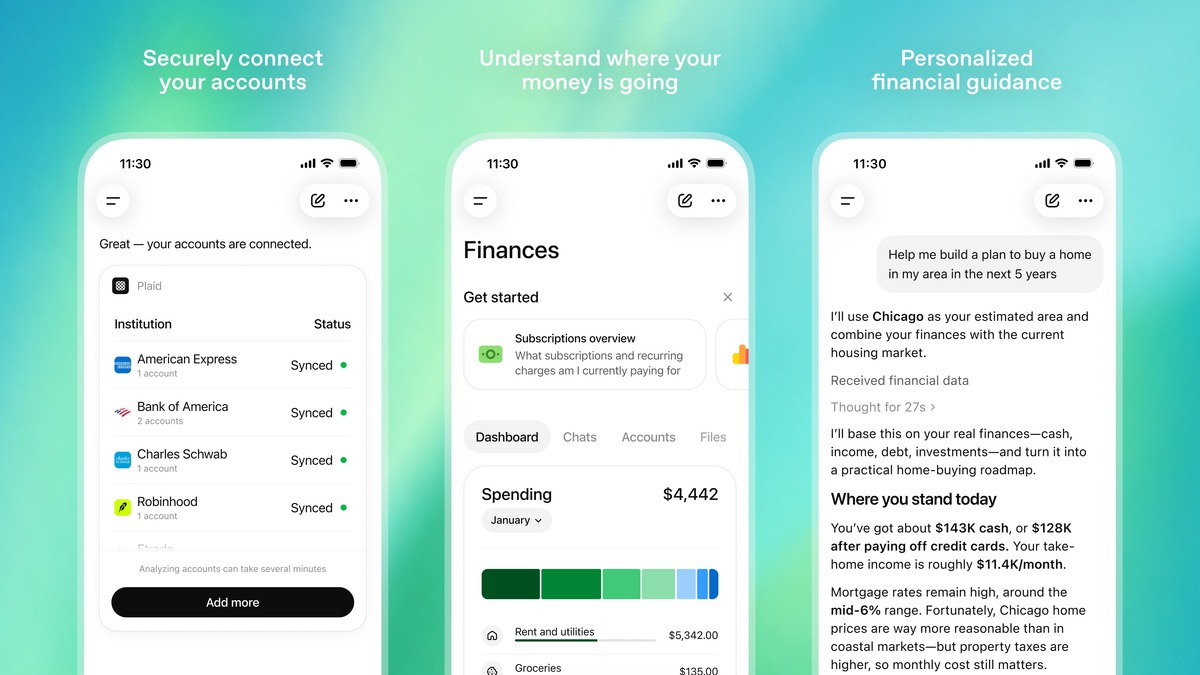 The ChatGPT Personal Finance dashboard, connecting bank accounts and investment portfolios via Plaid.
Source: techcrunch.com
The ChatGPT Personal Finance dashboard, connecting bank accounts and investment portfolios via Plaid.
Source: techcrunch.com
The Lawsuit That Landed a Day Before
The Allegations
On May 14, 2026 - one day before the personal finance launch - a class action complaint landed in California federal court alleging that OpenAI had embedded Meta Pixel and Google Analytics tracking code on ChatGPT web pages without user knowledge. The suit claims these trackers transmitted chat topics, user IDs, and email addresses to Meta and Google, with the data used for ad targeting.
The complaint specifically stressed that users discuss financial, health, and legal matters on ChatGPT. Those are exactly the sensitive categories the personal finance feature is now designed to aggregate in one place.
The Timing
OpenAI didn't respond to requests for comment on the sequence, and the feature's development predates the lawsuit - OpenAI acquired investment app Roi roughly six months earlier and absorbed personal finance startup Hiro in April 2026. But the one-day gap is damaging regardless of intent. The class action said users trusted ChatGPT with sensitive information; the next morning, OpenAI asked those same users to add their bank account data.
The Next Web put the liability framing directly:
"A human financial adviser has a legal obligation to act in a client's best interest. ChatGPT does not."
 Plaid's integration covers 12,000+ US financial institutions, handling secure tokenized authentication for OpenAI.
Source: plaid.com
Plaid's integration covers 12,000+ US financial institutions, handling secure tokenized authentication for OpenAI.
Source: plaid.com
A Product Built Without Fiduciary Duty
The Liability Gap
ChatGPT Personal Finance carries a disclaimer that it "is not a replacement for professional financial advice." Under US law, that disclaimer does real legal work: licensed financial advisors who manage client assets carry a fiduciary duty to act in clients' interests. ChatGPT carries none of that obligation, which means users making decisions based on its recommendations have no legal recourse if those recommendations go wrong.
Dylan Lerner, an analyst at Javelin Research, described OpenAI's move as an "aggressive push into financial services, positioning the company to own what he called 'share of mind' in consumer finance." That's accurate - and it describes exactly the asymmetry the product represents. OpenAI wants the consumer finance relationship without the regulatory constraints that come with it.
This follows a broader pattern of AI companies moving into financial services without inheriting the accountability frameworks that govern traditional advisors.
OpenAI's Strategic Play
The Plaid partnership is the first public output of a longer build. Hiro shut its service on April 20 and deleted all user data by May 13, two days before ChatGPT Personal Finance went live. Roi was absorbed earlier still. OpenAI is assembling a consumer finance stack, and the feature is its first move above the surface.
Future plans include an Intuit integration for tax analysis and credit approval odds. Worth noting: Intuit has already partnered with Anthropic on AI-driven financial tools - so OpenAI's entry puts it in direct competition on that front.
OpenAI says more than 200 million users already turn to ChatGPT monthly for financial guidance. The personal finance tab converts that informal behavior into a structured, data-rich product.
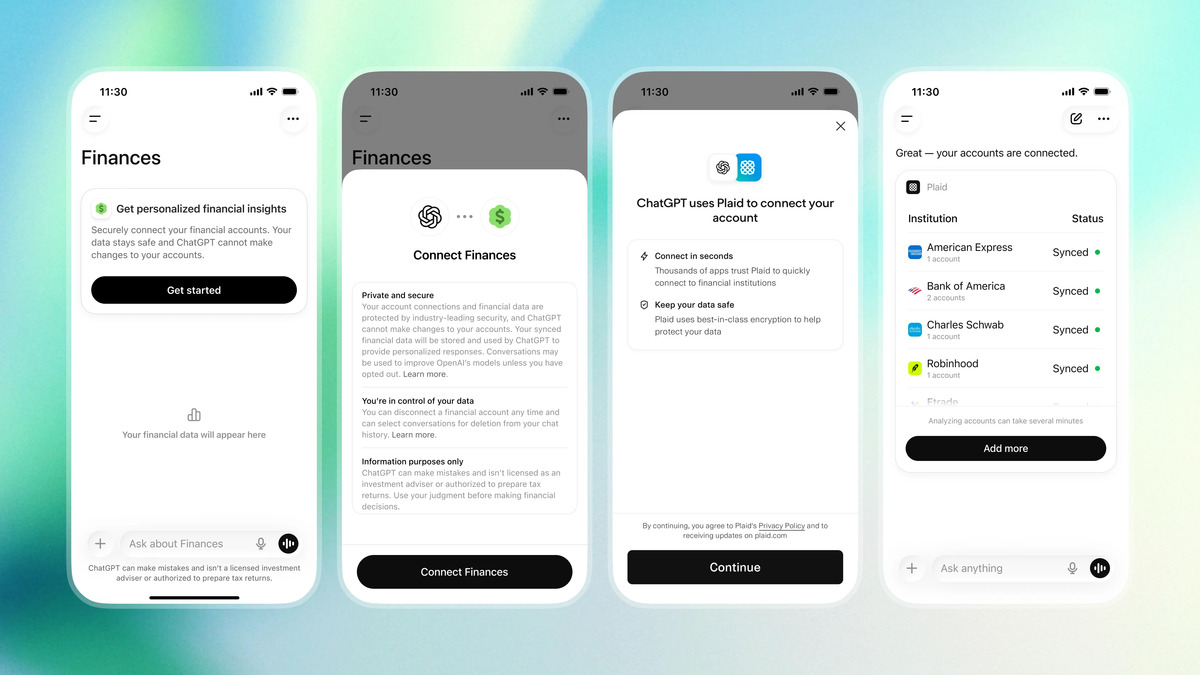 ChatGPT's Finance tab, accessible via the sidebar or by typing @Finances.
Source: openai.com
ChatGPT's Finance tab, accessible via the sidebar or by typing @Finances.
Source: openai.com
What the Feature Doesn't Say
Training Data Questions
The "improve the model for everyone" toggle being off by default is a meaningful protection for financial data. But the class action that filed the day before the launch was about data flowing to third parties via tracking pixels - a mechanism completely separate from model training, and one users had no toggle to disable. Those are two different data pathways, and only one of them is addressed by the product's stated privacy controls.
Perplexity Beat OpenAI by One Day
Perplexity added Plaid integration to its own finance product on May 14 - one day before OpenAI's announcement. The company had launched "Computer for Professional Finance" on May 5 with 40+ built-in tools covering SEC filings and institutional data, then added personal account linking as the second phase. OpenAI is entering the personal finance space later but with a user base that dwarfs Perplexity's.
OpenAI is already managing multiple active litigation threads. The class action filed on May 14 is now one more. Whether that record changes user behavior depends on whether the feature is useful enough that users decide the risk is worth it - which was OpenAI's calculation when it launched the day after.
Sources:
- A new personal finance experience in ChatGPT - OpenAI
- OpenAI launches ChatGPT for personal finance - TechCrunch
- ChatGPT will offer personalized financial advice - Engadget
- What ChatGPT's new experience signals for digital finance - Plaid
- OpenAI, Plaid to Bring Tailored Financial Guidance - Yahoo Finance
- OpenAI wants ChatGPT to see your bank account - The Next Web
- ChatGPT Personal Finance, Privacy Lawsuit - BigGo Finance
Last updated

