
Canada Launches $2.3B National AI Strategy
PM Mark Carney's AI for All commits $2.3 billion to hit 250,000 new jobs and 60% business adoption by 2034 - but critics call it a wish list without hard delivery mechanisms.
 6 min read
Prime Minister Mark Carney unveiled Canada's national AI strategy on June 4 at the University Health Network in Toronto, pledging $2.3 billion in new federal spending and setting targets that would reshape the country's tech sector over the next decade. Branded "AI for All," the strategy aims to lift business AI adoption from 12 percent today to 60 percent by 2034, create 250,000 new jobs, and build domestic compute infrastructure to reduce dependence on American cloud providers.
TL;DR
- Canada commits $2.3B in new spending under "AI for All," launched June 4 by PM Carney in Toronto
- Targets 250K new jobs and $200B in GDP growth over five years, with AI adoption rising from 12% to 60% by 2034
- 850 MW of sovereign compute capacity targeted by 2030; US firms currently control 85% of Canadian cloud
- Former RIM co-CEO Jim Balsillie: "hype, spray and pray is not a strategy"
"Artificial intelligence, the defining technology of our era, is here."
- Prime Minister Mark Carney, June 4, 2026
The timing is calculated. Carney won a federal election partly on economic sovereignty as US tariff pressure mounted. His AI strategy is an extension of that argument: Canada can't afford to let American hyperscalers control the infrastructure layer of its digital economy while the compute arms race locks in advantages that compound over years.
| Stakeholder | Impact | Timeline |
|---|---|---|
| Canadian AI startups | $500M Tech Growth Fund + $500M Regional AI Initiative | 2026-2031 |
| Small businesses | $500M BDC LIFT financing for adoption | 2026-2028 |
| Compute sector | 850 MW public supercomputer build | By 2030 |
| Post-secondary students | 1M covered by AI Literacy Initiative | 2026-2029 |
| Healthcare sector | $100M Health Sector Data Space + $200M AI Missions | 2026-2030 |
| Research institutes | $130M commercialization funding | Ongoing |
Companies
Canadian Tech and Startups
The biggest new check goes to growth capital. The $500 million Canadian Tech Growth Fund aims to keep AI companies from selling to American buyers too early - a pattern that cost Canada several prominent firms in the previous decade. The strategy adds $500 million to the Regional AI Initiative and expands the Compute Access Fund to $700 million, giving startups GPU time without routing through AWS or Azure.
Canada's three National AI Institutes - Vector in Toronto, Mila in Montreal, and Amii in Edmonton - receive $130 million in new commercialization funding. The problem those institutes have faced historically isn't research quality; it's that Canadian researchers leave for higher-paying US roles once their PhDs are done. More money for commercialization programs doesn't fix compensation gaps against frontier lab salaries.
US Hyperscalers
The strategy isn't hostile to American cloud providers, but it names the problem directly. US firms control 85 percent of Canadian cloud spending. Ottawa still wants foreign direct investment and has signed 11 international AI cooperation agreements - including a Sovereign Technology Alliance with Germany and a trilateral partnership with Australia and India on AI and quantum. The 850 megawatt sovereign compute target is the structural answer: build infrastructure that Canada controls, even if the economics of running it compete badly against hyperscaler pricing.
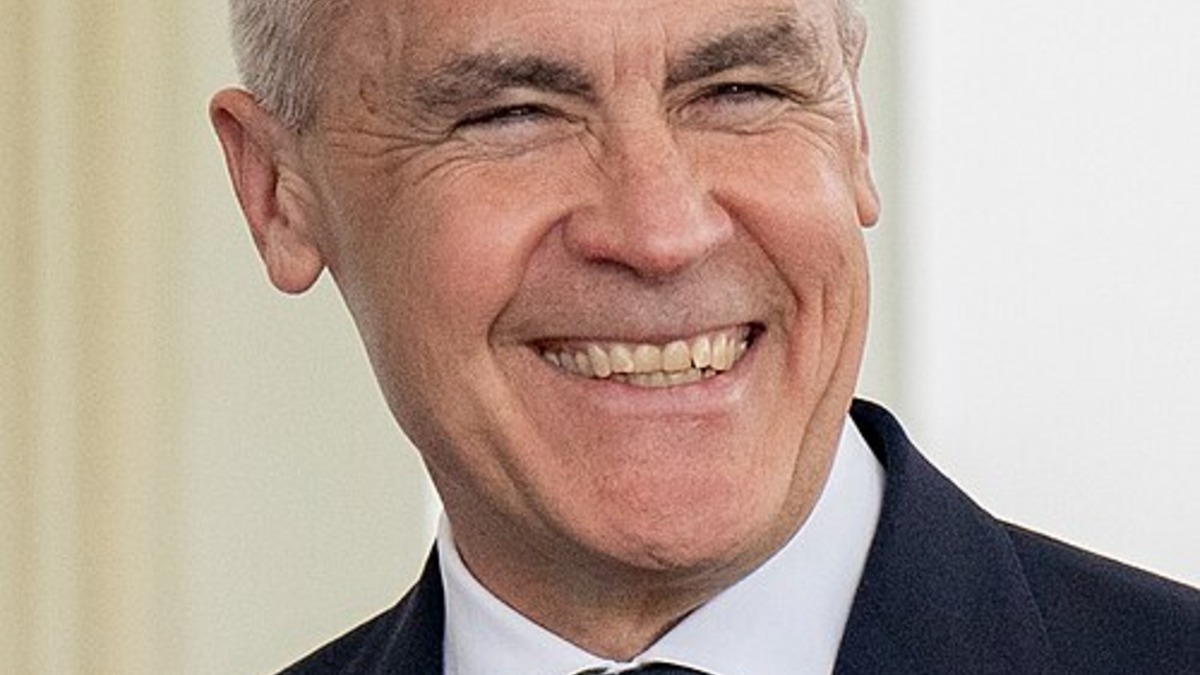 PM Mark Carney at the University Health Network in Toronto on June 4, 2026, where he launched the national AI strategy.
Source: wikimedia.org
PM Mark Carney at the University Health Network in Toronto on June 4, 2026, where he launched the national AI strategy.
Source: wikimedia.org
Users
Businesses
The 12-to-60-percent adoption jump is the strategy's most ambitious number. Reaching 60 percent AI adoption across Canadian businesses by 2034 requires consistent policy follow-through across four or five federal budgets and governments. The plan targets health, energy, transportation, agriculture, manufacturing, and robotics. A new "Canada Trusted AI Certification" program will signal that deployments meet safety standards - though the certification criteria haven't been published yet, which makes the launch announcement feel slightly incomplete.
Workers
This is where the document gets thin. NDP Leader Avi Lewis described the strategy as "heavy on adoption incentives but light on regulatory guardrails and worker protections." The plan makes no estimate of how many jobs AI adoption might eliminate, nor does it include worker transition funding. The $500 million BDC LIFT program helps small businesses adopt AI tools; it does nothing for the employees whose roles those tools might replace. That gap drew criticism from labour economists and opposition parties alike.
An Ipsos AI Monitor from 2026 found that 67 percent of Canadians feel nervous about AI, with only 26 percent feeling excited. The strategy treats that caution as an information problem - addressable through literacy programs reaching one million post-secondary students and training 3,000 educators. Whether public skepticism is really a knowledge gap or a rational reaction to AI's demonstrated limitations is a debate the strategy sidesteps.
Students and Researchers
The National AI Literacy Initiative is the most accessible piece of the plan: one million post-secondary students get access to an AI agent, educators get training kits, and young Canadians get 90,000 AI job placements over five years. These are real numbers that'll show up in the data. Whether they translate into higher wages or just more people familiar with AI tools is a different measurement problem.
Competitors
Canada is joining a race already well underway. The US passed the CHIPS Act in 2022, China has run a national AI plan since 2017, and the EU AI Act entered enforcement phases starting August 2026. Canada's 2017 Pan-Canadian AI Strategy was the first government AI strategy globally - a legitimate claim to leadership that Ottawa has struggled to convert into economic advantage.
The strategy explicitly positions Canada as an alternative to both US and Chinese AI ecosystems for allied nations that want sovereignty. The 20 new economic and defence partnerships Carney has signed since taking office - representing nearly $100 billion in foreign investment commitments - give some substance to that framing, even if the AI-specific commitments within those deals remain vague.
Jim Balsillie, the former Research in Motion co-CEO who has spent years criticizing Canada's IP and innovation policy, offered the sharpest assessment:
"This strategy reads like an extensive Christmas list of money and aspiration without any reconsideration of why the same strategies over the last decade did not work. Hype, spray and pray is not a strategy. Focus, expertise, coherence and leverage are missing."
Conservative Deputy Leader Melissa Lantsman said the announcement was "a lot of fanfare, short on details and a lot of hollow words from a podium."
What Happens Next
Parliament must still pass two bills underpinning the strategy - a privacy modernization bill and an online harms bill covering deepfakes. Neither has a confirmed timeline for passage. The 850 MW compute target requires private sector partnerships the government describes only as "being finalized." The Canadian AI Safety Institute expansion needs to recruit researchers to fill its newly enlarged mandate.
The practical test comes in the next federal budget. If the Canadian Tech Growth Fund mechanisms aren't in place within twelve months, the talent continues flowing south and the compute target slips further. Carney's majority government removes the legislative risk - the real risk is administrative velocity in a sector that moves faster than government procurement cycles.
Sources: AI for All launch - PM.gc.ca - CBC News - Globe and Mail - Global News - what's missing - ISED Strategy details - Engadget analysis - The Walrus

