
ByteDance Seedream 5.0 Pro - 2x Faster Than GPT-Image 2
ByteDance's Seedream 5.0 Pro reaches developer APIs with 2K output, 14-language text rendering, and layer-based editing at roughly one-fifth the cost of GPT-Image 2.
 6 min read
ByteDance's Seed research team shipped Seedream 5.0 Pro on July 8, directly challenging GPT-Image 2 at roughly one-fifth the price. The model handles text-to-image generation, multi-reference image fusion, and interactive layer-based editing in a single API - and it's already available on fal, BytePlus, and ComfyUI.
Key Specs
| Spec | Value |
|---|---|
| Max resolution | 2048x2048 (native 2K) |
| Language support | 14+ (incl. Arabic RTL) |
| Editable layers | 10+ per output |
| Generation speed | ~2.1 seconds |
| fal price (1536x1536) | $0.0675/image |
| fal price (2048x2048) | $0.135/image |
| Batch limit | Up to 6 images/request |
Four Core Capabilities
Complex Information Visualization
The headline use case is dense information layouts - infographics, data posters, educational diagrams - created from a single prompt. ByteDance's blog demos show the model producing an Antarctic research station overview that combines a timeline, bar charts, pie charts, weather tables, and a photorealistic station rendering in one coherent frame. The information hierarchy holds across all elements without losing visual quality on any single component.
This is the capability that distinguishes Seedream 5.0 Pro most clearly from its predecessors. Producing a multi-element infographic previously required combining outputs from separate models or significant post-processing. Seedream 5.0 Pro handles the whole pipeline in one pass.
Precision Editing and Layer Separation
The editing toolkit goes notably beyond inpainting masks. Seedream 5.0 Pro supports point selection, lasso selection, box selection, sketch-based edits, color swaps via hex codes or color swatches, and material replacement. Inputs can include up to 10 reference images simultaneously for multi-subject compositing.
Layer separation is the most unusual feature. Producing a poster and requesting "layer separation" yields 10 or more independent alpha-channel PNGs: the main text, supporting copy, the foreground subject, the background, and individual decorative elements. ByteDance's demos show background areas previously occluded by foreground subjects getting inpainted automatically, so each layer can be repositioned independently in a downstream tool.
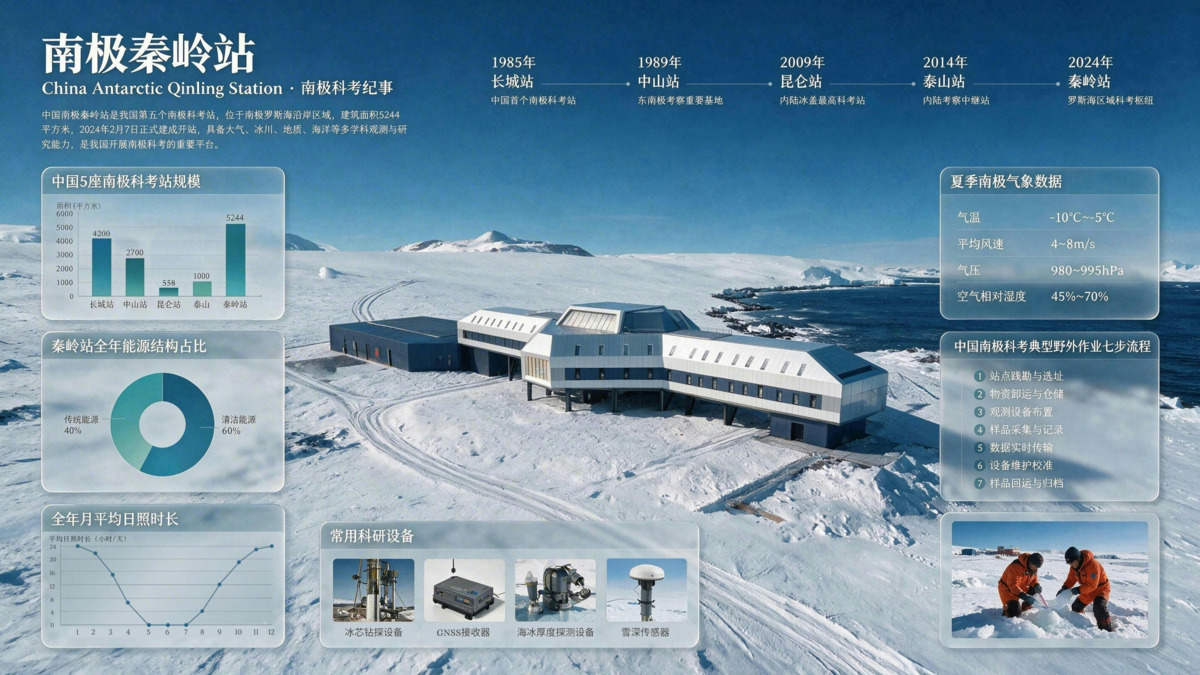 Seedream 5.0 Pro's complex information visualization - a full Antarctic research station overview with embedded data charts produced from a single prompt.
Source: seed.bytedance.com
Seedream 5.0 Pro's complex information visualization - a full Antarctic research station overview with embedded data charts produced from a single prompt.
Source: seed.bytedance.com
Photorealistic Output
The model includes explicit training toward physical lighting accuracy: "god ray" effects through windows, realistic material properties for glass and metal, skin texture with three-dimensional facial detail, and consistent lighting across multi-person composites. Photographic techniques including panning shots and motion blur are handled as prompt modifiers rather than requiring post-processing.
Compared to ByteDance's Seedance 2.0 video model, which targeted Hollywood-grade video generation, Seedream 5.0 Pro targets the design and production workflow market where still outputs go directly into production without further editing.
Multilingual Text Rendering
Text rendering inside generated images is the weak point for most image models, but Seedream 5.0 Pro supports native text generation in 14 languages: Chinese, English, French, German, Russian, Japanese, Korean, Spanish, Arabic, and five others. Arabic support includes right-to-left layout handling and proper accent reproduction. The model adapts typography, not just character sets - it applies culturally appropriate font styles and layout conventions per language.
The system can also translate foreign text within an existing image while matching the original layout, a capability ByteDance highlights for menu translation and localization workflows.
How It Stacks Up
| Seedream 5.0 Pro | GPT-Image 2 | |
|---|---|---|
| Max resolution | 2K (2048x2048) | 4K |
| Generation speed | ~2.1 seconds | ~4.2 seconds |
| Typography accuracy | 89.5% | 98.5% |
| Layer editing | Yes, 10+ layers | No |
| Multilingual text | 14+ languages | Limited |
| Web search integration | Lite variant only | No |
| Price (standard output) | $0.0675/image | ~$0.28/image |
Speed is the clearest win: 2.1 seconds against GPT-Image 2's 4.2 is a meaningful difference in any interactive workflow. Typography accuracy is the clearest gap: 89.5% vs 98.5% matters when the output goes into a client deliverable without a proofreading pass. For high-stakes text-heavy designs - print ads, branded assets, legal materials - GPT-Image 2 still has the accuracy edge.
The pricing gap, though, is substantial. At GPT-Image 2's high-quality tier, Seedream 5.0 Pro generates four-plus images for the same cost as one. For bulk production workflows where a human reviews outputs and discards near-misses, that changes the economics of the pipeline.
Testing by Atlas Cloud published alongside the launch found that Seedream 5.0 carried stronger factual accuracy for geographic and real-world subjects - it "correctly identified the Alstom design and winglet data" in their aviation test while GPT-Image 2 failed on the color scheme. The tradeoff is body text: Seedream 5.0 produced gibberish in long-form body copy blocks where GPT-Image 2 held accuracy.
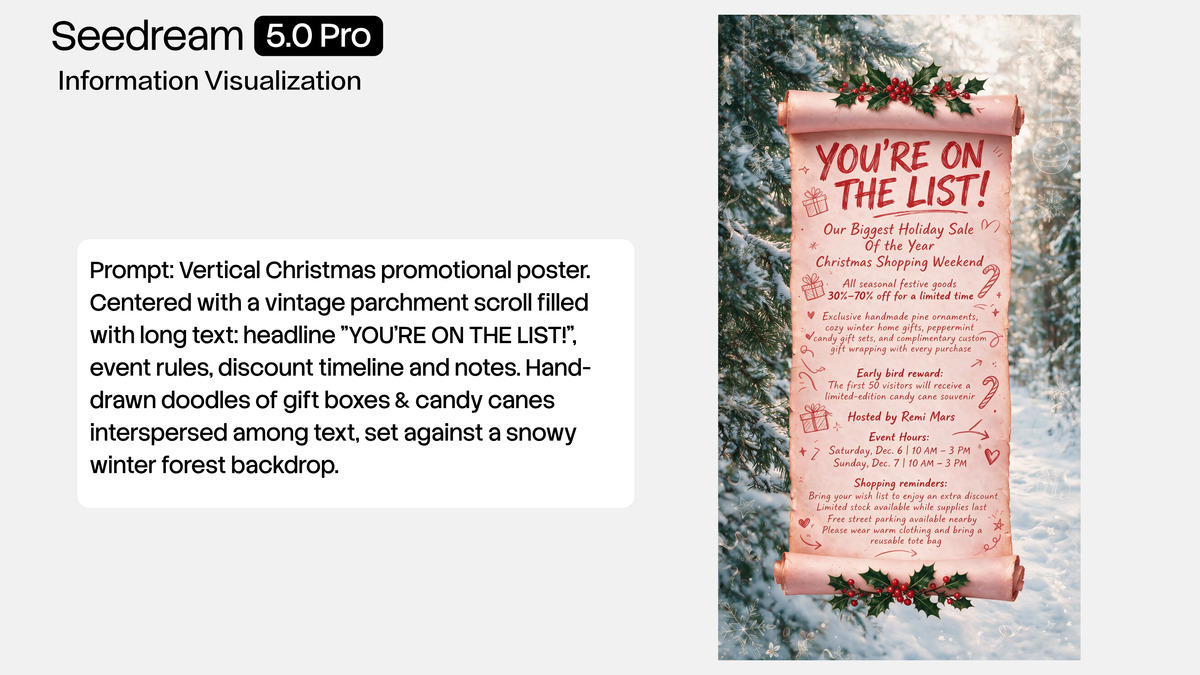 The model rendering a detailed Christmas shopping poster prompt - the Seedream 5.0 Pro interface showing the text prompt with the output.
Source: seed.bytedance.com
The model rendering a detailed Christmas shopping poster prompt - the Seedream 5.0 Pro interface showing the text prompt with the output.
Source: seed.bytedance.com
Developer Access and Pricing
Fal launched the Seedream 5.0 Pro API with ByteDance's announcement on July 8. The text-to-image endpoint runs $0.0675 per output at up to 1536x1536 pixels and $0.135 for the full 2K output at 2048x2048. Editing endpoints use the same base pricing; extra reference images beyond the first add $0.0045 each. Outputs come in JPEG or PNG, with an optional safety checker parameter.
BytePlus and the Volcano Ark platform carry the official API. Magnific offers access up to 1.5K resolution. For local and workflow use, ComfyUI node support is available from launch day. The consumer-facing entry points are ByteDance's Doubao and Jimeng apps, both with daily free usage limits.
The model card for Seedream 5.0 Pro covers the full parameter and capability breakdown. For context on the image generation API market, FLUX 2 Pro on fal runs $0.05 per standard image - Seedream 5.0 Pro's $0.0675 positions it at a moderate premium over FLUX for the added editing and multilingual capabilities.
A Lite variant also ships alongside Pro. Lite integrates real-time web search into the generation process, which gave it the factual accuracy edge in Atlas Cloud's tests over both Pro and GPT-Image 2. The web search integration makes Lite the better choice for news-responsive content and time-sensitive assets where image accuracy is the constraint; Pro handles design workflows where editing and layer control matter more.
What To Watch
The typography gap is real. 89.5% text accuracy means roughly 1 in 9 characters in a dense layout is wrong. That's acceptable in a design mockup context where a human reviews before print, and it's competitive enough for purely visual text styling, but it's a hard limit on fully automated production pipelines. ByteDance will need to close this gap before Seedream 5.0 Pro can fully replace human proofreading on text-heavy outputs.
Export flexibility is also worth monitoring. Photoshop and Figma layer imports from AI-produced layered outputs are still workflow-specific; there's no standardized handoff format yet, so integrating Seedream 5.0 Pro's layer exports into existing design pipelines will require custom tooling for most teams.
On the geopolitical side, ByteDance's position adds uncertainty to any long-term integration decision. The company runs Seedream through Volcano Ark and BytePlus, and access patterns can shift with regulatory changes - the same dynamic that complicated Seedance 2.0's Hollywood rollout.
Sources:

