
Bezos's Physical AI Lab Hits $38B After $10B Round
Project Prometheus has closed a $10 billion funding round at a $38 billion valuation, with BlackRock and JPMorgan backing Bezos's bet on physical AI for industry.
 Updated
5 min read
Updated
5 min read
Project Prometheus, the physical AI lab co-founded by Jeff Bezos and scientist Vikram Bajaj, has closed a $10 billion funding round at a $38 billion valuation. The round, confirmed Thursday by Bloomberg, is backed by JPMorgan and BlackRock - two of the largest financial institutions on the planet, neither of which is a typical venture investor.
TL;DR
- $10 billion round closed, valuing Prometheus at $38 billion - up from $30 billion in February
- Total capital raised now beats $16 billion, including the $6.2 billion launch round from November 2025
- BlackRock and JPMorgan are confirmed investors, replacing Abu Dhabi Investment Authority as the headline backers
- The lab has no public products and no confirmed commercial deployments
- Kyle Kosic, an xAI co-founder, was poached to lead large-scale infrastructure
That last detail is the one worth sitting with. BlackRock manages roughly $11 trillion in assets. JPMorgan is the largest US bank by market capitalization. When both institutions back the same startup at a $38 billion valuation - for a company that hasn't demonstrated a single product publicly - the money is not chasing demonstrated revenue. It's chasing a thesis.
The thesis is physical AI.
What Prometheus Is Betting On
Unlike the companies building language models on internet text, Prometheus is training systems on "real-world experimental data, robotics interactions, and engineering workflows," according to the lab's public statements. The goal is AI that understands materials, manufacturing tolerances, and the laws of physics - not one that summarizes them.
The targets are industries where operational data is scarce and expensive: aerospace, automotive manufacturing, drug discovery, logistics automation, and semiconductor fabrication. Prometheus argues this scarcity is itself a moat. Text data is free and abundant; data on how a jet turbine blade fails under cyclic stress isn't.
 Prometheus targets industrial sectors where AI must contend with the physical world, not just language. Physical data is far more expensive to collect than text.
Source: unsplash.com
Prometheus targets industrial sectors where AI must contend with the physical world, not just language. Physical data is far more expensive to collect than text.
Source: unsplash.com
Bajaj, who earned a PhD in physical chemistry from MIT and co-founded Alphabet's Verily and Xaira Therapeutics before leading Google X projects, brings a credible scientific pedigree to the mission. So does the company's recent acquisition of General Agents, an agentic AI startup founded by a former DeepMind researcher, and its recruitment of Kyle Kosic - one of the 11 original xAI employees who built the infrastructure behind Grok and Colossus.
The Funding Timeline
Deal Milestones
| Date | Event | Valuation |
|---|---|---|
| November 2025 | Launch round - $6.2B | ~$20B estimated |
| February 2026 | Holding company raise announced; ADIA/JPMorgan in talks | $30B |
| April 23, 2026 | $10B round closes; BlackRock + JPMorgan confirmed | $38B |
The valuation jumped $8 billion in under two months, from the $30 billion reported in February when Prometheus announced its holding company strategy to the $38 billion confirmed today. Total capital raised since launch: over $16 billion. The holding company itself is targeting as much as $100 billion, sourced from sovereign wealth funds and institutional investors, to acquire industrial businesses whose operational data would feed Prometheus's models.
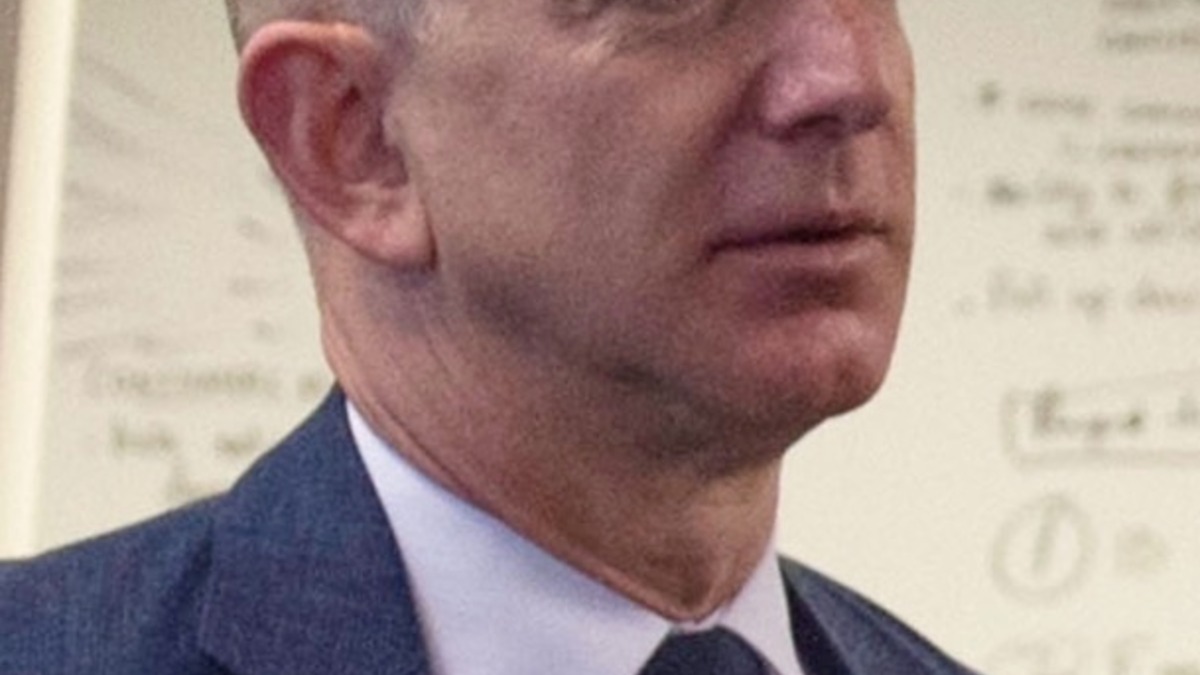 Jeff Bezos, back in an operational role for the first time since leaving Amazon in 2021, is co-CEO of Prometheus alongside Vikram Bajaj.
Source: commons.wikimedia.org
Jeff Bezos, back in an operational role for the first time since leaving Amazon in 2021, is co-CEO of Prometheus alongside Vikram Bajaj.
Source: commons.wikimedia.org
That's not a startup fundraise. That's a restructuring of how capital flows into industry.
Who Benefits
The clearest winner is the physical AI category itself. Prometheus's raise follows Eclipse Ventures' $1.3 billion fund close in April for robotics and manufacturing AI. Two significant capital events in the same month suggest institutional conviction is hardening around the idea that AI's next frontier isn't another chatbot or code assistant - it's the factory floor.
Bezos benefits personally. This is his first operational role since stepping down as Amazon CEO in 2021. The Prometheus bet is structurally distinct from his other ventures: it combines AI model development with industrial acquisition, which mirrors the Amazon playbook of building infrastructure others depend on rather than competing on product features.
BlackRock and JPMorgan benefit if the thesis holds. Physical AI for manufacturing could command premium returns precisely because the data moat Prometheus is building cannot be reproduced by scraping the internet. If the models work, the pricing power is enormous.
Prometheus employees - 120-plus staff recruited from OpenAI, xAI, Meta, and DeepMind - benefit from options in a company whose valuation has nearly doubled in five months.
 The sectors Prometheus targets - aerospace, semiconductor fabrication, automobile manufacturing - produce operational data that can't be scraped from the web. That's the moat.
Source: unsplash.com
The sectors Prometheus targets - aerospace, semiconductor fabrication, automobile manufacturing - produce operational data that can't be scraped from the web. That's the moat.
Source: unsplash.com
Who Pays
The obvious answer is BlackRock and JPMorgan's clients: pension funds, insurance pools, and retail investors who indirectly own stakes in these institutions' balance sheets.
The more structural concern is valuation discipline. Prometheus is valued at $38 billion with no public products, no disclosed revenue, and no confirmed commercial deployments. The February number was $30 billion. Nothing has shipped between those two data points; the valuation grew because investor demand did.
That gap between price and proof is a known feature of frontier AI fundraising, not unique to Prometheus. OpenAI closed a $122 billion round at an $852 billion valuation before showing the products that justified it. Anthropic's valuation outpaced its revenue for years before enterprise contracts started to close. The question isn't whether Prometheus deserves its current valuation - it's whether the proprietary data moat it's claiming will take shape before the capital runs out.
The lab's opacity doesn't help. There are no published benchmarks, no documented architecture, and no named enterprise customers. What exists is a compelling theory, a scientist with a serious academic record, a former Amazon CEO, and $16 billion in institutional conviction. That might be enough. It has been enough before.
Prometheus has positioned itself as the only AI lab whose product requires buying a factory to build - and BlackRock and JPMorgan just decided that's a bet worth $10 billion.
Sources:
- The Next Web: Jeff Bezos's physical AI lab is close to raising $10 billion
- TechFundingNews: BlackRock and JPMorgan back Bezos' AI lab in $10B raise at $38B valuation
- TechStartups: Prometheus poaches xAI co-founder from OpenAI
- BW People: Vikram Bajaj Takes Helm as Co-CEO Alongside Jeff Bezos for Project Prometheus
- Wikipedia: Project Prometheus (company)
- TechCrunch: OpenAI raises $122B funding round
Last updated

