
BadHost: The Auth Bypass Lurking in 325M AI Systems
CVE-2026-48710 in Starlette lets a single malformed HTTP header bypass authentication on vLLM, LiteLLM, FastAPI, and every MCP server in production.
 7 min read
A one-line HTTP header trick can unlock every protected endpoint across the Python AI stack - vLLM inference servers, LiteLLM proxies, FastAPI applications, and every MCP server built on top of them. The vulnerability, CVE-2026-48710, branded BadHost, was discovered by security researchers at X41 D-Sec while auditing vLLM, and it traces back to a design flaw in Starlette - the ASGI framework downloaded more than 325 million times per week that forms the foundation of nearly all Python AI services running in production today. A patch dropped on May 31. An unknown number of systems haven't applied it.
"Starlette constructs request.url by concatenating the HTTP Host header with the request path without validating what the Host header contains. Any middleware that makes security decisions using request.url.path is making those decisions on attacker-controlled data."
- CVE-2026-48710 disclosure, badhost.org
Impact at a Glance
TL;DR
- CVE-2026-48710 in Starlette (all versions before 1.0.1) allows auth bypass via a malformed
Hostheader - Affected: vLLM, LiteLLM, FastAPI, Text Generation Inference, MCP servers, Google ADK-Python, Ray Serve, BentoML
- Real-world exposure: pharmaceutical databases, cloud mailboxes, SSH access to industrial equipment found unprotected in production
- Fix: upgrade to Starlette 1.0.1; replace
request.url.pathwithrequest.scope["path"]in custom middleware - Scanner: public detection tool available from X41 D-Sec and Nemesis
| Stakeholder | Impact | Timeline |
|---|---|---|
| vLLM operators | Unrestricted access to LLM inference endpoints | Patch now - Starlette 1.0.1 |
| LiteLLM users | Auth bypass on proxy layer; API key extraction | Patch now |
| MCP server admins | Full endpoint exposure; agent tooling accessible | Patch now |
| FastAPI apps with path-based auth | Authentication silently skipped | Patch or refactor middleware |
| Enterprises running AI agents | Unauthorized compute consumption; data exposure | Ongoing until patched |
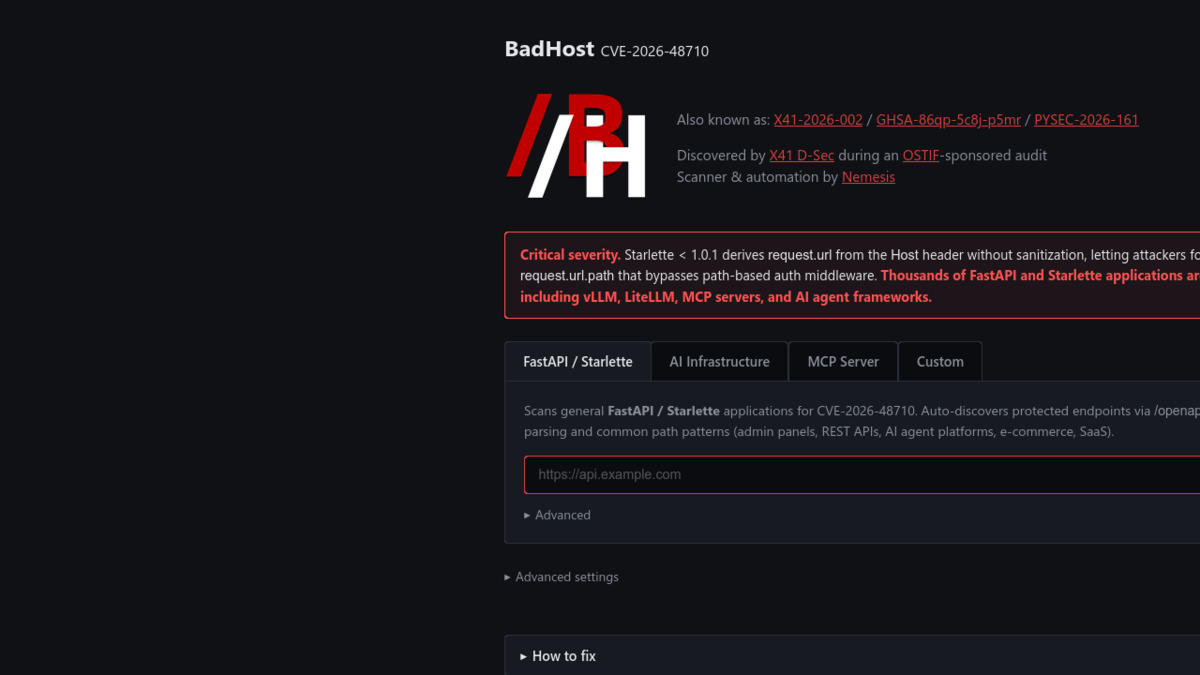 The official BadHost disclosure site at badhost.org, released by X41 D-Sec.
Source: badhost.org
The official BadHost disclosure site at badhost.org, released by X41 D-Sec.
Source: badhost.org
How One Character Breaks the Stack
The flaw is not in the authentication logic of any specific AI framework. It's in how Starlette builds the URL object that middleware reads to decide what's and isn't protected.
When a request arrives, Starlette reconstructs request.url by stitching together the Host header and the request path. If the path is /admin and the Host header is example.com, the resulting request.url.path is /admin - correct. But if an attacker sends the Host header as example.com/health?x=, Starlette builds an URL where request.url.path assesses to /health - an open, unauthenticated endpoint the middleware is designed to allow through.
The router sends the request to /admin. The middleware, reading request.url.path, thinks it is /health. The attacker gets through.
The Root Cause in Code
The correct value to use for security decisions is request.scope["path"], which comes directly from the ASGI server and can't be tampered with by HTTP headers. The request.url object, by contrast, is reconstructed from untrusted inputs. Any middleware that uses request.url.path to decide whether to authenticate a request is vulnerable regardless of what AI framework is built on top of it.
FastAPI's own Depends() and Security() decorators use the router scope and are not affected. The vulnerability is specific to custom middleware that wraps the entire application at the ASGI layer.
MCP Servers Are Especially Exposed
MCP servers compound the risk because they mandate a unauthenticated OAuth discovery endpoint by design - the specification requires that /.well-known/oauth-authorization-server be reachable without credentials. This is a feature, not a bug. But it creates a predictable open path that an attacker can embed in a malicious Host header to slip past auth middleware on every other endpoint on the server.
Anthropic's Python MCP SDK, Google's ADK-Python, and the broader MCP ecosystem all run on FastAPI and Starlette. An MCP RCE flaw disclosed earlier this year affected an estimated 200,000 servers; BadHost's attack surface is larger because it requires no special configuration - just that path-based middleware was used instead of per-route decorators.
Who Is Exposed
AI Inference Servers
vLLM and LiteLLM are the two most widely rolled out open-source LLM inference and proxy layers in the industry. Both run on Starlette. A BadHost exploit against an unpatched vLLM server allows an attacker to send inference requests to any available model without credentials - burning compute budget, extracting cached responses, or probing the model for prompt injection entry points.
LiteLLM proxies aggregate API keys for OpenAI, Anthropic, and other providers into a single endpoint. LiteLLM has been targeted before - a SQL injection CVE patched in 2026 exposed internal routing tables. BadHost is a different attack vector but the same target: an organization's entire LLM API budget sitting behind a single gateway.
Text Generation Inference (Hugging Face), Ray Serve, and BentoML - all common in enterprise AI deployments - are listed in the advisory as affected.
Agent Frameworks and MCP Servers
MCP servers connect AI agents to external systems: email inboxes, cloud storage, databases, calendars, code repositories. A compromised MCP server is not a compromised chat interface - it's a compromised set of credentials and capabilities across every system that server can reach.
The advisory notes that production scans found MCP servers exposing full mailbox access at SaaS providers, SSH access to industrial devices, clinical trial databases at pharmaceutical companies, personal identity data at verification firms, and AWS topology and distributed trace data at cloud companies. These were production deployments, not test environments. The researchers didn't name the companies.
 AI inference servers and agent frameworks depend on Starlette for request handling - the layer where BadHost operates.
Source: unsplash.com
AI inference servers and agent frameworks depend on Starlette for request handling - the layer where BadHost operates.
Source: unsplash.com
The Governance Problem BadHost Exposes
The security story here isn't unusual - foundational library, bad assumption, years in production before anyone looked closely enough. The difference is the blast radius. Starlette's 325 million weekly downloads are a floor, not a ceiling: every FastAPI app, every vLLM deployment, every LiteLLM install, every MCP server written in Python - all of them stand on Starlette.
The AI industry has spent two years building an infrastructure stack at extraordinary speed. Supply chain attacks have followed - compromised packages, malicious MCP servers, injected dependencies. BadHost is a different category: it's not an attacker getting into the supply chain. It's a design pattern that was never audited for security effects at scale.
There's no AI-specific regulation that would have caught this. The EU AI Act, the White House executive orders, the NIST AI Risk Management Framework - none of them mandate security audits of the Python web frameworks that AI systems are built on. That's not an argument for more regulation; it's an observation about where the actual risk surface is, and where the current oversight apparatus isn't looking.
X41 D-Sec and Nemesis have released a public scanner. Checking whether your deployments are vulnerable costs less than the compute that an undetected exploit would consume.
What Happens Next
The patch is Starlette 1.0.1, released May 31, 2026. The fix is two lines: replace request.url.path with request.scope["path"] in any middleware that makes authentication decisions. Downstream frameworks including FastAPI, vLLM, and LiteLLM will need to release their own updates confirming compatibility with Starlette 1.0.1 or shipping the fix directly.
The harder problem is the long tail. Starlette isn't installed by hand. It is a transitive dependency of FastAPI, which is a transitive dependency of vLLM, LiteLLM, and hundreds of other packages. Organizations that aren't explicitly pinning versions may not know what version of Starlette is running inside their inference stack. The public scanner addresses this for actively monitored deployments. Internal agent frameworks and MCP servers running in enterprise environments, behind firewalls, often are not.
The combination of a critical CVSS rating, a trivial attack vector, and a target class - MCP servers connected to live enterprise systems - that wasn't on most security teams' patch radar six months ago makes BadHost the most operationally significant AI infrastructure vulnerability disclosed this year.
Sources:
- BadHost CVE-2026-48710 official disclosure - badhost.org
- BadHost threatens millions of AI agents and MCP servers - ITdaily
- BadHost: Starlette flaw puts millions of AI agents at risk - firethering.com
- CVE-2026-48710: BadHost - Starlette auth bypass - cybersecuritynews.com
- BadHost breaks into FastAPI and vLLM with a single character - hackingpassion.com

