
Artisan Ran an AI Ad With a Meme It Never Licensed
AI startup Artisan used KC Green's 'This Is Fine' meme in subway ads without permission, drawing a sharp response from the artist and raising questions about AI companies and creator rights.
 6 min read
"We have a lot of respect for KC Green and his work, and we're reaching out to him directly."
- Artisan spokesperson, responding to TechCrunch
That statement was Artisan's entire response when a reporter asked why the AI startup had plastered a modified version of KC Green's "This Is Fine" dog in a New York subway ad - without asking Green for permission, without a license, and without notice. Green found out through social media.
TL;DR
| What they said | Artisan expressed "a lot of respect" for KC Green and pledged to reach out |
| What we found | The company ran a commercial subway ad using Green's character without a license or prior contact |
| What comes next | Green is seeking legal representation; the Furie v. Infowars precedent sets a $15,000 floor for this type of case |
The Claim
Artisan, the AI startup best known for its "Stop Hiring Humans" billboard campaign, modified KC Green's 2013 "This Is Fine" webcomic character for a subway advertisement. The original strip - the anthropomorphic dog sitting calmly in a burning room - became one of the internet's most recognized memes. In Artisan's ad, the dog says "[M]y pipeline is on fire" while a prompt urges viewers to "Hire Ava the AI BDR." Ava is Artisan's AI-powered business development representative product, the core of a company that raised $25 million in April 2025.
When TechCrunch contacted Artisan about the ad, the company said it had "a lot of respect" for Green and was scheduling time to speak with him. That was the full statement. No acknowledgment that the use was unauthorized. No apology. No indication the ad had been pulled.
The Evidence
What KC Green Actually Said
Green's response, posted to social media, was unambiguous: "it's not anything [I] agreed to. it's been stolen like AI steals. please vandalize it if and when you see it."
He told TechCrunch he'd be "looking into [legal] representation, as I feel I have to," while noting the situation "takes the wind out of my sails." He'd rather make comics than spend time on litigation.
His reference point was deliberate: Matt Furie's 2019 copyright case against Infowars over unauthorized use of Pepe the Frog. Infowars had sold a poster featuring Pepe without Furie's permission, made roughly $14,000 from it, and settled for $15,000 after a federal judge rejected its fair use defense. The settlement required Infowars to destroy remaining posters and barred any future Pepe merchandise.
What Copyright Law Says About Ads
The fair use doctrine shields various transformative or commentary-driven uses of copyrighted work. It applies very differently to commercial advertising than to organic meme sharing online. Courts weigh four factors, and the commercial nature of a use is explicitly one of them.
An AI startup running paid subway ads is about as commercial as a use gets. Artisan wasn't commenting on Green's work or parodying it in any meaningful sense - it was borrowing his art to sell a product. The "transformation" of the dialogue ("This is fine" becoming "[M]y pipeline is on fire") adds a brand message on top of Green's original, which normally weakens rather than strengthens a fair use argument. Copyright attorneys have generally held that when a meme migrates from organic sharing to advertising, the legal protection collapses.
The Pattern of Behavior
This isn't the first time Artisan has reached for provocative materials to market Ava. The "Stop Hiring Humans" billboards appeared across San Francisco and New York in October 2024, generated tens of millions of impressions, and sparked significant backlash. CEO Jaspar Carmichael-Jack later acknowledged the campaign was "mostly just for attention" and that he doesn't actually believe AI will replace all human workers. The company followed up with a softer variant: "Stop Hiring Humans ... *For Work They Hate."
That context matters. Artisan has a documented pattern of using controversy as a marketing tactic, then walking it back with asterisks. Using an unlicensed meme in a paid ad is the same move with higher legal stakes.
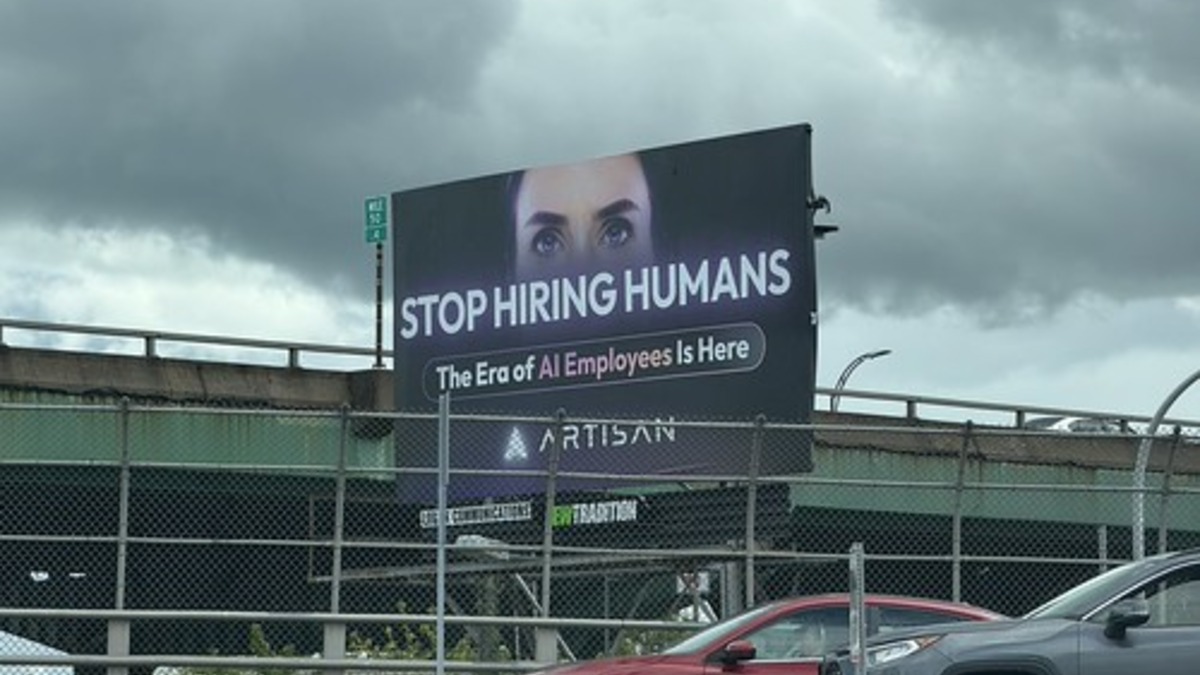 Artisan's "Stop Hiring Humans" billboard campaign launched in October 2024, appearing in San Francisco and New York. A similar billboard was photographed in Boston.
Source: flickr.com (ChrisAmico, CC BY-NC-ND 2.0)
Artisan's "Stop Hiring Humans" billboard campaign launched in October 2024, appearing in San Francisco and New York. A similar billboard was photographed in Boston.
Source: flickr.com (ChrisAmico, CC BY-NC-ND 2.0)
Claim vs. Reality
| Artisan's Position | What the Record Shows |
|---|---|
| "A lot of respect for KC Green" | Used his character commercially without asking |
| "Reaching out to him directly" | Green found out through social media, not Artisan |
| (Implied: one-time incident) | Follows a pattern of provocative, boundary-testing marketing |
| (Implied: transformative use) | Commercial advertising is the least-protected category under fair use |
What They Left Out
Artisan's statement doesn't explain why the company didn't license the image. Green isn't a reclusive figure. He runs a webcomic, he's publicly active, and his contact information isn't hard to find. A $25 million-funded startup has the resources to secure a license for creative work it intends to use in paid advertising.
The statement also skips over the mechanics of how this happened internally. Someone at Artisan or its ad agency selected that image, modified it, printed it, and placed it in a subway station. "Reaching out to him directly" after a reporter calls isn't a fix - it's crisis management.
This incident sits within a broader pattern of AI companies treating creators' work as freely available. The Britannica and Merriam-Webster lawsuit against OpenAI over allegedly copied content, the Hollywood copyright disputes surrounding ByteDance's Seedance, and the Academy's new rules barring AI-generated content from Oscar eligibility all reflect the same tension: AI companies moving quickly with other people's work and sorting out legal questions afterward, or not at all.
Artisan's case is distinct from those. This wasn't training data or model outputs. It was a direct commercial reproduction of Green's character in paid advertising - a simpler and more clearly actionable fact pattern.
 Copyright cases involving commercial use of creative work carry a much lower bar for infringement than fair use disputes over training data.
Source: unsplash.com
Copyright cases involving commercial use of creative work carry a much lower bar for infringement than fair use disputes over training data.
Source: unsplash.com
Furie v. Infowars established that "respect" for a creator's work is measured in licensing fees and removal notices, not press statements. Infowars paid $15,000 after a judge rejected its fair use defense. That's the number Artisan should have in mind as it schedules its call with KC Green.
Sources:
- 'This is fine' creator says AI startup stole his art - TechCrunch
- Artisan, the 'stop hiring humans' AI agent startup, raises $25M - TechCrunch
- InfoWars must pay Pepe the Frog creator Matt Furie $15,000 in legal settlement - The Washington Post
- Furie v. Infowars, LLC - U.S. Copyright Office Fair Use Summary
- Why we put "stop hiring humans" on billboards - Artisan blog

