
Apple Sues OpenAI Over Stolen Hardware Secrets
Apple filed suit against OpenAI on July 10, alleging a coordinated scheme to steal iPhone trade secrets through recruiting tactics and unauthorized file downloads.
 7 min read
Apple filed a lawsuit against OpenAI on Friday in the U.S. District Court for the Northern District of California, alleging a systematic scheme to steal confidential trade secrets tied to the AI lab's push to build consumer hardware. The complaint names OpenAI's Chief Hardware Officer Tang Tan, former senior engineer Chang Liu, and OpenAI's io subsidiary as defendants.
"OpenAI's nascent hardware business now rests on the shakiest of foundations, rotten to its core by its illegal reliance on misappropriated trade secrets." - Apple's lawsuit complaint
TL;DR
- Apple sued OpenAI in federal court on July 10 over alleged coordinated theft of hardware trade secrets
- Chief Hardware Officer Tang Tan is accused of asking job candidates to bring Apple device components to interviews and coaching departing staff to evade Apple's security procedures
- Former engineer Chang Liu allegedly kept an Apple laptop after leaving and downloaded 1,000+ pages of confidential technical documents
- More than 400 former Apple employees now work at OpenAI; the hardware project targets a 2027 device launch
- Apple is seeking an injunction, damages, and return of all confidential materials; OpenAI hasn't commented
The Allegations
The complaint's core claim is not a single act of opportunism. Apple describes what it calls a pattern of theft coordinated at the senior leadership level, beginning well before any individual employee made the decision to jump ship.
The Recruiting Machine
Tang Tan spent 24 years at Apple, leading hardware design on the iPhone and Apple Watch before departing in February 2024 to join Jony Ive's design startup io, which OpenAI later picked up for $6.5 billion. According to Apple's filing, Tan built OpenAI's hardware recruiting pipeline in a way that explicitly targeted Apple's confidential knowledge.
Apple alleges Tan used internal Apple project code names during job interviews with Apple employees - a detail that would be meaningless to an outsider but signals to candidates that their institutional knowledge is precisely what OpenAI wants. The complaint goes further: Tan allegedly asked candidates to bring actual Apple hardware components to interviews as "show and tell," and coached departing employees on how to evade Apple's standard security exit procedures. Apple also alleges OpenAI misrepresented itself to Apple suppliers, claiming permission to reproduce proprietary techniques it had no right to use.
The Laptop Download
Chang Liu joined OpenAI in January 2026 after eight years at Apple as a senior systems electrical engineer. Apple's filing states he failed to return a company-issued laptop after leaving. That laptop gave him access, through what Apple describes as a security vulnerability, to Apple's cloud file storage. Liu allegedly used it to download more than 1,000 pages of confidential technical files covering unannounced technologies, features, engineering specifications, and product data. The complaint also names a current Apple employee, Yu-Ting "Alyssa" Peng, who allegedly continued sending Liu project updates after he had joined OpenAI.
 A page from Apple's federal complaint filed in the Northern District of California on July 10, 2026.
Source: 9to5mac.com
A page from Apple's federal complaint filed in the Northern District of California on July 10, 2026.
Source: 9to5mac.com
Apple sent OpenAI a letter raising these concerns in February 2026. OpenAI did not respond.
What's Actually at Stake
The lawsuit is not really about a laptop. OpenAI is racing to ship its first consumer hardware - the io division, led by Tan and staffed heavily with former Apple engineers, is targeting a smart speaker priced between $200 and $300 for early 2027, along with an AI agent phone running on a customized MediaTek chip targeting the first half of 2027. If Apple can convince a court to block OpenAI from using the allegedly stolen IP, it puts those timelines at risk.
| Stakeholder | Impact | Timeline |
|---|---|---|
| OpenAI | Hardware launch and supply chain relationships at legal risk | 2027 targets in question |
| Tang Tan | Named defendant; professional and financial exposure | Active litigation |
| Chang Liu | Named defendant; potential criminal referral | Active litigation |
| Apple suppliers | Named in misrepresentation claims; exposed to contract disputes | Immediate |
| Jony Ive / io | $6.5B acquisition faces legal cloud over IP provenance | Near-term |
| AI hardware market | IP enforcement could raise barriers for all competitors | 12-24 months |
The financial math matters here. OpenAI paid $6.5 billion for io. It has over 400 former Apple employees, many of them in hardware roles. If the court finds that significant portions of OpenAI's hardware knowledge base rest on misappropriated Apple IP, the company faces injunctions that could suspend supplier relationships, redesign requirements, and damages that run to hundreds of millions at minimum.
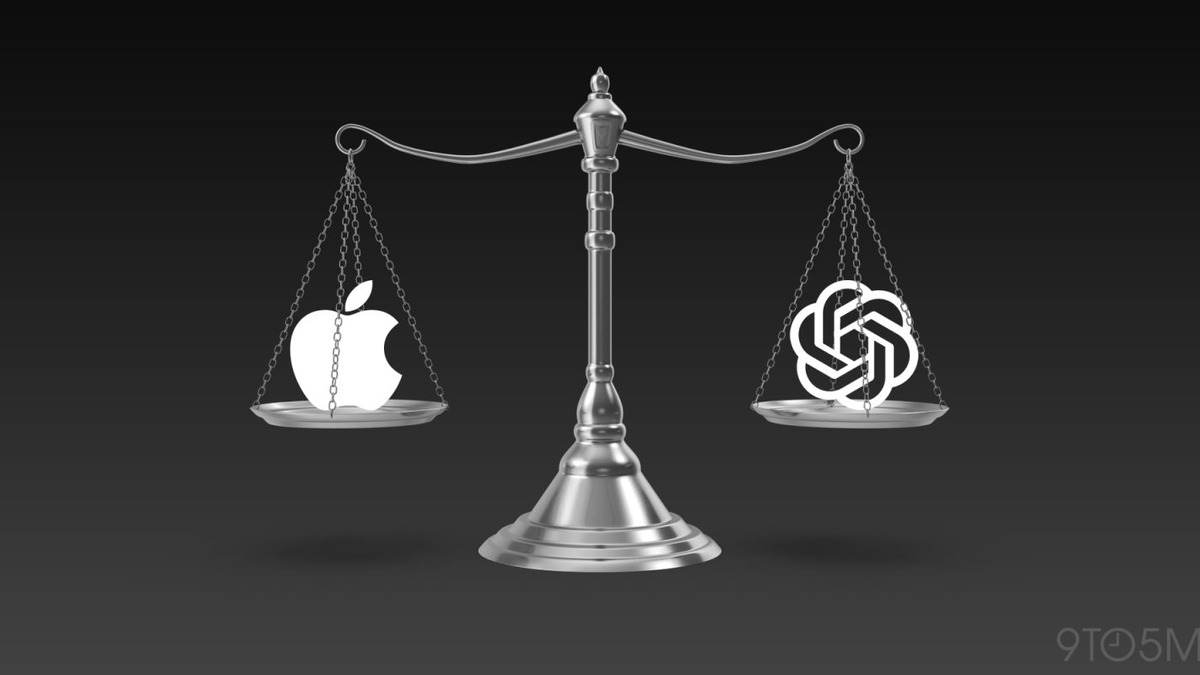 The two companies have had a complicated relationship - from the ChatGPT-Siri integration deal to mounting legal tension over hardware ambitions.
Source: 9to5mac.com
The two companies have had a complicated relationship - from the ChatGPT-Siri integration deal to mounting legal tension over hardware ambitions.
Source: 9to5mac.com
What This Means for the Players
Apple
Apple's motivations aren't purely defensive. OpenAI's AI agent phone is explicitly framed as an iPhone rival - a device that would replace traditional apps with AI agents running on hardware Apple once considered its exclusive territory. Apple has watched more than 400 of its hardware engineers walk out the door toward OpenAI. The lawsuit is both a legal action and a strategic signal: the talent drain has a price, and Apple is prepared to enforce it.
The relief Apple seeks is significant. It wants OpenAI barred from using or disclosing the trade secrets, forced to return all confidential material, and ordered to preserve all evidence. An injunction on use could mean OpenAI's supplier agreements, component specifications, and manufacturing processes all need to be unwound if they trace back to Apple IP.
OpenAI
OpenAI hasn't publicly responded to the complaint. That silence is consistent with the behavior Apple describes - the company reportedly didn't reply to Apple's February letter either. The lack of response won't help it in court.
The timing is rough. OpenAI is managing an IPO process, navigating a widening set of copyright lawsuits from publishers including the New York Times, and simultaneously trying to execute on its most ambitious product bet. A trade secret injunction against its hardware division during the pre-production phase of its first consumer devices would be a serious operational problem.
OpenAI previously hired outside lawyers to explore its own lawsuit against Apple over the collapsed ChatGPT-Siri integration deal, a move reported in May. That dispute has apparently not been settled. The two companies are now suing each other in different jurisdictions over different things.
Competitors
The suit has effects beyond Apple and OpenAI. Every AI lab with hardware ambitions - Google's DeepMind device work, Meta's smart glasses, Humane's successor efforts - relies heavily on talent that came from Apple, Samsung, and other device manufacturers. If Apple prevails here, it establishes that trade secrets travel with the knowledge of the employees who hold them, not just with the files they take. That makes aggressive hardware recruiting legally riskier across the board.
 OpenAI's San Francisco offices. The company picked up Jony Ive's io startup in 2025 for $6.5 billion to anchor its hardware ambitions.
Source: 9to5mac.com
OpenAI's San Francisco offices. The company picked up Jony Ive's io startup in 2025 for $6.5 billion to anchor its hardware ambitions.
Source: 9to5mac.com
What Happens Next
The case is assigned to the Northern District of California, which is the standard venue for Silicon Valley IP disputes and has handled comparable trade secret cases involving NVIDIA, Waymo, and Uber. Apple will likely seek a preliminary injunction, which would force a faster hearing on whether OpenAI can continue using the allegedly stolen knowledge while the case proceeds.
Discovery will be the battlefield. Apple will seek to depose Tang Tan, Chang Liu, and others. OpenAI will argue that its hardware work was developed independently, or that the stolen information played a marginal role. Courts assess trade secret cases partly on how much the stolen information actually contributed to the defendant's product.
OpenAI's previous legal challenges - the Musk trial, the copyright cases, the raft of regulatory inquiries - have been managed without obvious disruption to the company's product roadmap. This one is different. It sits central to OpenAI's most expensive bet, on a product that has not shipped yet, being built by people whose departure is now the subject of a federal complaint. Apple filed this case at the moment of maximum leverage.
Sources:
- Apple sues OpenAI over alleged trade secret theft - TechCrunch
- Apple Sues OpenAI for Stealing Trade Secrets to Build AI Hardware - MacRumors
- Apple sues OpenAI, two former employees for trade secrets theft - NBC News
- Apple sues OpenAI, accuses ex-employees of stealing trade secrets - 9to5Mac
- Everything We Know About OpenAI's Planned iPhone Rival - MacRumors

