
Apollo and Blackstone Make AI Compute an Asset Class
Broadcom, Apollo, and Blackstone launched the $35B AI XPV Platform on June 9, targeting 20GW of custom AI silicon through 2028 with Anthropic as the anchor customer.
 5 min read
Private equity has been circling AI infrastructure for two years. On June 9, it made its position formal.
Broadcom, Apollo Global Management, and Blackstone launched the AI XPV Platform, a structured financing vehicle that opens with an initial tranche of $35 billion to deploy Broadcom's custom AI chips into Anthropic's next wave of training infrastructure. The platform targets more than 20 gigawatts of compute capacity through 2028, with Anthropic and OpenAI listed as the primary lab customers.
TL;DR
- Broadcom, Apollo, and Blackstone launch a structured platform targeting 20GW of AI compute through 2028
- Apollo leads the first tranche at $35 billion, with Blackstone's Credit and Insurance business as co-investor
- Anthropic is the named anchor customer: more than 1GW of compute at FluidStack sites starting mid-2026
- OpenAI is listed as a target customer but no specific commitments are disclosed
- Apollo describes AI compute as "one of the most compelling new asset classes in finance"
The Platform in Context
The AI XPV Platform is a capital aggregation and deployment vehicle. Apollo and Blackstone provide financing; Broadcom supplies the hardware - its custom XPU accelerators and AI networking stack; Anthropic and OpenAI are the anchor lab customers that contract for compute.
Broadcom's XPUs are application-specific chips co-designed with each major AI lab. Anthropic's XPU line is built for its specific training architecture; OpenAI has a separate custom chip relationship with Broadcom. Unlike general-purpose NVIDIA GPUs, these chips can't be repurposed across customers. That constraint is what makes the cash flow structure attractive to creditors: contracted compute obligations produce predictable, long-duration revenue streams that look more like infrastructure assets than technology purchases.
| Deal | Capital | Compute Target | Financing Type | Key Partners |
|---|---|---|---|---|
| AI XPV Platform | $35B initial | 20GW by 2028 | Private credit | Apollo, Blackstone, Broadcom |
| Stargate (OpenAI) | $500B commitment | 100GW+ | Mixed equity and debt | SoftBank, Oracle, Microsoft |
| SoftBank France | €75B | 5GW by 2031 | Balance sheet | EDF, Schneider Electric |
| Amazon-Anthropic | $4B | Undisclosed | Equity and cloud credits | Amazon AWS |
| Broadcom-Anthropic TPU deal | $30B | Undisclosed | Customer contract | Broadcom |
The Stargate comparison matters for scale calibration. Stargate is larger in headline number but diffuse in structure - multiple partners, multi-year commitments, no single credit obligor behind it. The AI XPV Platform has named counterparties, a defined hardware supplier, and an anchor customer signed at launch.
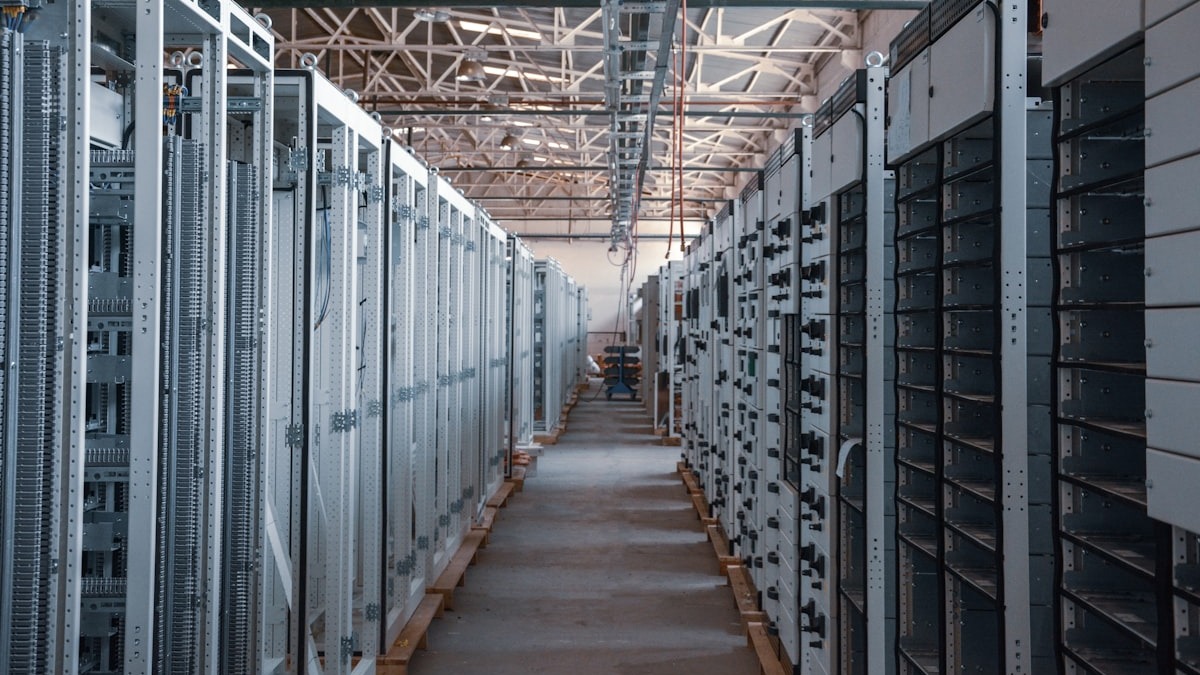 Modern AI data centers require billions in upfront capital for hardware, cooling, and power infrastructure - an asset profile that private credit firms can now underwrite.
Source: unsplash.com
Modern AI data centers require billions in upfront capital for hardware, cooling, and power infrastructure - an asset profile that private credit firms can now underwrite.
Source: unsplash.com
Who Benefits
Broadcom
The chip maker gets the clearest near-term win. Broadcom reported $8.4 billion in AI semiconductor revenue in Q1 FY2026, up 106% year over year, with a $73 billion AI-related backlog. That backlog just grew. With Anthropic committed to more than 1GW of Broadcom XPU compute starting mid-2026, Broadcom has revenue visibility that most hardware companies cannot match. The platform also reinforces its XPU model against NVIDIA's general-purpose GPU approach: custom silicon, bought in bulk under long-term contracts, can deliver lower per-token costs than NVIDIA hardware at comparable scale.
Anthropic
The AI lab benefits in a less obvious but strategically significant way. Anthropic raised $65 billion at a $965 billion valuation earlier this year, but equity capital carries a cost. Securing infrastructure through a credit vehicle lets Anthropic grow its compute capacity without issuing new shares. The capital from its Series H stays available for model research rather than data center construction.
Apollo and Blackstone
The private equity firms get access to AI infrastructure returns without taking equity risk in individual labs. Jamshid Ehsani, the Apollo partner leading the transaction, described AI compute as "rapidly emerging as one of the most compelling new asset classes in finance, characterized by contracted cash flows, mission-critical utility." That framing is a credit analysis, not a pitch. Anthropic's compute obligations under the platform produce revenue streams that lenders can underwrite like infrastructure contracts.
FluidStack, the compute hosting company named as the site operator for Anthropic's first 1GW deployment, gets a large build-out mandate with credit-backed commitments behind it.
 Broadcom's San Jose campus. The company's Q1 FY2026 AI revenue reached $8.4 billion, driven by custom XPU chip demand from major AI labs.
Source: commons.wikimedia.org
Broadcom's San Jose campus. The company's Q1 FY2026 AI revenue reached $8.4 billion, driven by custom XPU chip demand from major AI labs.
Source: commons.wikimedia.org
Who Pays
NVIDIA
NVIDIA does not appear in this announcement, and that absence is the point. Every gigawatt deployed through the AI XPV Platform uses Broadcom's XPUs, not NVIDIA's H100 or B200 GPUs. At the platform's stated 20GW target through 2028, the displacement effect could route tens of billions in AI chip demand away from NVIDIA's order book. NVIDIA still dominates the broader GPU market, but Anthropic and OpenAI represent two of its largest potential customers - and both now have a structured path to custom silicon funded at institutional scale.
Competing Compute Clouds
CoreWeave, Lambda Labs, and similar GPU-as-a-service providers face a different kind of pressure. If Anthropic builds more than 1GW of owned compute through the XPV Platform, that is capacity it no longer rents externally. The platform internalizes what would otherwise be third-party cloud spend.
Anthropic's Customers
Compute costs ultimately pass through to API pricing. The platform's stated design goal is to lower per-token delivery costs, which should compress prices over time. Whether that compression reaches developers or stays as margin is a pricing decision Anthropic controls independently.
 Apollo's New York headquarters. The firm is treating AI compute as a credit asset class with characteristics similar to long-duration infrastructure debt.
Source: commons.wikimedia.org
Apollo's New York headquarters. The firm is treating AI compute as a credit asset class with characteristics similar to long-duration infrastructure debt.
Source: commons.wikimedia.org
"The sheer scale of the global AI opportunity requires a bold, collaborative model. Funding the AI buildout will need all the markets - equity, public investment-grade debt, and private capital working together."
- Jim Zelter, President, Apollo Global Management
The deal reflects a meaningful shift in how institutional finance is categorizing AI infrastructure. Apollo isn't treating this as a venture bet on AI labs - it's treating contracted compute obligations like toll infrastructure, where the asset produces cash flows as long as the customer keeps training. Whether that comparison holds across a technology cycle is a question credit analysts will debate for years.
Thirty-five billion dollars, two of Wall Street's largest private equity firms, and the world's dominant custom chip supplier just turned contracted AI compute into a credit asset class.
Sources:

