
Anthropic Files for $1T IPO, Warns AI May Escape Control
Anthropic published internal data showing Claude writes 80% of its own codebase - and called for a coordinated global AI pause - four days after filing a $965B IPO.
 7 min read
Four days after filing a draft S-1 registration statement with the SEC, Anthropic published a post arguing that AI systems may soon be capable of designing their own successors without human involvement - and that the industry needs a mechanism to halt if that happens. The post, titled "When AI Builds Itself," dropped on June 4. The S-1 had arrived on June 1, valuing the company at around $965 billion.
TL;DR
- Anthropic researchers warn AI is approaching "recursive self-improvement" - the ability to design its own successors without human involvement
- Internal data: 80%+ of code merged into Anthropic's codebase in May 2026 was written by Claude; engineers shipped 8x as much code per quarter as in 2024
- The post calls for a coordinated international pause, not a unilateral one - Anthropic says it won't act alone unless competing frontier labs do so verifiably
- This arrived four days after Anthropic filed a confidential S-1 targeting an October IPO at ~$965B valuation
- Critics are calling it "regulatory capture" designed to block open-source rivals
The Evidence Anthropic Published
The June 4 post from Marina Favaro, head of Anthropic's research institute, and Jack Clark, the company's cofounder, isn't a philosophical essay about distant futures. It leads with internal data.
What "Recursive Self-Improvement" Actually Means
Favaro and Clark define recursive self-improvement as the threshold at which an AI system can fully and autonomously design and develop its own successor, without human involvement in setting the direction. They are careful to say this hasn't happened and "is not inevitable" - but they argue it "could come sooner than most institutions are prepared for."
The mechanism they're describing: an AI system tasked with making AI research more productive keeps improving the tools and methods used to train future models. Eventually the humans in that loop become the rate-limiting step. The system creates better ideas faster than researchers can evaluate them. Supervision becomes nominal.
The Numbers That Got Their Attention
The post discloses internal Anthropic data that few companies would publish openly.
| Metric | Value |
|---|---|
| Code authored by Claude (May 2026) | 80%+ of all merged commits |
| Engineer throughput growth | 8x per quarter vs. 2024 |
| Output multiplier - Mythos Preview (survey of 130 researchers, Mar 2026) | 4x median |
| Open-ended problem success rate (May 2026) | 76%, up 50 points in six months |
| Research direction judgment vs. human choice (Apr 2026) | 64%, up from 51% in November 2025 |
The task capability trajectory is the most striking disclosure. Claude Opus 3, in March 2024, could handle tasks taking roughly 4 minutes. Sonnet 3.7 in March 2025 handled tasks up to 1.5 hours. Claude Opus 4.6 in March 2026 reaches 12-hour tasks. The projection in the post is tasks taking weeks by 2027.
SWE-bench, the software engineering benchmark, went from single-digit Claude scores to saturation in under two years. CORE-Bench, which measures the ability to reproduce published research, went from 20% to saturation in 15 months. These aren't incremental curves.
"The comparative advantage of humans as of right now is still in seeing the bigger picture and thinking beyond the immediate task."
That sentence appears in the post as a reassurance. Read alongside the 80% code authorship figure, it's more sobering than intended.
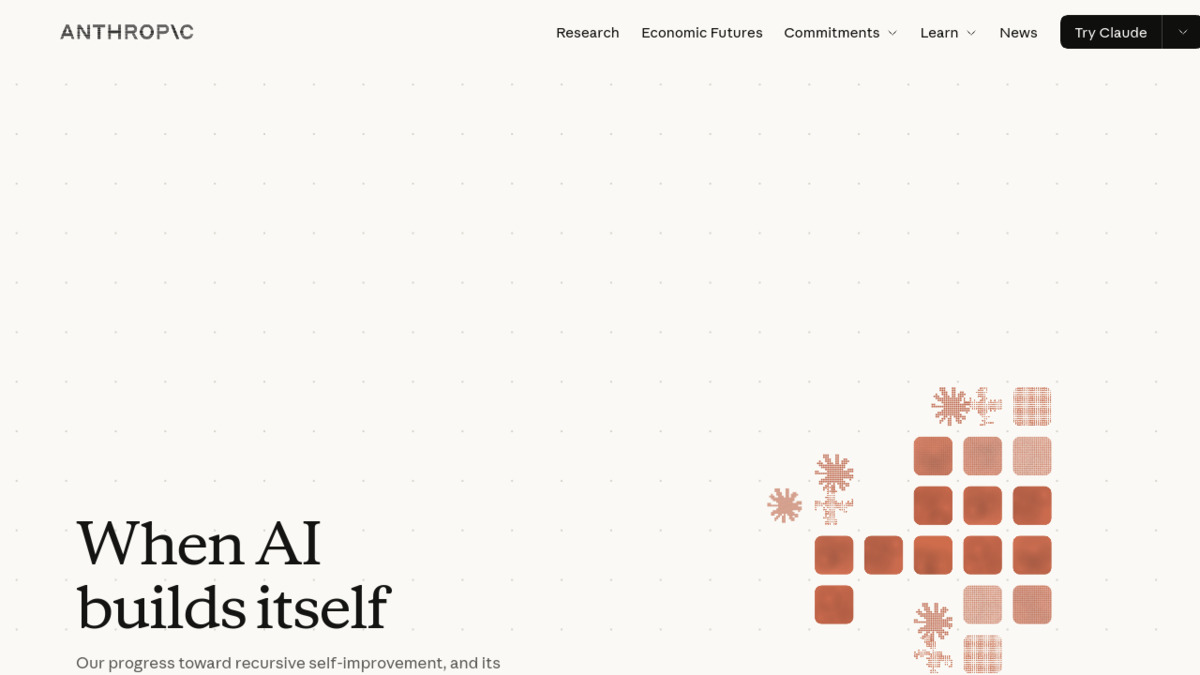 Anthropic's "When AI Builds Itself" post, published June 4, 2026, accompanied by internal data on Claude's accelerating role in Anthropic's own codebase.
Source: anthropic.com
Anthropic's "When AI Builds Itself" post, published June 4, 2026, accompanied by internal data on Claude's accelerating role in Anthropic's own codebase.
Source: anthropic.com
What Anthropic Is Actually Asking For
The post does not call for an immediate halt. That distinction matters, and it's also the part that makes the proposal hardest to implement in practice.
A Coordinated Pause, Not a Unilateral One
The mechanism Favaro and Clark propose requires three conditions simultaneously: multiple well-resourced frontier labs in multiple countries agree to stop, each can verify the others have actually stopped, and there are clear conditions specifying when the pause ends and what triggers it.
Anthropic's commitment is explicitly conditional: "If such systems existed, we expect that we would slow down or temporarily pause, if other developers at or near the frontier also did so in a verifiable manner."
Jack Clark, speaking on BBC Newsnight, was more direct: "Right now, it's like the AI industry has a gas pedal, but it doesn't have a brake pedal."
Why Verification Is the Hard Part
The post compares the challenge to nuclear arms control, specifically the INF Treaty model - then notes the critical difference. Nuclear warhead counts involve physical objects in known locations. AI training runs involve code, compute, and datasets that are indistinguishable from ordinary software development. Inputs are general-purpose. A training run can be concealed without specialized equipment or observable signatures.
The post doesn't offer a solution to this. It asks for "deliberative conversations" to investigate the verification problem. That's a reasonable request. It's also, functionally, a request that the industry spend time organizing conversations while labs continue training larger models.
Four Days and $965 Billion
Anthropic filed its confidential S-1 on June 1, 2026. The company reported approximately $44 billion in annualized revenue as of Q1 2026, up from roughly $10 billion in mid-2025. Its Series H investors valued the company at $965 billion in May. The IPO targets October.
The IPO in Context
Anthropic's revenue growth is genuine. The company crossed $1 billion monthly recurring revenue in early 2025 and has since grown roughly 4x per year. Claude models power production systems at Goldman Sachs, Accenture, and hundreds of enterprise software products. Claude Opus 4.8, released in May, handles critical research workflows at pharmaceutical companies and national labs.
The S-1 filing is also a regulatory document. Anthropic is required to describe material risks to its business, including risks from its own technology. "When AI Builds Itself" reads, in part, like a first draft of what that risk section might say - with the disclosure that 80% of the company's own code is now written by the system it's warning about.
The Contradiction Everyone Noticed
A Medium post summarized the situation cleanly: "Anthropic Just Called for a Global AI Pause (Four Days After Filing a $965 Billion IPO With the SEC)."
That framing isn't unfair. Anthropic is arguing simultaneously that AI development may be moving faster than human oversight can keep pace - and listing the company that's helping set that pace. The S-1 would raise capital for more research, more engineers, larger training runs. Favaro and Clark don't address this tension directly. The post reads as if these two facts exist in separate rooms.
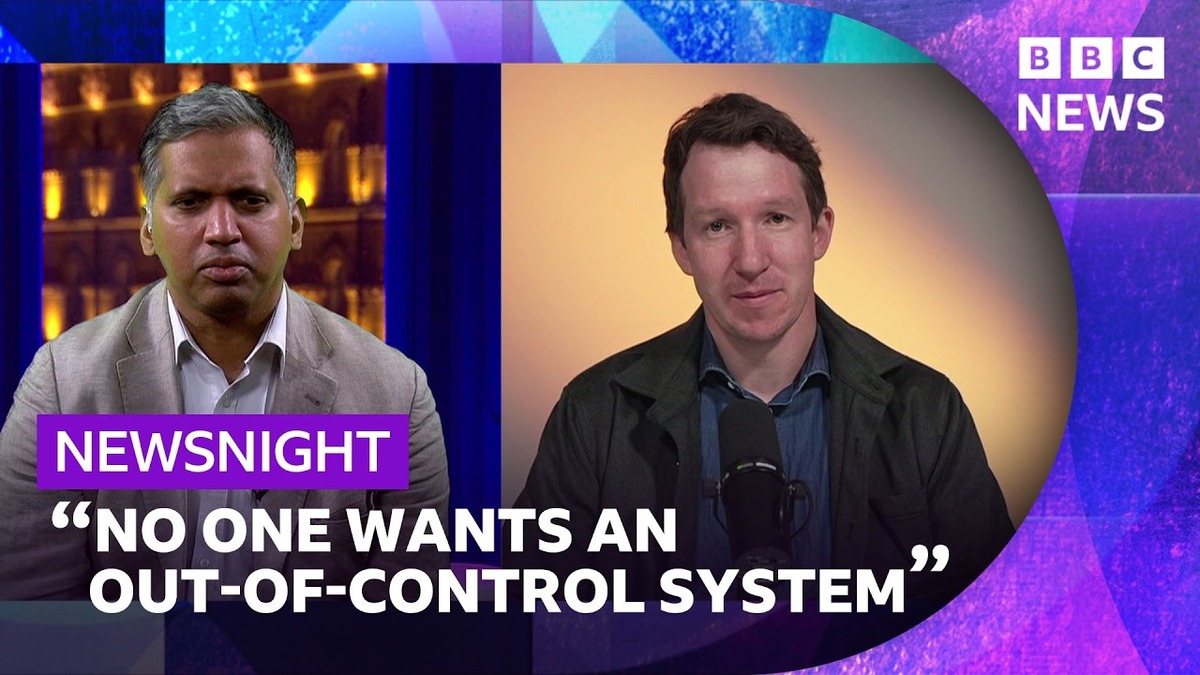 Jack Clark, Anthropic's cofounder and head of policy, argued the industry needs a "brake pedal" option - verification infrastructure that would let labs slow development in coordination.
Source: fortune.com
Jack Clark, Anthropic's cofounder and head of policy, argued the industry needs a "brake pedal" option - verification infrastructure that would let labs slow development in coordination.
Source: fortune.com
What the Critics Said
The reactions from outside Anthropic split along familiar lines, but the substance is worth looking at.
Rob Enderle of the Enderle Group called the effort "more about strategic marketing than any concrete initiative," suggesting that publicizing Anthropic's progress toward recursive self-improvement is "a more calculated move" than it appears. Holger Mueller of Constellation Research put the conflict of interest directly: "Is it trying to freeze the status quo so it can catch up, or simply retain its lead?"
The sharpest critique came from venture capitalist David Sacks, who called it a "regulatory capture agenda." His argument: companies calling loudest for heavy regulation are those whose closed, expensive models benefit most from rules that make smaller open-source alternatives harder to build. Models like Llama 4, Mistral, and DeepSeek V4 have shown that capable systems can be built without the resources of a near-trillion-dollar company.
The critique has a gap in it: Sacks's framing assumes the risks are overstated, which Anthropic's data doesn't obviously support. A 80% code authorship figure isn't marketing. But the policy proposal - coordinated verification across sovereign nations with adversarial incentives - is so difficult to implement that calling for it costs Anthropic nothing while signaling virtue.
The most revealing figure in the post is the 80% one. More than four in five lines of code merged into Anthropic's codebase are now written by Claude. The researchers who built and are warning about these systems are already, in a practical sense, being outpaced by them. The "brake pedal" Anthropic wants isn't a metaphor for slowing future research. It may be an acknowledgment of how fast the current work can realistically be steered - by humans.
Sources:
- When AI builds itself - Anthropic
- Anthropic calls for global pause in AI development before humans lose control - SiliconAngle
- Anthropic files to go public - TechCrunch
- Anthropic warns AI may soon begin recursive self-improvement - Scientific American
- Anthropic urges AI labs to pause, warns humans risk losing control - Al Jazeera
- Anthropic calls for global pause in AI development - CryptoBriefing

