
Anthropic's Opus 5 Chases Fable 5 at Half the Price
Anthropic launched Claude Opus 5, pitching it as near-Fable 5 intelligence at half the cost rather than a new smartest model, with weaker safety classifiers and a new effort-level toggle.
 6 min read
Anthropic shipped Claude Opus 5 on July 24, just under two months after Opus 4.8 went out the door on May 28. The company isn't calling it the smartest model it has ever built. That title still belongs to Claude Fable 5, released in June. What Anthropic is claiming instead is more specific: Opus 5 gets close enough to Fable 5's capability to matter, at roughly half the cost per task.
That's an unusual pitch for a flagship-numbered release. Most labs use their main version bump to claim a new state of the art. Anthropic is using it to claim a better price curve.
Key Specs
| Spec | Value |
|---|---|
| Input / output pricing | $5 / $25 per million tokens (unchanged from Opus 4.8) |
| Fast mode | 2.5x faster at 2x base price |
| Availability | Claude.ai, Claude Code, Claude Cowork, API - default on Claude Max |
| Safety audit score | 2.3 misalignment score, lowest of any recent Claude model |
| Positioning | Near-Fable 5 capability at roughly half Fable 5's cost per task |
A Version Number That Undersells the Pitch
Anthropic's own announcement leans on cost-per-task charts rather than a single leaderboard score. On CursorBench 3.2, Opus 5 lands within half a percentage point of Fable 5's top score while spending roughly half the budget to get there. On OSWorld 2.0, a computer-use benchmark, Opus 5 beats Fable 5's peak result using about a third of the cost.
Three Effort Levels, One Sticker Price
The model ships with a new setting that lets developers dial reasoning effort up or down (low, medium, high, plus an extended xhigh tier) without changing the per-token price. Anthropic's published cost curves plot Opus 5 against Opus 4.8, Fable 5, and OpenAI's GPT-5.6 Sol across that effort ladder. Opus 5's line sits above Fable 5's at every price point it was tested at, topping out around $8 per task for a CursorBench score of 70.0%. Fable 5's line keeps going past that, reaching 70.5% at close to $17 a task.
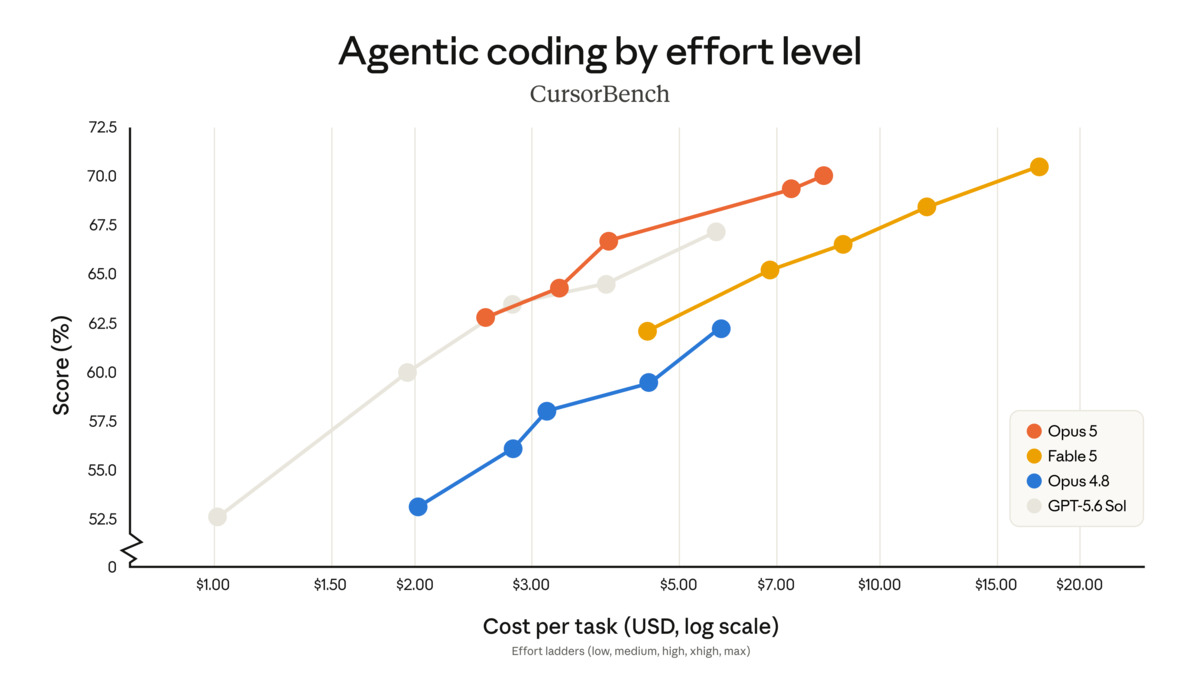 Anthropic's own CursorBench chart shows Opus 5 (red) outscoring Fable 5 (orange) at every price point it was tested at, though Fable 5's line continues further right to edge out a slightly higher ceiling near $17 a task.
Source: anthropic.com
Anthropic's own CursorBench chart shows Opus 5 (red) outscoring Fable 5 (orange) at every price point it was tested at, though Fable 5's line continues further right to edge out a slightly higher ceiling near $17 a task.
Source: anthropic.com
Where the Gap Actually Closes
The efficiency story isn't uniform across tasks. Anthropic says Opus 5 more than doubles Opus 4.8's score on its internal Frontier-Bench v0.1 suite and scores three times higher than the next-best model on ARC-AGI 3, a benchmark built around novel problem-solving rather than memorized patterns. On Zapier's AutomationBench, a workflow-automation eval, Opus 5's pass rate runs about 1.5 times the nearest competitor at matching cost. Anthropic also reports double-digit percentage-point gains on life-sciences evaluations, including a 10.2 point improvement on organic chemistry tasks.
How It Stacks Up
| Benchmark | Opus 5 | Opus 4.8 | Fable 5 |
|---|---|---|---|
| CursorBench 3.2 (peak) | 70.0% | 62.3% | 70.5% |
| CursorBench 3.2 (cost to hit peak) | ~$8/task | not reached | ~$17/task |
| ARC-AGI 3 | 3x next-best competitor | baseline | not disclosed |
| OSWorld 2.0 | Beats Fable 5 peak | below Fable 5 | reference peak |
| ExploitBench (offensive cybersecurity) | Behind Mythos 5 on exploitation | 40.0% | classifier-restricted |
Cost figures are read from Anthropic's published CursorBench chart rather than a single disclosed number, so treat them as approximate. The pattern holds regardless: Opus 5 reaches Fable-5-adjacent scores several times cheaper, then the two converge as spend climbs toward Fable 5's own ceiling.
Guardrails Loosen, Except Where They Don't
Anthropic says its automated behavioral audit puts Opus 5 at a misalignment score of 2.3, the lowest of any recent Claude release, with fewer deceptive-behavior flags and less susceptibility to misuse tricks than Opus 4.8, Sonnet 5, or Fable 5. Safety classifiers are also tuned to intervene roughly 85% less often than they do for Fable 5, and a new "automatic fallback" feature routes any request a classifier does block to a less-restricted model instead of returning a bare error.
That loosening doesn't extend to cybersecurity. Opus 5 closes much of the gap with Claude Mythos 5 on vulnerability discovery, but Anthropic says it remains "substantially behind" Mythos 5 on exploit development specifically, and the model still declines binary vulnerability scanning and exploit-generation requests outright. Source-code vulnerability analysis, judged lower-risk because it's defensive by nature, is allowed.
One quieter detail: unlike Fable 5 and Mythos 5, Opus 5 doesn't carry the 30-day data retention requirement that drew privacy criticism when Fable 5 launched.
"It isn't just better ... it's steadier, with far less variance."
That's Lovable's Fabian Hedin, one of the launch partners Anthropic quoted, describing Opus 5's consistency across runs rather than its peak score. Cursor's Sualeh Asif made a similar point about the trade-off Anthropic is selling: Opus 5, he said, "delivers near Fable 5 intelligence at Opus speed and cost."
 Anthropic's launch art for Opus 5, continuing the company's habit of pairing sober benchmark charts with illustrated version numbers.
Source: anthropic.com
Anthropic's launch art for Opus 5, continuing the company's habit of pairing sober benchmark charts with illustrated version numbers.
Source: anthropic.com
An IPO-Shaped Launch
The timing isn't incidental. Anthropic filed confidential paperwork for an initial public offering in June 2026 and is reportedly on track to list later this year, ahead of OpenAI, which faces its own complications including an Apple trade-secrets lawsuit and may push its listing into 2027. A model that undercuts your own flagship on cost while still beating the previous generation on nearly every benchmark is a cleaner story for prospective public-market investors than another round of "our smartest model yet."
Pricing itself didn't move. Opus 5 costs the same $5 per million input tokens and $25 per million output tokens as Opus 4.8, with fast mode available at 2.5x the base price for 2.5x the speed. The "half the cost" claim is about tokens needed to reach a given score, not a sticker-price cut, which is a meaningfully different thing to advertise even if the headline number sounds similar.
What To Watch
None of Anthropic's benchmark charts here have been reproduced independently yet, and the company's own framing, cost-per-task rather than raw score, makes direct comparison to competitors' self-reported numbers harder than usual. A few things worth tracking as Opus 5 sees real-world use:
- Whether the CursorBench and Frontier-Bench gains hold up against independent evals like SWE-Bench, which Anthropic didn't cite in its own announcement.
- Whether enterprise customers actually shift workloads from Fable 5 to Opus 5, or keep Fable 5 for the autonomous, long-horizon tasks Anthropic still recommends it for.
- Whether the automatic-fallback routing feature quietly increases how often users get a downgraded model without realizing it.
Sources:
- Introducing Claude Opus 5 - Anthropic
- Anthropic launches Opus 5 - TechCrunch
- Anthropic Releases Claude Opus 5, Beats Fable On Many Benchmarks At Half The Price - OfficeChai
- Anthropic's New Claude Opus 5 Nearly Matches Flagship Fable 5 at Half the Cost - MacRumors
- Anthropic debuts Claude Opus 5 with feature that lets users toggle between cost and capability - Fortune
- Anthropic debuts Opus 5 model as company preps for IPO later this year - Yahoo Finance

