
Anthropic Locks In Micron as HBM Defines the AI Race
Micron and Anthropic signed a multi-year HBM supply deal on June 22, with Micron also investing in Anthropic's Series H as memory bandwidth becomes the rate-limiting constraint for frontier AI.
 7 min read
High-bandwidth memory capacity is sold out through 2026 at every major fab. On Monday, Anthropic made sure it wasn't at the back of the line.
Micron Technology and Anthropic announced a strategic supply agreement on June 22 covering HBM, DRAM, and SSD allocations for Anthropic's multi-year scaling roadmap. The same day, Micron also confirmed a strategic equity investment in Anthropic's Series H round. Micron's stock jumped 5.5% on the news.
The financial terms of the supply deal and the Series H stake were not disclosed. What's clear is the strategic intent: Micron exits a spot-market relationship and enters a dedicated allocation arrangement that follows Anthropic's long-term compute growth.
TL;DR
- June 22: Micron signs multi-year HBM, DRAM, and SSD supply deal with Anthropic, plus a strategic investment in Series H
- HBM capacity is sold out at SK Hynix, Micron, and Samsung through 2026, with shortages expected into 2027
- Anthropic's Series H raised $65B at a reported ~$965B post-money valuation; Samsung and SK Hynix also invested
- DDR5 contract prices more than doubled in 2025; HBM commands even steeper premiums
- The deal gives Anthropic priority allocation at a time when every AI lab is competing for the same constrained output
The Actual Constraint
This isn't an abstract supply problem. HBM production consumes roughly three times the wafer capacity per gigabyte that standard DRAM does, because the chips are stacked in complex 3D configurations and bonded directly to accelerators using through-silicon vias. That physics means adding HBM capacity is slow and expensive regardless of how much money flows into the sector.
SK Hynix - the largest HBM supplier and NVIDIA's primary partner for H100 and Blackwell series chips - has said its HBM capacity is basically fully allocated for 2026. Micron, after exiting the consumer DRAM market earlier this year to redirect wafers toward enterprise and AI products, is in the same position. Samsung has warned that memory shortages across its portfolio will persist through at least 2027, even as it scales HBM production by 50% in 2026 and builds a $17 billion facility in Taylor, Texas.
The packaging step is also a constraint. Integrating HBM stacks onto GPUs and custom accelerators requires advanced CoWoS technology from TSMC, and that capacity is allocated years in advance to NVIDIA, AMD, and custom ASIC builders. A lab that secures raw HBM allocation still needs to fight for CoWoS slots or build relationships with chipmakers who bring their own packaging.
"Memory and storage are central to how efficiently we can train and serve Claude."
- Tom Brown, co-founder, Anthropic
The Supply Map
Three companies control the global HBM supply chain, and all three are operating at or near capacity.
| Supplier | HBM Status | Planned Expansion | AI Lab Ties |
|---|---|---|---|
| SK Hynix | Sold out through 2026 | +50% HBM capacity in 2026 | NVIDIA, Google |
| Micron | Sold out; exited consumer DRAM | $24B Singapore fab; CHIPS Act funding in NY and ID | Anthropic (confirmed) |
| Samsung | Tight; shortages through 2027+ | Taylor TX $17B facility; +50% HBM ramp | Series H investor; Anthropic |
Samsung participated in Anthropic's Series H with Micron and SK Hynix, which signals that all three major memory makers have now formalized relationships with at least one frontier AI lab. The resulting allocation priority isn't just a purchasing advantage - it's a structural moat that takes 12 to 18 months for a competitor to replicate even if the willingness to pay is there.
The geographic concentration adds another layer to the constraint. Micron's primary HBM production happens in Idaho and Singapore. Samsung and SK Hynix are based in South Korea. Any geopolitical disruption to East Asian semiconductor production - export controls, shipping chokepoints, labor disputes - lands directly on AI training capacity.
 AI data centers are now the primary destination for global memory production, consuming an estimated 70% of all chips made worldwide.
Source: unsplash.com
AI data centers are now the primary destination for global memory production, consuming an estimated 70% of all chips made worldwide.
Source: unsplash.com
Who Gets Squeezed
Labs Without Long-Term Deals
A frontier AI lab that doesn't have a supply agreement in place now is buying HBM on the spot market, which means paying a significant premium over contract prices while also accepting allocation uncertainty. DDR5 contract prices have already more than doubled since early 2025. HBM spot pricing is less transparent but tracks the same direction.
For well-funded labs, the premium is manageable. For smaller research groups or startups building from scratch on frontier-class training runs, HBM cost and availability is a genuine constraint on what models they can train and how frequently they can iterate.
Inference Providers
Companies like Baseten - which closed a $1.5B round in June as open-source inference scaled fast - need continuous HBM to serve models from loaded GPU fleets. Inference providers don't train models, but they do need to maintain enough GPU capacity to serve traffic spikes, and they don't have the leverage of a frontier lab to negotiate priority access with memory suppliers.
The same pressure applies to any company operating large fleets of inference hardware, including Groq's neocloud, Together AI, and Fireworks. Their ability to expand capacity is partly a function of whether they can get allocated GPUs, and GPU availability tracks HBM availability closely.
Sovereign AI Programs
Europe's EUROPA Consortium, selected in June to build a 400+ billion parameter open-source model on a 6,000-chip NVIDIA Blackwell cluster, is now training on EuroHPC capacity. But sovereign AI programs globally - India's push, Japan's, Brazil's - are all competing for the same HBM output, and none of them have the direct supplier relationships that hyperscalers and major US AI labs have built over years.
What Breaks First
The clearest near-term bottleneck is inference scaling. Training runs are discrete events where you can plan HBM procurement months in advance. Inference capacity has to grow continuously to match user traffic, and that growth requires a steady drip of new GPU deployments, each of which carries HBM.
The second pressure point is context window expansion. Every doubling of a model's usable context window requires more KV cache, which requires more VRAM, which requires more HBM per GPU or more GPUs per query. Labs that want to push from 200K tokens to 1M tokens or beyond are effectively increasing their HBM consumption per inference request even without adding a single new user.
The third is competitive sequencing. A lab that locks in a supply agreement now gets to plan its 2027 training roadmap with reasonable confidence in hardware availability. A lab that doesn't is pricing uncertainty into every model development timeline.
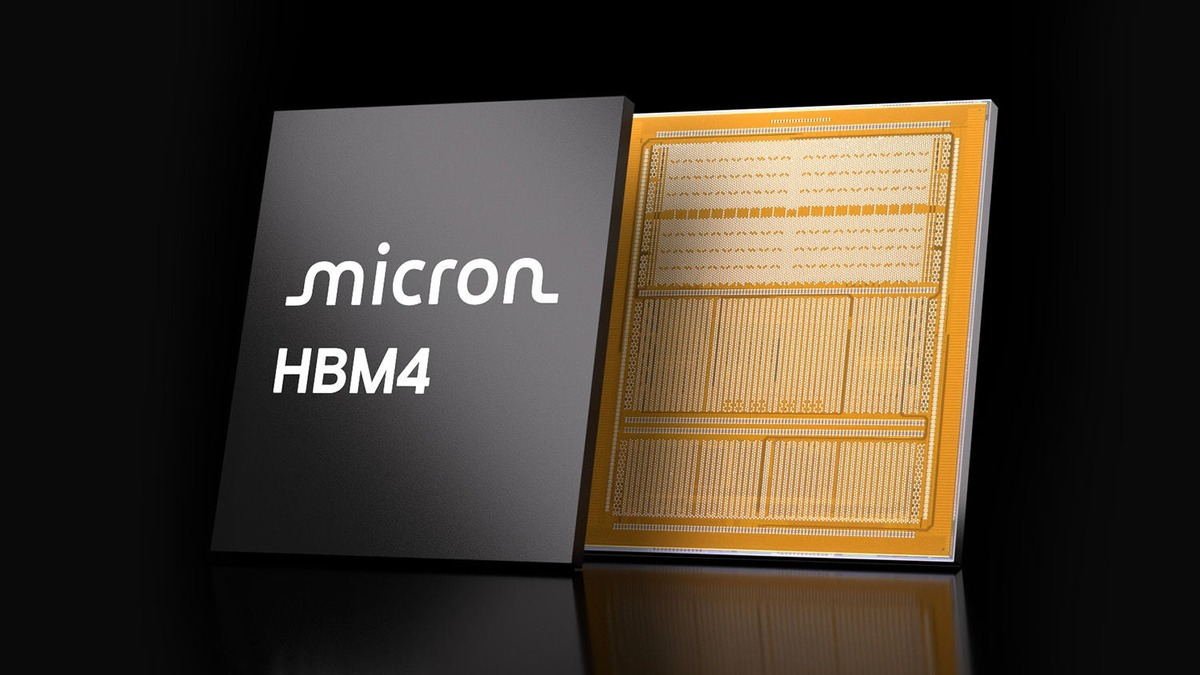 HBM stacks mounted on an AI accelerator package - each integration requires advanced CoWoS packaging capacity that is also in short supply.
Source: micron.com
HBM stacks mounted on an AI accelerator package - each integration requires advanced CoWoS packaging capacity that is also in short supply.
Source: micron.com
Infrastructure Collaboration
Beyond pure supply, the Micron-Anthropic agreement includes collaborative work on memory and storage architecture for AI workloads. This covers performance optimization, energy efficiency, and what the companies describe as "token economics" - the cost per token produced, which depends heavily on how efficiently a model can move data between HBM and compute cores.
This part of the deal is harder to quantify but potentially more significant over a 3-5 year horizon. Micron has visibility into what memory patterns Claude's training and inference workloads produce. That data shapes how they focus on HBM4 and CXL interconnect development. Anthropic gets custom optimization work that a lab buying commodity DRAM on the open market doesn't get. Micron also deployed Claude internally for engineering and manufacturing use cases, giving the relationship a production feedback loop.
The memory supply problem for frontier AI isn't going away in 2026. Samsung's own timeline projects tightness through 2027. Micron has new fabs in construction but not in production. SK Hynix's 50% capacity expansion won't fully flow through until late next year at the earliest. In that environment, a multi-year supply agreement isn't a nice-to-have - it's a structural prerequisite for training models at scale. Anthropic has one now. Many of its competitors don't.
Sources:
- Micron and Anthropic Announce Strategic Agreement to Scale Next-Generation AI Infrastructure - Micron Investor Relations, June 22, 2026
- Micron invests in Anthropic and grants it a supply deal - Blocks and Files, June 23, 2026
- Micron signs supply and investment agreement with Anthropic - BNN Bloomberg, June 22, 2026
- Samsung and SK Hynix warn AI-driven memory shortages could last until 2027 and beyond - Tom's Hardware
- Memory Chip Shortage 2026: HBM Takes 23% of DRAM Wafers - Tech Insider

