
Claude Science Puts Anthropic in Drug Discovery Race
Anthropic's Claude Science workbench completes a three-way AI battle with Google DeepMind and OpenAI over drug discovery, backed by Nobel laureate John Jumper and 60+ scientific database integrations.
 6 min read
On June 30, Anthropic shipped Claude Science, a beta research platform for life scientists. The move completes a three-way race between the largest AI labs for control of drug discovery. Google DeepMind got there first with AlphaFold and its Isomorphic Labs spin-off. OpenAI entered in April with GPT-Rosalind. Anthropic is last into the field, but it isn't arriving without credibility.
TL;DR
- Claude Science launched June 30 in beta for Pro, Max, Team, and Enterprise subscribers, with $30K in credits available for research projects (deadline: July 15)
- Platform integrates 60+ scientific databases across genomics, proteomics, and cheminformatics, plus NVIDIA BioNeMo and Basecamp Research's EDEN biological dataset
- John Jumper, Nobel laureate and AlphaFold co-creator, left Google DeepMind for Anthropic on June 19
- All three major labs are now in drug discovery; zero AI-discovered drugs have FDA approval out of 200+ in clinical trials
What Claude Science Actually Does
Claude Science isn't a standalone model. It's an agent platform running on Anthropic's existing Claude stack, with pre-configured access to more than 60 curated scientific databases and analysis tools. The platform covers genomics, single-cell analysis, proteomics, structural biology, and cheminformatics from a single interface, removing the need to switch between disconnected research tools.
The infrastructure side is handled automatically. Claude Science can route compute to local machines, HPC clusters, or on-demand GPU access through Modal, requesting permission before accessing new resources. Every figure and manuscript comes with the code and environment that produced it, so outputs can be audited and re-run. A dedicated reviewer agent checks citations, calculations, and figure accuracy and self-corrects errors it identifies.
The platform also connects to NVIDIA's BioNeMo toolkit - including the Evo 2 and Boltz-2 models - and Basecamp Research's EDEN dataset, described as the world's largest biological dataset built from sequencing millions of microbial species. Stephen Francis, a researcher at UCSF who joined the beta, reported completing analyses "in around a tenth of the time it previously took."
The Three-Way Race
The drug discovery AI competition now has three distinct players, each with a different strategy.
| Lab | Product | Launched | Approach | Key Partners |
|---|---|---|---|---|
| Google DeepMind / Isomorphic Labs | IsoDDE | Feb 2026 | Diffusion model for molecule binding | Internal pharma; proprietary |
| OpenAI | GPT-Rosalind | Apr 2026 | Foundation model trained for life sciences | Amgen, Moderna, Allen Institute |
| Anthropic | Claude Science | Jun 30, 2026 | Agent platform with 60+ database integrations | NVIDIA, Basecamp Research, Modal |
Google moved first and has the deepest research history. AlphaFold 2 and 3 were open-sourced, producing enormous goodwill in academic biology. IsoDDE, the next-generation diffusion model that doubles AlphaFold 3's accuracy on hard protein-ligand prediction cases, is proprietary - a shift in approach that has attracted criticism from the scientific community that built its trust on open data.
OpenAI entered drug discovery in April with GPT-Rosalind, partnering with Amgen, Moderna, and the Allen Institute as anchor clients. The model aims to extract insights from large scientific datasets and translate published research into drug development applications. Anthropic's approach is architecturally different: Claude Science is a horizontal platform designed for researchers at any institution, not a model trained narrowly on pharmaceutical data.
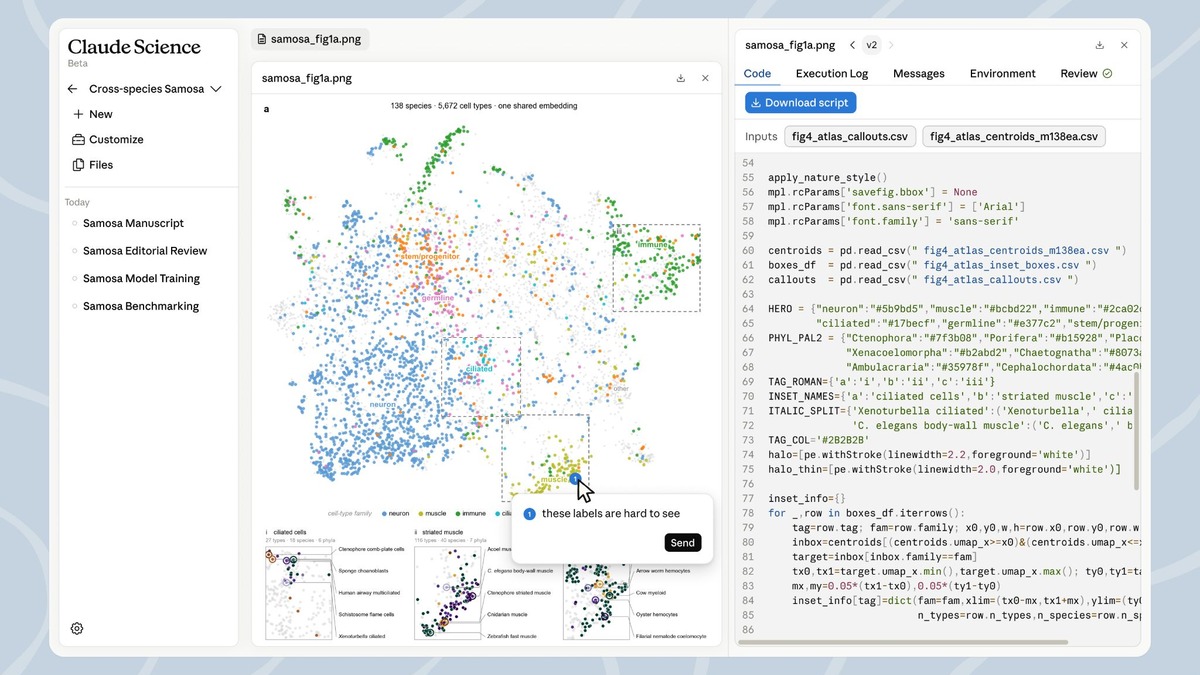 The Claude Science beta interface handles protein folding, single-cell RNA analysis, and CRISPR design from a single environment.
Source: anthropic.com
The Claude Science beta interface handles protein folding, single-cell RNA analysis, and CRISPR design from a single environment.
Source: anthropic.com
The Talent Signal
The bigger move came two weeks before the product launch. John Jumper - who shared the 2024 Nobel Prize in Chemistry for AlphaFold and spent nine years at Google DeepMind - announced on June 19 that he was joining Anthropic.
Jumper led the development of AlphaFold 2, the protein structure prediction system that resolved a problem in computational biology that had been open for 50 years. His presence at Anthropic changes how pharmaceutical companies and government research funders assess the company as a partner. The person most associated with AI's largest contribution to biology is now building at a company that, six weeks ago, had no drug discovery product.
"Our mission is to develop AI that serves humanity's long-term well-being, and we believe that by far the greatest opportunity to do that is in the life sciences," said Eric Kauderer-Abrams, Anthropic's head of life sciences.
The product launch builds on Anthropic's April acquisition of Coefficient Bio, a stealth drug discovery startup it bought for $400 million in stock. Claude Science is the first public product from that investment, arriving less than three months after the deal closed.
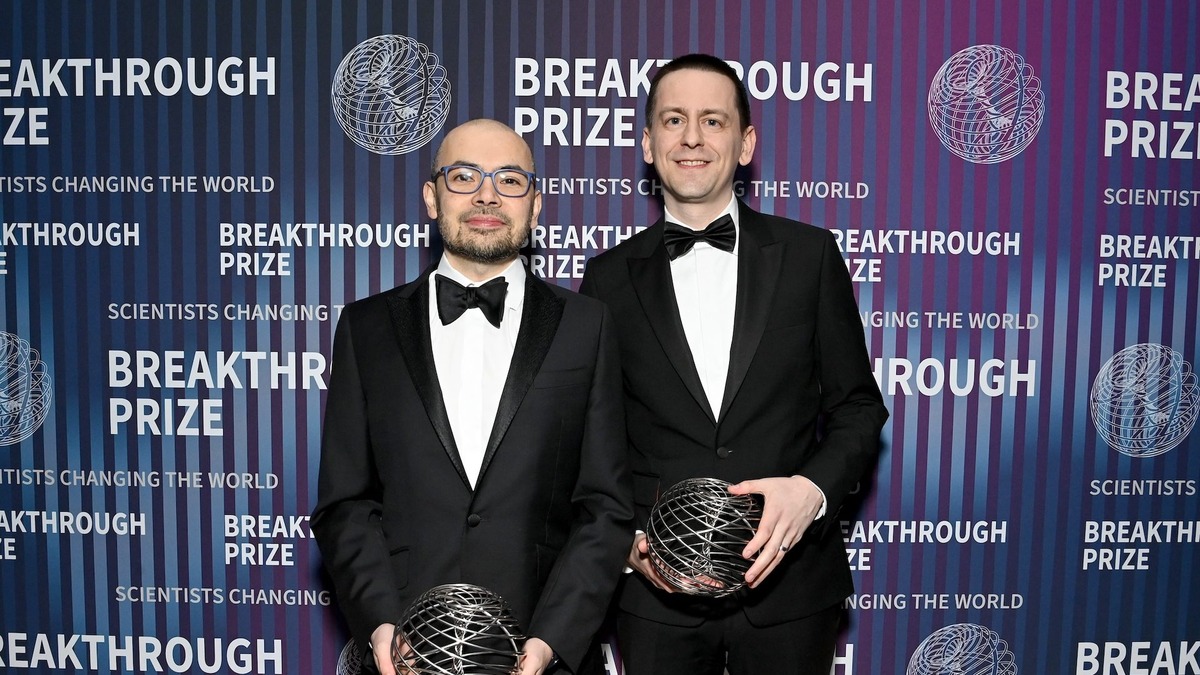 John Jumper (right) and Demis Hassabis at the 2024 Breakthrough Prize ceremony. Jumper announced his departure to Anthropic on June 19, 2026.
Source: TechCrunch / Getty Images
John Jumper (right) and Demis Hassabis at the 2024 Breakthrough Prize ceremony. Jumper announced his departure to Anthropic on June 19, 2026.
Source: TechCrunch / Getty Images
The Business Logic
Anthropic filed for an IPO in June at a near-$1 trillion valuation, targeting an October 2026 debut. Its annualized revenue had reached an estimated $47 billion by May 2026, but pharmaceutical partnerships offer a contract structure very different from developer API billing.
Drug discovery agreements normally run for multiple years and involve milestone payments tied to clinical outcomes. A single partnership with a major pharma company can be worth tens to hundreds of millions over its life, and the revenue is stickier than subscription billing. If Anthropic can land Tier 1 pharmaceutical companies as Claude Science customers ahead of its IPO roadshow, the commercial narrative changes.
The company is also planning to use Claude Science for internal drug discovery, with an early focus on neglected diseases that traditional pharmaceutical companies won't fund. That's partly altruistic, partly strategic - it creates the kind of scientific credibility that makes commercial conversations easier.
Counter-Argument: The Approval Clock
The competitive framing makes the race look exciting. The clinical data makes it look slower.
More than 200 AI-discovered drug candidates are in clinical development as of early 2026: 94 in Phase 1, 56 in Phase 2, 15 in Phase 3. Zero have FDA approval. Isomorphic Labs, the most funded and most credentialed dedicated drug discovery AI company, is still preparing its first human clinical trials, focused on oncology.
Drug development timelines don't compress just because the early research moves faster. Even if Claude Science cuts research time by the "tenfold" Fable 5 benchmarks suggest, the clinical and regulatory phases that follow still require years. A platform that accelerates research only matters when research is the bottleneck - and in pharmaceutical development, it usually isn't.
What the Market Is Missing
Platform adoption and pharmaceutical revenue are not the same thing. A researcher using Claude Science more efficiently generates no revenue milestone for Anthropic. A drug candidate discovered with Claude Science that clears Phase 3 trials and wins FDA approval would be a different kind of result completely - and it's that outcome, not tool subscriptions, that would validate the whole investment thesis.
Anthropic has built a credible research platform and hired the most prominent scientist in AI biology. Whether any of the three labs can convert that into an approved drug, and on what timeline, is the question none of them can answer yet.
Sources:
- Claude Science: An AI workbench for scientists - Anthropic
- Claude Science is Anthropic's newest flagship product - MIT Technology Review
- AlphaFold Nobel Laureate John Jumper Joins Anthropic - TechTimes
- Anthropic Launches Claude Science AI Research Workbench - TechTimes
- Anthropic Unveils 'Claude Science,' Joining Three-Way AI Drug Discovery Race - BigGo Finance
- Anthropic launches Claude Science for pharma researchers - pharmaphorum

