
Anthropic Releases Fable 5 Despite Its Own AI Safety Warning
Anthropic opens Mythos-class capabilities to the public with Claude Fable 5 at $10/$50 per million tokens, days after calling for a global AI pause.
 Updated
7 min read
Updated
7 min read
Two days after calling for a global pause on frontier AI development, Anthropic shipped the most powerful AI model it has ever made available to the general public. Claude Fable 5, released June 9, gives every paying Claude subscriber access to Mythos-class capabilities that were, until this morning, restricted to 52 vetted organizations under Project Glasswing.
The release isn't a contradiction, according to Anthropic. Safety classifiers built into the model's inference stack route high-risk queries in cybersecurity, biology, chemistry, and model distillation to Claude Opus 4.8 rather than fulfilling them. Fewer than 5% of sessions ever trigger a fallback. Anthropic says the arrangement lets it deploy the model responsibly while keeping it accessible.
Whether you find that convincing depends on what you think the pause call was actually about.
TL;DR
- Fable 5 is Anthropic's Mythos-class model for the general public, priced at $10/$50 per million tokens
- Safety classifiers route flagged requests to Opus 4.8; fewer than 5% of sessions trigger any fallback
- All users now face mandatory 30-day data retention - including enterprises that had zero-retention agreements
- Subscriptions include Fable 5 free until June 22; usage credits are required from June 23 onward
- Mythos 5, a separate model with fewer restrictions, was released simultaneously for Project Glasswing partners
The Numbers
| Model | Access | Input price | Output price | SWE-bench Pro | Classifiers |
|---|---|---|---|---|---|
| Fable 5 | Public | $10/M | $50/M | 80.3% | Active |
| Mythos 5 | Glasswing partners | $10/M | $50/M | Undisclosed | Partially lifted |
| Mythos Preview | 52 orgs (prior) | $25/M | $125/M | 77.8% | N/A |
| Claude Opus 4.8 | Public | ~$5/M | ~$25/M | 69.2% | N/A |
Fable 5 scores above Mythos Preview on SWE-bench Pro - 80.3% versus 77.8%. This is a second-generation Mythos architecture, not a cut-down version of the first. The public model is genuinely more capable on coding benchmarks than the restricted one it's replacing.
Two Models, One Launch
Anthropic released two separate models today.
Fable 5
Fable 5 is the public release. Safety classifiers are fully active. When a query touches cybersecurity, biology, chemistry, or model distillation, the system silently falls back to Opus 4.8. The user gets a capable response; the sensitive request never reaches Fable 5's full capabilities.
The model is available through the Claude API and all major cloud platforms - Amazon Bedrock, Google Cloud Vertex AI, and Microsoft Foundry. GitHub Copilot users get access today as well. For subscription users on Pro, Max, Team, and Enterprise plans, Fable 5 is included at no extra cost until June 22. On June 23, those users will need usage credits to continue accessing it. Anthropic says it plans to restore Fable 5 as a standard subscription feature "as soon as possible" without specifying when.
Mythos 5
Mythos 5 is the restricted release for Project Glasswing partners, with some classifiers lifted - especially for cybersecurity research. A separate biology trusted-access program is planned. Pricing matches Fable 5 at $10/$50, down from Mythos Preview's $25/$125. On cybersecurity tasks, Mythos 5 scores 78% on ExploitBench, which puts it ahead of any publicly tested model on that benchmark.
How the Safety Architecture Works
Anthropic stress-tested the classifiers before launch: more than 1,000 hours of external bug bounty work and red-teaming failed to find a universal jailbreak. When a request trips a classifier, the user doesn't hit a wall - they get an Opus 4.8 response instead. Anthropic argues this reduces jailbreak motivation, since the payoff of a workaround is lower when the fallback is already a strong model.
Third-party enterprise testers verified the performance claims before launch. Hex reported 90% on its core analytics benchmark of complex, long-running tasks. Genspark said Fable 5 "beat every other model" in its own evaluations. Base44 praised its ability to "one-shot full apps" with tool-calling.
"Fable 5 compressed months of engineering work into days," said Stripe, one of the enterprise early-access partners.
Rakuten described the model as enabling "highly autonomous operations" - a phrasing that suggests it's running Fable 5 as an orchestrator across its business, not merely as a code assistant.
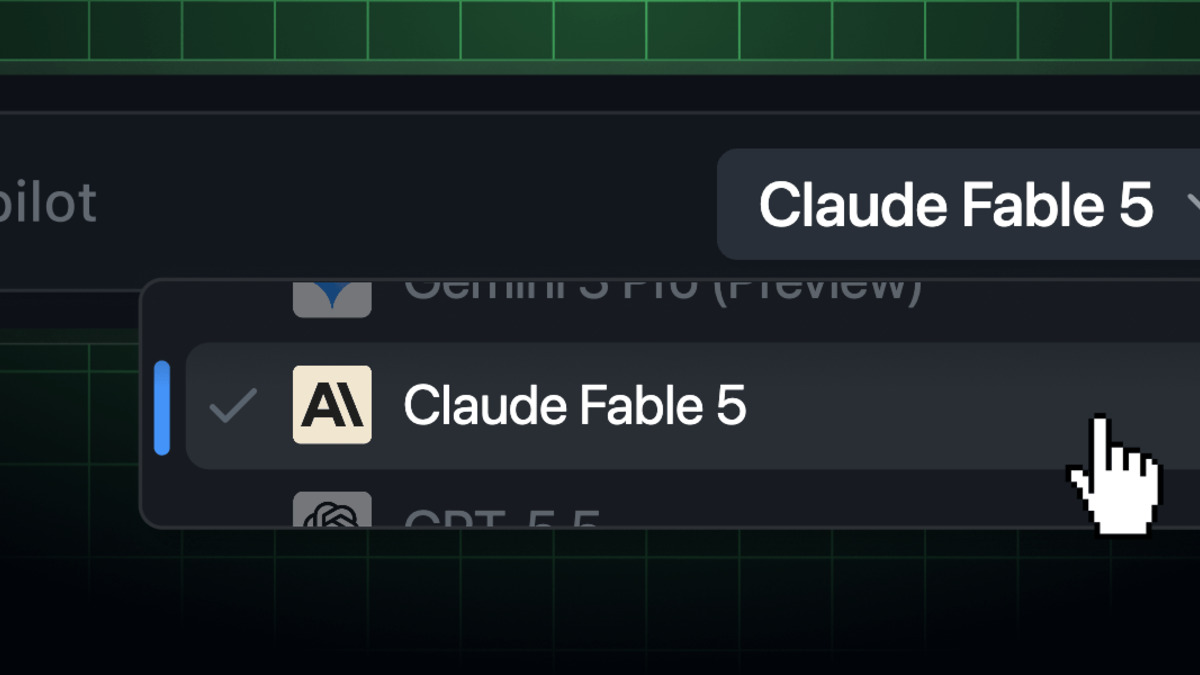 Claude Fable 5 became generally available on GitHub Copilot on June 9, 2026.
Source: github.blog
Claude Fable 5 became generally available on GitHub Copilot on June 9, 2026.
Source: github.blog
Who Benefits
Enterprises with heavy software engineering workloads are the obvious winners. The SWE-bench Pro jump from 69.2% on Opus 4.8 to 80.3% on Fable 5 is large enough to matter for organizations running AI-assisted coding at scale. For GitHub Copilot users, that improvement lands in existing workflows without any additional integration.
Knowledge Work and Finance
Beyond coding, Fable 5 tops Hebbia's Finance Benchmark for document reasoning and data interpretation. The model also shows improved token efficiency on long documents, which benefits legal review, financial analysis, and research-heavy knowledge work. Rakuten's "highly autonomous operations" framing suggests the model is finding adoption in business process orchestration, not just in developer tools.
Science
Mythos 5, on the biology track, reportedly accelerates drug-design processes and generates research hypotheses preferred by researchers approximately 80% of the time, according to Anthropic's own early testing. These numbers come from Anthropic and should be treated accordingly.
 Anthropic's mandatory 30-day data retention applies to all Fable 5 and Mythos 5 traffic, including from enterprises that previously held zero-retention agreements.
Source: pexels.com
Anthropic's mandatory 30-day data retention applies to all Fable 5 and Mythos 5 traffic, including from enterprises that previously held zero-retention agreements.
Source: pexels.com
Who Pays
Data Retention
The most significant cost isn't in the pricing table. With Fable 5 and Mythos 5, Anthropic now requires 30-day traffic retention from all users - including those that previously held zero-retention agreements with the company.
Anthropic says it won't use the retained data for model training and will use it only to "defend against complex and novel attacks, including new jailbreaks" and "identify and reduce false positives." It deletes prompts and outputs after 30 days. Enterprise customers that built compliance and legal workflows around zero-retention will need to renegotiate those assumptions. Anthropic hasn't offered a carve-out.
The Subscription Cliff
Including Fable 5 in subscriptions until June 22 is a standard onboarding play. Users build workflows around the model, get dependent on the capability level, then face an usage credit requirement less than two weeks after launch. The gap between June 22 and the restoration of Fable 5 as a standard subscription feature - however long it lasts - converts free-trial adoption directly into API revenue.
Counter-Argument
Anthropic would push back on that framing, and not completely without reason.
A 1,000-hour red-teaming effort with external bug bounty participants is more rigorous than most AI labs apply before a major release. The fallback design - Opus 4.8 rather than a hard refusal - is a deliberate security research choice: refusals push users toward workarounds, while graceful degradation keeps them inside a controlled system. The 95%+ sessions with no fallback is evidence the classifier is calibrated narrowly enough to avoid over-triggering.
On the data retention point, Anthropic's argument is operational. Safety classifiers trained on synthetic adversarial data drift as attack techniques evolve. Seeing real traffic is the only way to keep the classifier current against novel jailbreaks. The 30-day window with no training use is a narrower claim than "we retain your data," though it does mean zero-retention is no longer available to any user at any price.
The AI pause call is also more precise than the coverage of it suggests. Anthropic urged labs to slow recursive self-improvement specifically. Releasing Fable 5 with hard classifier limits on the domains that carry that risk - biology, cybersecurity, model distillation - is at least internally consistent with that position, even if the optics are poor.
What the Market Is Missing
The safety engineering is real, but it isn't the complete picture.
Mandatory 30-day retention across every enterprise account - including those that paid specifically for zero-retention - gives Anthropic a corpus of Mythos-class usage data at commercial scale. That corpus has value beyond classifier training. It shows what frontier capabilities get used for in production, which applications drive the most token volume, and where demand concentration sits. None of that's visible from API metrics alone. When Anthropic's S-1 process advances toward a public offering, that usage intelligence becomes part of the growth story.
The timing of the subscription cliff matters for the same reason. OpenAI filed its own confidential S-1 last week, and both companies are competing for the same investor narrative: that enterprise AI spending is locked in, recurring, and growing. Two weeks is enough time to convert enough early adopters into credit purchasers to show a revenue conversion rate. What Anthropic calls a safety rollout is simultaneously the fastest commercial onboarding it has ever done.
Fable 5 is a capable model backed by a serious safety engineering effort. It is also the most commercially timed release Anthropic has made. Both can be true.
Sources:
- Anthropic Releases Claude Fable 5 - TechCrunch
- Fable 5 and Mythos 5: Major Gains in Coding and Science - The Decoder
- Anthropic Launches Claude Fable 5: Most Powerful Public Model - TechTimes
- Claude Fable 5 on Amazon Bedrock - AWS Blog
- Claude Fable 5 Available for GitHub Copilot - GitHub Changelog
- Anthropic Claude Fable 5 and Mythos 5 Launch - Yahoo Finance
Last updated

