
Anthropic Launches Claude Corps, a $150M AI Fellowship
Anthropic commits $150 million to place 1,000 AI-trained fellows inside US nonprofits for a year at $85,000 each, no degree required.
 6 min read
Anthropic is committing $150 million to train and place 1,000 early-career workers inside US nonprofits for a year at $85,000 salaries. No degree required. The company is calling the initiative Claude Corps - and announcing it the same week it sits atop a confidential $1 trillion IPO filing and a public call for a pause on advanced AI development.
The name isn't accidental. Claude Corps maps directly onto the Peace Corps model: embed trained people in underserved institutions, build durable capacity, measure the results. The difference is that the skill being transferred isn't public health or agriculture. It's prompt engineering, Claude-based automation, and the organizational know-how to keep those systems running after the fellow leaves.
TL;DR
- Anthropic commits $150 million to place 1,000 fellows at US nonprofits for 12-month full-time placements
- Fellows earn $85,000 per year - open to anyone over 18 with under two years of work experience
- 400+ nonprofits participating in year one, including food banks, veteran support groups, and marine conservation orgs
- Three partners split the work: Anthropic (funding and strategy), CodePath (employer of record and training), Social Finance (measurement)
- First cohort of 100 starts October 2026; applications close July 17
How the Fellowship Works
Who Qualifies
The eligibility bar is low by design. Any US resident over 18 with under two years of full-time work experience can apply. No degree. Relocation support available. Each fellow gets five hours of weekly training all through the year - Claude instruction from Anthropic plus workforce development programming from CodePath, which is America's largest provider of collegiate computer science education. The remaining hours go to actual work inside the host organization.
That $85,000 salary deserves attention. It sits above the median salary for many of the nonprofit roles fellows will sit with. Anthropic isn't paying fellowship wages. It's paying competitive wages - a deliberate signal that the program is meant to attract people who'd otherwise take corporate jobs.
What Host Organizations Receive
Each of the 400+ participating nonprofits gets a fellow for a year, a $10,000 grant, and free Claude API credits. The grant and credits matter less than the human. Anthropic's working theory is that nonprofits don't fail at AI adoption because they lack access to models - they fail because they lack people who can build workflows around those models and then train colleagues to use them without the original builder present.
Named host organizations include Braven (workforce development for first-generation college students in Chicago), Montgomery County Food Bank in Texas, Team Red White and Blue (veteran health and wellness in Indiana), Reef Environmental Education Foundation in Key Largo, SoundOff (anonymous counseling access for service members in San Antonio), and the International Rescue Committee. RAINN, which runs the national sexual assault hotline, is also participating.
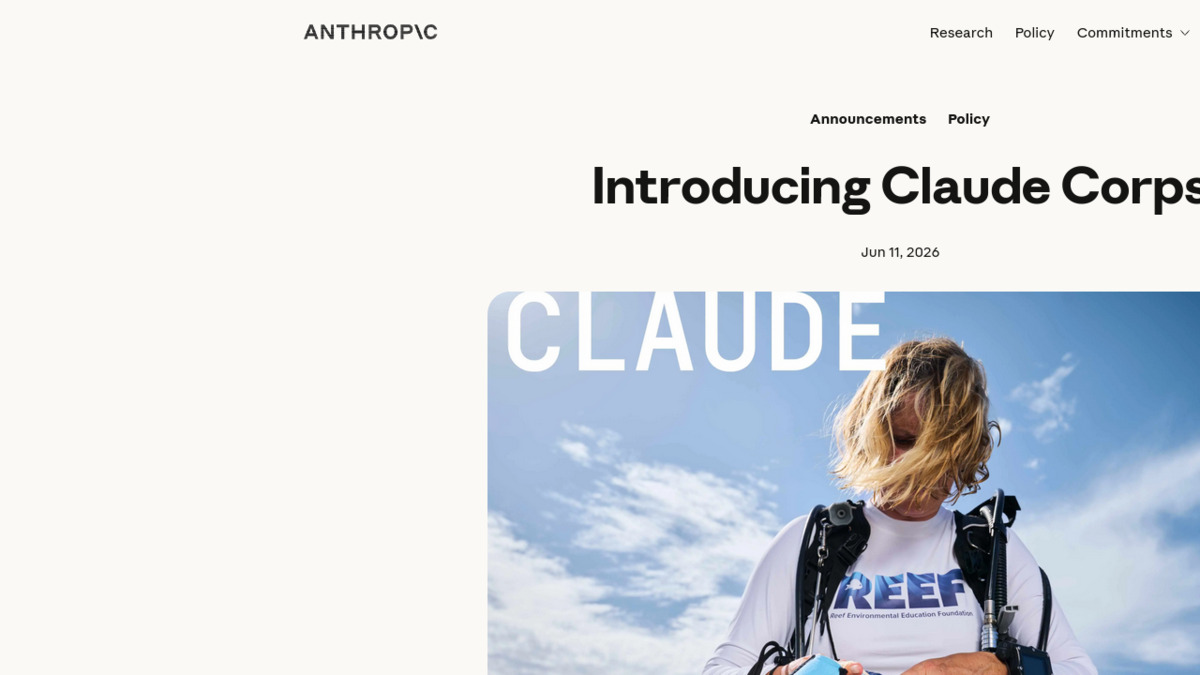 The official Claude Corps page, live at anthropic.com/claude-corps, features a fellow wearing a REEF shirt - one of the inaugural host nonprofits.
Source: anthropic.com
The official Claude Corps page, live at anthropic.com/claude-corps, features a fellow wearing a REEF shirt - one of the inaugural host nonprofits.
Source: anthropic.com
What the Partners Are Saying
Several nonprofit leaders gave statements that read less like press release filler and more like genuine descriptions of operational gaps.
RAINN's statement cut straight to the point: the time its staff spends on technical infrastructure is time away from helping survivors. "We aren't replacing human connection," the organization noted. The International Rescue Committee, which works in active conflict zones, cited reach: Claude Corps fellows can "help us rethink how humanitarian organizations deliver impact at scale at the last mile."
Goodwill Industries International mentioned the gap between AI's potential and "responsible, real-world application." That phrase - repeated in various forms across several partner statements - suggests the program's framing resonated with organizations that have had bad experiences with AI tools deployed without enough support.
The most direct statement came from the CEO of Braven:
"AI is reshaping the labor market, and with deep intentionality, it can help level the economic playing field for first-generation and low-income college students. Braven is proud to join Claude Corps' inaugural cohort to accelerate AI literacy for our fellows, build capacity, and shape how higher education and employers approach the future of entry-level work."
- Aimée Eubanks Davis, Founder and CEO, Braven
 Community distribution operations - the kind of work Claude Corps fellows will help organizations like Montgomery County Food Bank run more efficiently using AI-assisted workflows.
Source: unsplash.com
Community distribution operations - the kind of work Claude Corps fellows will help organizations like Montgomery County Food Bank run more efficiently using AI-assisted workflows.
Source: unsplash.com
Why Now, and What It Reveals About Anthropic's Strategy
The Timing Is Deliberate
Claude Corps arrives at a specific moment in Anthropic's public positioning. The company filed a confidential S-1 targeting a $1 trillion IPO. Days later, it called for a pause on advanced AI systems. Now it's announcing a $150 million social program named after its own product.
The three moves together describe a company managing several audiences at once. Investors need a growth story. Safety researchers need evidence that Anthropic takes disruption seriously. Communities at risk need something concrete, not policy white papers. Claude Corps is meant to speak to the third group while not complicating the first two.
Anthropic's own framing confirms this reading. The official announcement states: "The companies building this technology have a responsibility to make sure the benefits are fully realized and widely shared, and to invest directly in the workers absorbing the change."
Fits a Larger Pattern
This isn't the first time Anthropic has made a large social commitment. Earlier this year the company committed $200 million alongside the Gates Foundation to global AI deployment. It also launched its Institute for AI's Societal Impact. Claude Corps fits the same logic: institutional moves that establish Anthropic as a company thinking downstream.
The fellowship also connects to Anthropic Academy, which launched 13 free AI courses earlier this year. The Academy teaches; the Corps pays. One is a content play, the other is a labor market intervention. Together they form the clearest picture yet of how Anthropic plans to position Claude as the AI tool of record for civil society.
The program is being announced with a separate policy framework on AI's impact on work. At time of writing, that document had not been published in full. Its existence suggests Claude Corps isn't a standalone philanthropic gesture - it's designed to implement something, and the framework will say what.
The Honest Caveats
1,000 fellows over three cohorts is small relative to the scale of labor market disruption Anthropic's own research describes. Anthropic says it plans to scale "far beyond 1,000 fellows" if the program measures well, and to open-source the fellowship infrastructure so other organizations can copy it without Anthropic's involvement.
Social Finance is handling measurement - they'll track whether host organizations actually advance their missions and whether fellows develop transferable skills. That's the right question to ask. Whether Social Finance will publish those results openly, or whether they'll remain internal, determines how much the evidence base for this model actually grows.
Applications are open at anthropic.com/claude-corps. The deadline for the first cohort is July 17. The second cohort begins January 2027, the third in August 2027. For a 26-year-old with one year of work experience and no clear path into the AI industry, $85,000 to spend a year automating workflows at the International Rescue Committee is not a bad deal.
Sources: Anthropic Claude Corps announcement | PYMNTS coverage

