
California Signs Anthropic Deal for Claude at Half Price
California gives all state agencies access to Claude at 50% off, as Newsom publicly breaks with the federal government's hostile stance toward Anthropic.
 Updated
5 min read
Updated
5 min read
California will give all its state agencies - and every city and county in the state - access to Anthropic's Claude at a 50% discount starting right away, Governor Gavin Newsom announced Monday. The agreement makes Claude the first AI productivity tool available statewide through California's centralized software portal, and comes bundled with free workforce training and on-call technical support from Anthropic engineers.
The deal lands at a politically charged moment. The federal government has spent months treating Anthropic as a liability; California is treating it as a partner.
TL;DR
- California state agencies and local governments get Claude at 50% off standard pricing
- Access runs through CDT's new SITeS portal - Claude is the first AI tool on the platform
- Deal includes free workforce training and direct technical assistance from Anthropic developers
- California has already deployed Claude at the DMV, Department of Healthcare Services, and CDT/CalOES
- No contract value or total spending figures were disclosed
What the Deal Actually Covers
The partnership runs through the California Department of Technology's new Statewide Information Technology Shared Services (SITeS) portal, a centralized AI procurement platform with transparent pricing tied to specific business use cases. Claude is the first tool to go live on it.
Beyond the price cut, Anthropic will provide free workforce training, direct technical assistance from Anthropic engineers, and workflow consultation. The state says it has already developed over 20 AI training modules for employees. The same discounted pricing applies not just to state agencies but to cities and counties throughout California.
| Tier | Access |
|---|---|
| State agencies | 50% discount via SITeS portal |
| Cities and counties | Same 50% discount |
| Workforce training | Free, included |
| Anthropic developer support | Free, included |
No total contract value was disclosed. The announcement does not specify which Claude product tier agencies will access, or whether different pricing tiers within the Claude line will apply.
 California's state government is now Claude's largest single public-sector deployment in the United States.
Source: commons.wikimedia.org
California's state government is now Claude's largest single public-sector deployment in the United States.
Source: commons.wikimedia.org
Who Benefits
State Workers and Agencies
California agencies had already begun launching Claude before this formal agreement. The Department of Motor Vehicles uses it for customer service and wait time reduction. The Department of Healthcare Services uses it to assist Medicaid case workers. CDT and the California Office of Emergency Services use Claude Code for cybersecurity scanning and patching. The deliberative democracy platform Engaged California runs on Claude.
Then there is Poppy - a state-built AI assistant named after California's official flower, designed specifically for government workflows, with pre-built queries tailored to common state business needs. Poppy piloted with 2,800+ state employees across 67 departments and is on track for statewide rollout in July 2026. The SITeS deal formalizes and centralizes what was already spreading organically.
"AI should not replace the human work of government," Newsom said in a statement. "It should help our workers move faster, solve problems more effectively, and deliver better results for Californians."
Anthropic
For Anthropic, the California deal is more than a procurement win. The company has spent much of 2026 fighting the federal government's designation of it as a supply-chain risk - a label applied after Anthropic declined Pentagon requests for mass domestic surveillance tools and fully autonomous weapons systems. A federal court subsequently blocked that designation.
A statewide deal covering the most populous US state, 39 million residents, and an economy larger than most G7 nations gives Anthropic a public-sector reference case it badly needs. Kate Jensen, Anthropic's Head of Americas, framed it in personal terms: the company "feels a real responsibility to our home state," she said.
Government clients tend to be sticky. Procurement cycles are long. And a California deployment opens doors with other state and federal agencies in ways that commercial deals can't.
Who Pays
On the California side, the actual cost is unclear. The announcement provides no aggregate spending figure, no per-seat pricing, and no projection for how many workers will actively use the service. The phrase "half price" appears prominently in every briefing; what half of enterprise list price adds up to at scale across 230,000 state employees is left unspecified.
That opacity is worth noting. Enterprise AI contracts at government scale routinely run into the tens of millions of dollars per year. If even a fraction of California's workforce becomes regular Claude users, the undisclosed total could be substantial - and taxpayers will not know until it shows up in budget filings.
On Anthropic's side, the 50% discount is a deliberate bet on market share over margin. The company gets a flagship government customer, a proof point for enterprise reliability, and a platform to train state workers on Claude before the contract comes up for renewal.
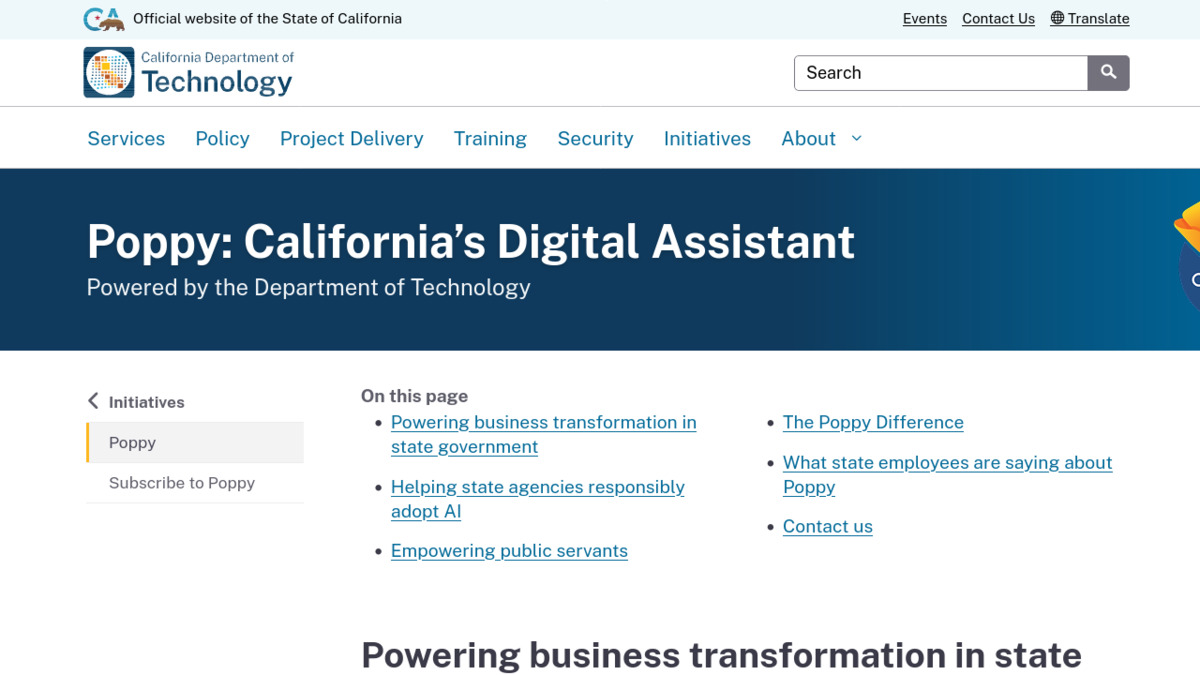 Poppy was piloted by 2,800+ employees across 67 California departments before the Anthropic deal was formalized.
Source: cdt.ca.gov
Poppy was piloted by 2,800+ employees across 67 California departments before the Anthropic deal was formalized.
Source: cdt.ca.gov
The Federal Backdrop
The political undertone here is hard to miss. Newsom has spent months positioning California as a counterweight to the Trump administration on AI - on regulation, on worker protection, and on which companies government should trust.
In March 2026, Newsom signed an executive order requiring AI vendors seeking California contracts to demonstrate responsible practices on bias prevention, civil rights, and misuse safeguards. Monday's announcement is the first major commercial deal to emerge from that framework.
The contrast with Washington is made explicit by California's own officials. CIO Chris Given said the federal supply-chain risk designation against Anthropic "just didn't come up" during contract negotiations. From Sacramento's perspective, what the Pentagon thinks of Anthropic isn't relevant to the state's calculus.
Newsom is term-limited and won't be on the ballot this fall. His AI positioning is less about electoral politics than about legacy - and California's ambition to write its own technology policy independent of Washington.
The federal government put Anthropic on a blacklist. California put it in its government software portal. One of those decisions will look prescient; the other will look like a procurement mistake.
Sources:
- Anthropic and Gov. Newsom forge deal allowing California government to use Claude at half price - TechCrunch
- Governor Newsom announces first-of-its-kind Anthropic partnership - Governor of California
- California gives all state agencies access to Claude at half price - The Next Web
- Newsom's office touts Anthropic partnership, 50% discount on Claude AI for California agencies - Fox Business
Last updated

