
Anthropic Blackout Forces Europe to Confront AI Reliance
The EU Commission has warned that Washington's Anthropic export ban is discriminatory against allies, as European politicians demand AI sovereignty and Dario Amodei heads to the G7 in France.
 7 min read
Europe was given no warning. On June 12, the US Commerce Department ordered Anthropic to block all foreign nationals from its two most capable models, Fable 5 and Mythos 5. Anthropic complied by pulling both models offline globally. British hospitals running pilot programs lost access mid-session. French research labs found their API calls returning errors. No email. No transition period. Nothing.
By June 13, Brussels had seen enough.
"We believe that contingency measures taken in this light should not be discriminatory against partners," said Thomas Regnier, European Commission spokesperson for tech sovereignty, in a statement that marked the EU's most direct pushback yet on US AI policy.
TL;DR
- The EU Commission warned that US export controls on Anthropic's Fable 5 and Mythos 5 are "discriminatory against partners" and said it's examining practical consequences for European users
- French, British, and Dutch politicians across party lines framed the shutdown as a sovereignty crisis
- Mistral and OVHcloud are now named in French policy speeches as the obvious alternatives
- Dario Amodei joins Sam Altman and Demis Hassabis at the G7 summit in Évian-les-Bains, France starting June 15 - the first time all three major AI lab leaders appear together at a heads-of-government gathering
The Order and What It Set Off
The Trump administration's Commerce Department sent a letter to Anthropic barring any foreign national - wherever they're located - from accessing Fable 5 and Mythos 5, citing national security. Reports suggest Amazon CEO Andy Jassy raised concerns with Treasury Secretary Scott Bessent about alleged jailbreak risks after Amazon researchers used Claude Fable 5 in ways that could yield information useful for cyberattacks. Amazon is one of Anthropic's largest investors, a detail that adds a layer of complexity neither company has addressed directly.
Anthropic chose global suspension over geo-blocking. The company pushed back privately on the characterization of the vulnerabilities but complied with the order. Senior technical staff flew to Washington on June 14 for meetings with White House officials, with both sides indicating willingness to find a resolution - though what that looks like in practice remains unclear.
What the Ban Covers
The export control targets Fable 5 and Mythos 5 specifically, not Anthropic's full product line. Other Claude models remain accessible. The order applies to "foreign nationals" regardless of location, which means Anthropic must treat any user whose US identity it can't verify as a foreign national - effectively global suspension is the path of least operational resistance.
Impact by Stakeholder
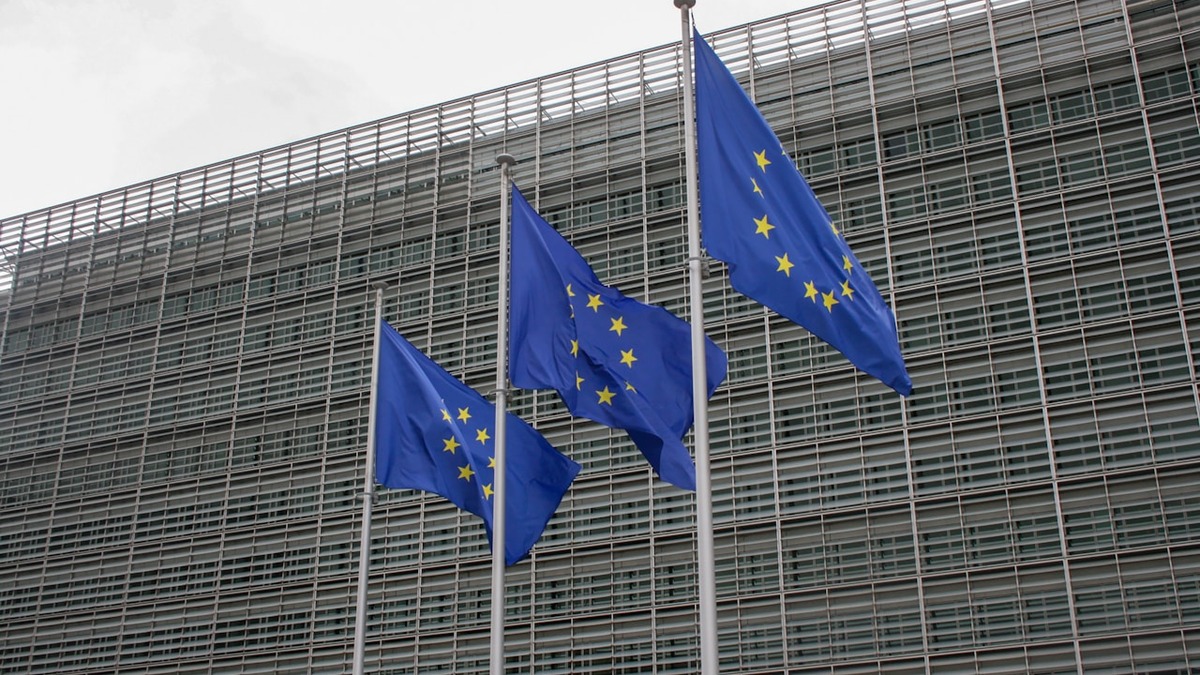 European Commission flags outside the Berlaymont building in Brussels, where officials confirmed they're assessing the impact of the US export controls.
Source: unsplash.com
European Commission flags outside the Berlaymont building in Brussels, where officials confirmed they're assessing the impact of the US export controls.
Source: unsplash.com
| Stakeholder | Impact | Timeline |
|---|---|---|
| Enterprise subscribers | Fable 5 / Mythos 5 access suspended | Immediate, June 12 |
| University research labs | Active model experiments disrupted | Immediate, June 12 |
| Healthcare institutions | Hospital pilots halted without notice | Immediate, June 12 |
| EU public institutions | Access pending policy resolution | Indefinite |
| European Anthropic revenue | Billing suspended for affected models | Until order modified |
Businesses and Researchers
European customers ranged from large enterprise API users to academic labs running multi-week evaluation studies. The cut was clean and immediate. No staged rollout, no warning email, no grace period. Businesses discovered the suspension when their systems stopped responding.
Al Carns, British MP and former armed forces minister, put it plainly: "The most advanced AI model on the planet got switched off by a foreign government." Carns noted that British researchers, companies, and hospitals all lost access simultaneously in a decision made in Washington without consultation with London.
Healthcare and Public Institutions
Hospital pilots and public-sector research programs appear to have been among the hardest-hit categories. The Euronews reporting specifically called out healthcare as an affected sector, with British hospitals among those named. Public institutions evaluating Anthropic models for procurement decisions also lost the ability to continue their assessments.
The Competitive Fallout
The shutdown created an immediate practical problem and, more durably, a procurement calculus problem. European enterprise buyers now have a documented case study of what happens when critical AI infrastructure is controlled by a company subject to unilateral US export orders. That data point will show up in RFPs.
The Political Blowback
France
French politicians mobilized faster than any other government, and the divisions ran across the usual left-right split.
Bruno Retailleau, France's interior minister and 2027 presidential candidate, called the decision a "wake-up call" and demanded France "rearm our technological power" behind companies like Mistral and OVHcloud. Benjamin Haddad, France's minister delegate for Europe, argued Europe "cannot settle for being an open market dependent on technologies designed, funded, and controlled elsewhere."
Former Prime Minister Édouard Philippe reached for infrastructure language: "AI is now a critical infrastructure, as essential as electricity or the Internet. An infrastructure whose models we do not control is infrastructure others can unplug."
Jordan Bardella, president of the National Rally and leading MEP, called for immediate acceleration of state support for Mistral AI - framing what's basically a company-specific subsidy demand as a national sovereignty argument.
United Kingdom
The UK finds itself in an awkward position: outside the EU's collective policy response mechanism but fully exposed to the same service disruption. MPs broadly agreed the episode showed a structural gap. Tom Tugendhat, former security minister, described Britain's current approach as cutting itself off from the future - a reference to the lack of domestic frontier AI development.
Continental Europe
In the Netherlands, Geert Wilders framed the episode as a sovereignty question, calling for Dutch acceleration of domestic AI development. The European Commission's formal response was measured but meaningful. Regnier's statement - that "contingency measures should not be discriminatory against partners" - established the EU's position: this isn't simply a security matter, it's a trade and partnership one.
Who Benefits
Mistral's €3 billion fundraising round was a financing story before June 12. After it, the round became a sovereignty argument. Mistral and OVHcloud were named in political speeches across at least three EU member states without any lobbying effort required.
Mistral CEO Arthur Mensch has spent months warning that Europe has a narrow window to avoid AI dependency on US providers. The Anthropic shutdown gave those arguments a concrete example rather than a theoretical scenario. European cloud providers may find that AI contract renewals now carry a new clause: where's the model provider incorporated, and whose export orders do they answer to?
What Happens Next
 The G7 summit in Évian-les-Bains, France, running June 15-17, will bring AI lab leaders face to face with heads of government who are now citing the Anthropic shutdown in policy debates.
Source: unsplash.com
The G7 summit in Évian-les-Bains, France, running June 15-17, will bring AI lab leaders face to face with heads of government who are now citing the Anthropic shutdown in policy debates.
Source: unsplash.com
The Anthropic technical team's Washington meetings on June 14 suggest the order could be modified - narrowed, subject to a licensing process, or reversed if the security characterization is successfully challenged. Nothing is confirmed.
The geopolitical layer gets more complicated starting today. Dario Amodei is attending the G7 summit in Évian-les-Bains with Sam Altman and Demis Hassabis - the first time all three major AI lab heads have appeared together at a heads-of-government summit. A working lunch Wednesday will bring political leaders and tech executives into the same room to discuss AI infrastructure and regulation.
European leaders arrive at that summit already on record criticizing US AI policy by name. The Anthropic shutdown gives them a specific incident to raise, not a general concern. The presence of Amodei in France makes deferring the conversation much harder.
Whether the G7 produces a concrete framework on allied-nation access to frontier AI models is the open question. The UK's separate position outside the EU's collective response creates one complication. The US's domestic security rationale creates another. What isn't in question is that the episode changed the terms of the debate. European AI dependency was a theoretical risk before June 12. It's a documented one now.
Sources:
- EU Commission: controls should not be discriminatory against partners
- Europe reacts: Anthropic halting Fable 5 and Mythos 5 is a wake-up call
- Anthropic shutdown deepens Europe's fear of US tech reliance
- Amazon CEO raised Anthropic model concerns before crackdown
- AI leaders from OpenAI, Google DeepMind, and Anthropic to join G7 summit
- US AI export controls put Europe on notice
- EU assesses impact of US restrictions on Anthropic models

