
AMD Locks Up 2.5 GW of Compute From an Ex-Bitcoin Miner
AMD signed a 15-year, $14B+ infrastructure deal with Core Scientific for 500+ MW of AI data center capacity, with an option to scale to 2.5 GW - its third major hosting deal in five months.
 5 min read
Three years ago, Core Scientific's data centers ran Bitcoin miners. On July 28, the company signed a 15-year lease putting more than 500 megawatts of that same footprint to work hosting AMD's GPUs instead, with an option to scale to 2.5 gigawatts.
The deal, announced with Core Scientific's Q2 earnings, is worth more than $14 billion in base contracted revenue over its initial term. It's also the third time in five months that a former crypto miner has signed a multi-billion-dollar lease with a chipmaker or hyperscaler - a pattern that says as much about the AI industry's power hunger as it does about AMD's ambitions.
TL;DR
- 15-year lease, 500+ MW initial capacity across five campuses, option to scale to 2.5 GW
- More than $14 billion in base contracted revenue; Core Scientific's total contracted book now tops $24 billion
- AMD gets warrants on Core Scientific stock, tied to commercial milestones - the same structure it used with Meta
- Deployment starts 2027, runs through 2028; Core Scientific's total AI hosting capacity doubles to 1.1 GW
- CORZ shares fell after the announcement despite the headline number
The Deal, Piece by Piece
Capacity and Sites
The initial buildout spans five Core Scientific campuses: Pecos and Hunt in Texas, Muskogee in Oklahoma, Auburn in Alabama, and Dalton in Georgia. Construction is already underway at Pecos, with first deliveries targeted for the first half of 2027 and deployment continuing through 2028. AMD directly leases 377 MW of that capacity across the Texas and Oklahoma sites; the remaining 152 MW in Alabama and Georgia goes to an unnamed neocloud operator, according to Cloud Computing News.
| Site | State | MW | Leaseholder |
|---|---|---|---|
| Pecos | Texas | part of 377 MW | AMD |
| Hunt | Texas | part of 377 MW | AMD |
| Muskogee | Oklahoma | part of 377 MW | AMD |
| Auburn | Alabama | part of 152 MW | Neocloud (unnamed) |
| Dalton | Georgia | part of 152 MW | Neocloud (unnamed) |
Financial Structure
The lease runs 15 years with three five-year extension options - potentially stretching the relationship to 2056 if all options are exercised. AMD also picked up warrants to buy up to 30 million Core Scientific shares at $23.47 each, with 6.5 million vesting immediately. It's the same instrument AMD used in its Meta deal earlier this year: give the customer's landlord equity upside so the chipmaker's fortunes and its infrastructure partner's fortunes move together.
Hardware and Software
The buildout centers on AMD Instinct GPUs, EPYC CPUs, and the ROCm software stack - AMD didn't specify which Instinct generation ships at each site, though the 2027 delivery window lines up with the launch cadence of AMD's newer Instinct MI450 accelerators. Rolling out ROCm workloads at this scale looks routine on paper:
docker run -it --device=/dev/kfd --device=/dev/dri \
  --group-add video --shm-size 16G \
  rocm/pytorch:latest
Getting that command to run identically across 500 MW of leased, third-party-operated infrastructure, with someone else's power contracts and cooling loops underneath it, is the part that doesn't fit in a terminal.
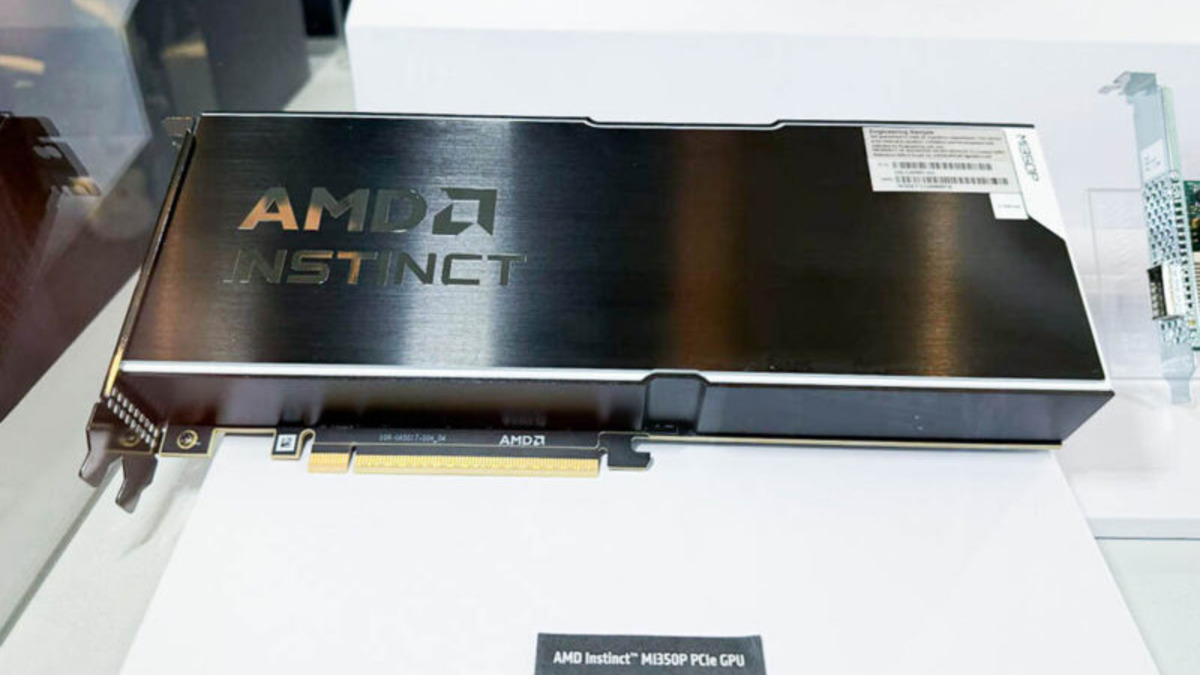 AMD's Instinct lineup is what Core Scientific's new capacity is being built to run - this MI350P, shown at its 2026 launch, is one generation behind the chips expected in the 2027 buildout.
Source: servethehome.com
AMD's Instinct lineup is what Core Scientific's new capacity is being built to run - this MI350P, shown at its 2026 launch, is one generation behind the chips expected in the 2027 buildout.
Source: servethehome.com
The Third Miner-to-Landlord Deal This Quarter
Core Scientific isn't the first crypto operator to become an AI landlord this year, and it isn't the biggest deal by megawatts either. In May, Nvidia committed up to $2.1 billion to IREN for access to 5 GW of capacity. In July, Anthropic signed a $19 billion, 20-year lease with TeraWulf at a former aluminum smelter in Kentucky. Now AMD, for a smaller but still sizable 2.5 GW ceiling.
| Deal | Chipmaker/Lab | Miner | Term | Value |
|---|---|---|---|---|
| Nvidia-IREN | Nvidia | IREN | 5 years (cloud contract) | $2.1B warrant + $3.4B cloud |
| Anthropic-TeraWulf | Anthropic | TeraWulf | 20 years | ~$19B |
| AMD-Core Scientific | AMD | Core Scientific | 15 years | $14B+ |
The pattern holds because the underlying asset is the same in all three cases: grid interconnects and substations that already exist, permitted and energized, because someone built them to run mining rigs a few years ago. Building that from scratch takes years. Leasing it from a miner who already has it takes a signature.
Why AMD Needs This
AMD doesn't have Nvidia's decade of hyperscaler relationships or CUDA's software gravity. What it has is a widening list of infrastructure deals - the Meta agreement, now this one - that get Instinct GPUs into buildings without AMD having to build those buildings itself. Core Scientific CEO Adam Sullivan framed the arrangement plainly on the earnings call: "Value is not announced. It is delivered." AMD's chief strategy officer, Mathew Hein, put it from the other side: the partnership "expands access to the infrastructure our customers need to deploy AMD AI solutions at scale."
 Adam Sullivan, Core Scientific's CEO, has steered the company from Bitcoin mining into AI hosting since taking over in 2023.
Source: corescientific.com
Adam Sullivan, Core Scientific's CEO, has steered the company from Bitcoin mining into AI hosting since taking over in 2023.
Source: corescientific.com
Where It Falls Short
Core Scientific's stock fell after the announcement, not despite the Q2 numbers but partly because of them. The company reported a net loss of roughly $1.15 billion for the quarter - almost completely a non-cash charge from the rising fair value of its outstanding warrants and contingent value rights as its own share price climbed, not an operating loss. Strip that out and the operating story is strong: colocation revenue hit $136.7 million, up from $10.6 million a year earlier, and adjusted EBITDA more than doubled.
The risks that are real: AMD's build-out alone is estimated at roughly $6 billion, most of the $14 billion in revenue doesn't land until 2027 and 2028, and Core Scientific's CFO Jim Nygaard has acknowledged that shifting from Bitcoin mining to colocation hosting gives the company "a financial profile that is essentially opposite" of what investors priced in for years. That's the pitch. It's also the reason the market wants to see megawatts energized before it believes the number on the press release.
Sources:

