
Alphabet's $85B AI Bet Reverses Decade of Buybacks
Alphabet priced an $84.75B equity raise on June 2, reversing a decade of share buybacks to fund a $180-190B AI infrastructure buildout - backed by a $10B bet from Berkshire Hathaway.
 Updated
6 min read
Updated
6 min read
Alphabet priced an $84.75 billion equity raise on June 2, 2026 - the largest single equity offering in US corporate history - and in doing so reversed a decade-long program that had returned $346 billion to shareholders through buybacks. The company says AI demand is now topping its available supply of compute. The capital markets, and Berkshire Hathaway, appear to believe it.
TL;DR
- $84.75B equity raise, upsized from $80B due to oversubscription, structured across three tranches
- Berkshire Hathaway commits $10B - Greg Abel's first major tech investment as CEO
- 2026 CapEx guidance: $180-190B, nearly double 2025's $91.4B and six times 2022's $31B
- Ends a decade where Alphabet repurchased $346B in shares, reducing outstanding float by roughly 13%
Compute Is the Bottleneck
Google Cloud revenue surged 63% year-over-year in Q1 2026 to $20 billion. Its contracted backlog has doubled over the past year to $462 billion. APIs are now processing 19 billion tokens monthly - six times the volume from a year earlier. By any measure, demand for Google's AI infrastructure is accelerating.
Demand Exceeds Supply
The constraint isn't product or pricing. CEO Sundar Pichai told investors plainly in June's equity offering presentation:
"We are experiencing strong demand for our AI solutions and services from enterprises and consumers, at levels that are meaningfully exceeding our available supply."
On the Q1 2026 earnings call months earlier, he'd been equally direct: compute capacity is "what keeps me up at night," and cloud revenue "would have been higher if we were able to" meet demand.
The Revenue Google Left on the Table
The $462 billion cloud backlog isn't revenue - it's contracted future spending that Alphabet physically cannot yet fulfill. That figure is both a commercial achievement and an admission of constrained infrastructure. The equity raise is, in part, an attempt to close that gap before a competitor does.
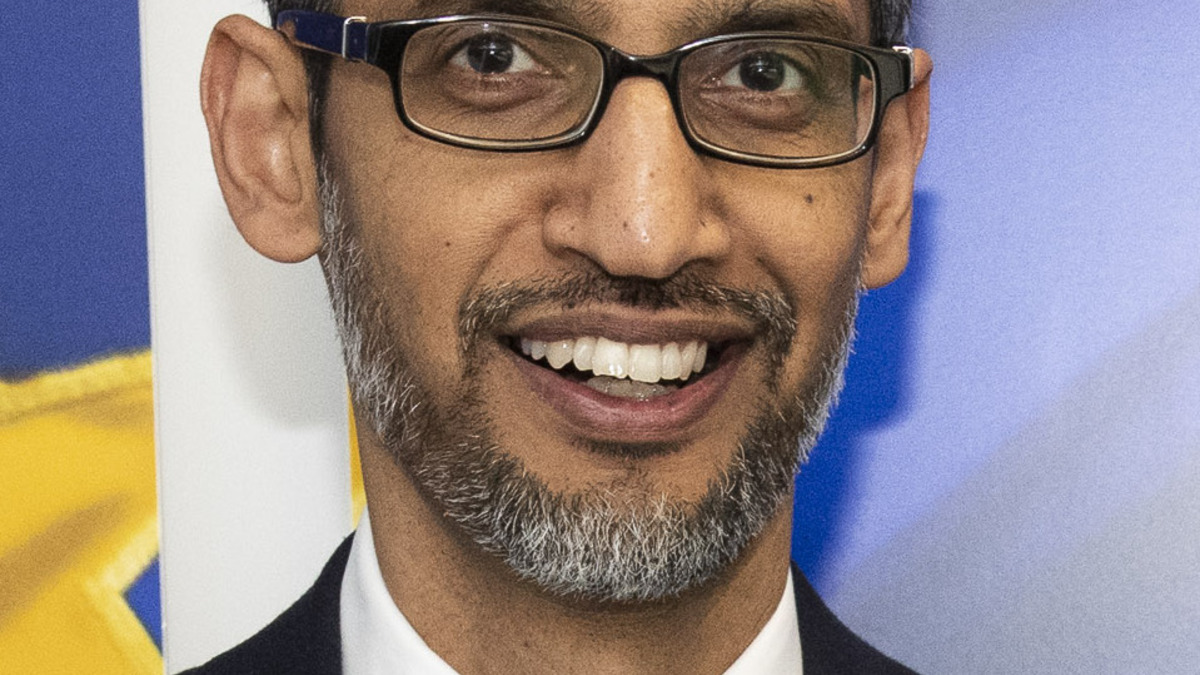 Alphabet CEO Sundar Pichai at a 2023 event. He has described compute capacity as the company's primary near-term constraint.
Source: commons.wikimedia.org
Alphabet CEO Sundar Pichai at a 2023 event. He has described compute capacity as the company's primary near-term constraint.
Source: commons.wikimedia.org
Inside the Three-Part Raise
The $84.75 billion breaks into three distinct tranches, each serving a different purpose.
The Oversubscribed Public Offering
Alphabet initially announced $30 billion in underwritten public offerings - a mix of mandatory convertible preferred stock and common shares. Institutional demand was strong enough to upsize the total raise from the originally announced $80 billion to $84.75 billion. The public portion covers core capital needs and signals a baseline of market confidence in the AI infrastructure thesis.
The At-the-Market Program
Starting in Q3 2026, Alphabet will run a $40 billion at-the-market equity program. The company says this is mostly designed to cover employee equity tax obligations - a mechanism to avoid the cash drag from settling RSU taxes. In practice, ATM programs create ongoing share issuance across the year, compounding dilution effects beyond the initial offering.
Berkshire's $10 Billion Signal
The most closely watched component is a $10 billion private placement to Berkshire Hathaway: $5 billion in Class A common stock at $351.81 per share and $5 billion in Class C capital stock at $348.20 per share, both at a discount to market.
Berkshire under Greg Abel has been quietly building a major Alphabet position. The company accumulated roughly $26 billion in Alphabet exposure since Q3 2025, making it one of Berkshire's largest concentrated bets on a single technology company outside Apple. The $10 billion private placement accelerates that position.
This matters beyond the size. Warren Buffett spent decades avoiding capital-intensive technology raises, viewing them as structurally risky businesses that consume cash rather than create it. Abel's willingness to anchor a dilutive equity offering in one of the most capital-intensive sectors in corporate history is a different kind of institutional signal.
"We intend to fund these investments through a balanced approach, combining our strong operating cash flow with debt and today's equity raise." - CFO Anat Ashkenazi
Where the Capital Goes
 Alphabet's capex will be "overwhelmingly" directed at technical infrastructure - data centers, networking, and AI compute hardware.
Source: pexels.com
Alphabet's capex will be "overwhelmingly" directed at technical infrastructure - data centers, networking, and AI compute hardware.
Source: pexels.com
Sundar Pichai said in the investor presentation that "the overwhelming majority" of 2026 spend will go to technical infrastructure. The breakdown: data centers and the compute, networking, and cooling needed to run large AI workloads at scale.
A CapEx Trajectory With No Ceiling in Sight
Alphabet's 2026 capex guidance of $180-190 billion compares to $91.4 billion in 2025 and $31 billion in 2022. The company has confirmed that 2027 capex is expected to "significantly increase" compared to 2026. There's no inflection forecast.
For context: Microsoft guided to roughly $80 billion in AI-related capital expenditure for fiscal 2025. ByteDance announced $70 billion in AI capex for 2026. Anthropic's $65 billion Series H, with its $965 billion valuation, reflects investor confidence that model training costs are about to increase again. The companies at the frontier are all spending at rates that require external capital to sustain.
The Combined External Financing
Alphabet has paired this equity raise with a recent $85 billion-plus in debt issuance. Combined, the company is deploying more than $165 billion in external capital specifically to support its AI buildout. Operating cash flow was $174 billion over the trailing twelve months, which sounds like ample coverage - until you stack the capex numbers against it.
The Buyback Generation Is Over
Alphabet's share repurchase program was one of the most consistent in tech. Between roughly 2015 and 2025, the company launched $346 billion in buybacks, reducing shares outstanding by around 13%. It was a clear signal that the company had more cash than growth opportunities large enough to absorb it.
That logic no longer holds, or Alphabet's leadership no longer believes it does.
What Existing Shareholders Are Giving Up
The public offering, combined with the ATM program running through late 2026, creates a sustained dilution effect on existing shareholders. The per-share earnings base is expanding - which matters for a company trading at a premium to historical multiples on the expectation that AI infrastructure investment translates to revenue at scale.
The bet is that demand at $462 billion of contracted backlog justifies the dilution math. If compute capacity catches demand and conversion rates stay high, the thesis holds. If AI infrastructure spending continues to run ahead of enterprise budget commitments, existing shareholders will have funded a capex cycle that serves customers who haven't yet signed contracts.
CFO Ashkenazi's framing - "strong operating cash flow with debt and today's equity raise" - is accurate but selective. Operating cash flow is strong now. Capex guidance for the next two years passes historical cash generation by a significant margin. The equity raise and debt are filling that gap, not augmenting surplus.
The $346 billion buyback era reflected a Google that created more cash than it could deploy. The $84.75 billion equity raise reflects a Google that has found something large enough to absorb everything - and is asking shareholders to help fund it. Whether Google Cloud's $462 billion backlog converts to revenue at the margins needed to justify the investment is the only question that matters from here. The capital markets, for now, think it'll.
Sources:
- Alphabet Upsizes Equity Offering to $85 Billion for AI Spending - Bloomberg
- Alphabet Prices $84.75 Billion Equity Raise - TechTimes
- Alphabet Plans to Raise $80 Billion to Pay for AI Buildout - TechCrunch
- Alphabet Plans $80B AI Raise With Berkshire Hathaway Backing - Memeburn
- Alphabet Investor Presentation June 2026 - Google Blog
- Alphabet Plans to Raise $80 Billion from Stock Sales - CNBC
- Google to Raise $85B for AI - Incrypted
Last updated

