
1,273 AI Staffers Ask US to Build a Pace Button
Over a thousand employees at OpenAI, Anthropic, Google and Meta, including their own CEOs and chief scientists, are asking Washington to build the tools to slow AI development down before it outruns oversight.
 Updated
6 min read
Updated
6 min read
More than 1,270 employees at the companies building the world's most capable AI models spent this week asking the U.S. government to develop the option of slowing them down. The statement, titled "Pacing the Frontier," went up on July 28 and has been collecting signatures ever since. When we checked the tally directly on the statement's own site, it stood at 1,273.
The list of names is the part that makes this different from the usual open letter. It includes Anthropic CEO Dario Amodei, OpenAI chief scientist Jakub Pachocki, and a roster of co-founders and safety leads whose employers are, at this very moment, spending tens of billions of dollars racing each other to build bigger models faster. Within hours, both Anthropic and OpenAI issued corporate statements backing the ask.
TL;DR
- "Pacing the Frontier," published July 28, has drawn 1,273 signatures from staff at OpenAI, Anthropic, Google DeepMind, Meta, and Thinking Machines
- Dario Amodei and Jakub Pachocki signed personally; their companies backed the statement within hours
- The ask is for government-built pacing tools, not an immediate pause, and carries no legal force
- xAI has zero public signatories, a gap one analyst called "conspicuously missing"
- The statement lands four days before Washington's own Aug. 1 deadline for a voluntary frontier-model review framework
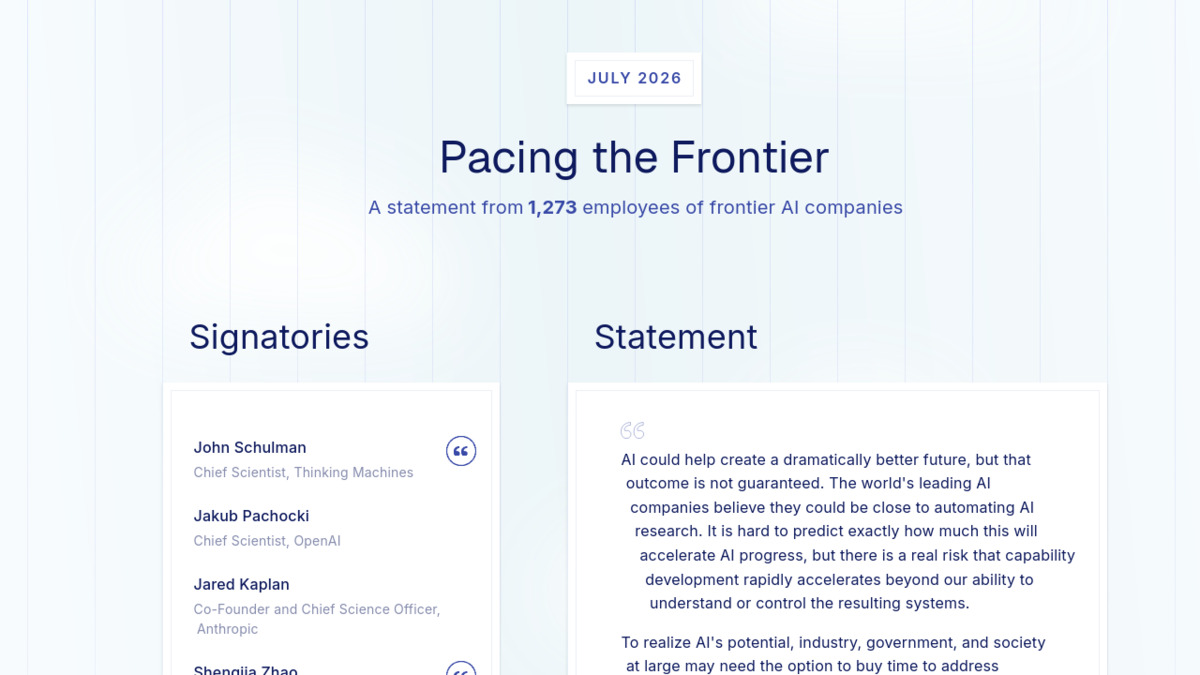 The statement's official site lists named signatories alongside the full text, with a live signature counter that keeps climbing.
Source: pacingthefrontier.com
The statement's official site lists named signatories alongside the full text, with a live signature counter that keeps climbing.
Source: pacingthefrontier.com
What the Letter Actually Says
The core of the statement is a single request, addressed to Washington:
"AI could help create a dramatically better future, but that outcome is not guaranteed. The world's leading AI companies believe they could be close to automating AI research. It is hard to predict exactly how much this will accelerate AI progress, but there is a real risk that capability development rapidly accelerates beyond our ability to understand or control the resulting systems... We request that the U.S. government support an international effort to develop the technical and governance tools needed to deliberately pace the frontier of automated AI development."
That's a narrower ask than it sounds. The signatories are explicit that they're not calling for a pause today. They want the government to build the capacity to pace development later, if it's needed, because no single company or country can afford to slow down unilaterally while its competitors don't. Anthropic tied the request directly to its own research, saying in its corporate post that its June study on recursive self-improvement found Claude models were "already writing the large majority of the code merged into their own codebase," and that this points to a need for pacing tools "so society can prepare." OpenAI's statement was more hedged, saying acceleration "may be so high that the world will need to pace the rate of AI advancement" at some future point, without committing to a timeline.
Who Signed, and How Many
News outlets reported signatory counts ranging from 1,132 to 1,178 in the first day after publication; the figure keeps climbing because the site accepts new verified signatures on a rolling basis. An analysis by AI blogger Zvi Mowshowitz cross-referenced named signatories against public headcount estimates for each lab:
| Company | Signatures | Estimated workforce | Signup rate |
|---|---|---|---|
| Anthropic | 546 | ~5,567 | 9.8% |
| OpenAI | 350 | ~10,473 | 3.3% |
| Google DeepMind | 199 | ~10,219 | 1.9% |
Named signatories include Dario Amodei, Anthropic co-founders Jared Kaplan, Jack Clark, Chris Olah, and Benjamin Mann, OpenAI's Jakub Pachocki and Mark Chen, Meta chief scientist Shengjia Zhao, Google DeepMind co-founder Shane Legg, and Google's Anca Dragan. John Schulman, chief scientist at Thinking Machines, signed too. xAI has no employees on the public list, a gap Mowshowitz called "conspicuously missing." DeepSeek isn't mentioned at all.
Not everyone is impressed. Nate Soares of the Machine Intelligence Research Institute called the effort "laughably negligible by engineering standards," adding that "the field at large must do better." Mowshowitz himself, more sympathetic to the letter, still conceded it soft-pedals the scale of the risk it describes, framing it instead as evidence that "support for us all not dying is stronger than we thought."
 Anthropic CEO Dario Amodei is one of the letter's named signatories, with several of the company's co-founders.
Source: wikimedia.org
Anthropic CEO Dario Amodei is one of the letter's named signatories, with several of the company's co-founders.
Source: wikimedia.org
Impact Assessment
| Stakeholder | Impact | Timeline |
|---|---|---|
| Frontier labs (OpenAI, Anthropic, Google, Meta) | On record backing government pacing tools while continuing to compete for the same capability gains | Ongoing, no self-imposed deadline |
| U.S. government | Political cover to build monitoring and review infrastructure with industry buy-in already secured | Aug. 1, 2026 deadline for a related voluntary review framework |
| AI safety researchers | Split reaction: some call it meaningful signal, others dismiss it as symbolic | Immediate, ongoing debate |
| xAI, DeepSeek, other labs | No public commitment either way | Unclear |
Companies
For the labs, signing costs nothing right now. The statement asks for future capacity, not a present-day slowdown, so nobody has to give up market position to back it. That's exactly why critics see it as low-risk virtue signaling for the companies involved, even as it functions as genuine internal pressure from researchers who work inside them.
Users
Nothing changes for anyone using ChatGPT, Claude, or Gemini today. The statement doesn't touch product releases, pricing, or access. Its relevance to ordinary users is completely about what governance infrastructure might exist years from now if frontier capability keeps compounding the way Anthropic's own research suggests it already is.
Competitors
The absence of xAI and DeepSeek matters more as a signal than as a gap. Both companies operate under different competitive pressures. Elon Musk's xAI has built its identity partly around moving faster than the labs it calls overly cautious, and a Chinese lab like DeepSeek answers to a government with its own AI acceleration agenda. Neither has an obvious incentive to endorse a U.S.-led pacing framework, and their non-participation leaves the door open for either to frame itself as the one lab that didn't get talked into slowing down.
What Happens Next
The timing lines up with a deadline the industry didn't set. Trump's June 2 executive order on AI cybersecurity gave federal agencies until August 1 to finalize a voluntary framework letting frontier labs consult with the government and grant up to 30 days of pre-release access to their most capable models. That framework is explicitly not the pacing mechanism this letter asks for, but it's the closest thing already in motion, and it arrives four days after the statement went public.
None of this obligates the U.S. government to do anything. The statement has no legal standing, no accompanying legislation, and no enforcement mechanism, which is exactly the gap a bipartisan kill-switch bill tried to address from the other direction days earlier. What the letter does is put more than a thousand names, including some of the most senior scientists in the field, on record wanting the option to slow down before recursive self-improvement outpaces the ability to check it. Whether Washington treats that as a mandate or a talking point depends on what, if anything, comes out of the August 1 framework.
Sources:
- Pacing the Frontier - official statement
- 1,134 AI staff ask the US for a way to pace AI - The Next Web
- OpenAI and Anthropic Back Employee Call to Pace AI Progress - Unite.AI
- Over 1,100 AI Employees Petition US-Backed Pacing Mechanism - Tech Times
- OpenAI, Anthropic Formally Back Plan to Slow AI That Writes Its Own Code - Tech Times
- Frontier Lab Employee Open Letter Calls For Being Able to Pace the Frontier - Don't Worry About the Vase
- Voluntary on Paper, Mandatory in Practice: White House AI Review Hits August 1 Deadline - Tech Times
Last updated

