
SWE-1.7
Cognition's proprietary coding model powering Devin, scoring 42.3% on FrontierCode 1.1 Main at $1.97/task via Cerebras inference at 1000 tokens/sec.
 8 min read
TL;DR
- Cognition's newest proprietary coding model, trained by applying reinforcement learning on top of Moonshot's already RL-trained Kimi K2.7 Code base
- 42.3% on FrontierCode 1.1 Main, 81.5% on Terminal-Bench 2.1, 77.8% on SWE-Bench Multilingual, served at 1000 tokens/sec via Cerebras
- Trails GPT-5.5 and Claude Opus 4.8 on raw score but claims a far better cost-per-task ratio - $1.97 per FrontierCode rollout versus several dollars for the frontier flagships
- Not sold as a standalone API model - access is bundled into Devin's Pro, Max, Teams, and Enterprise plans across Web, Desktop, and CLI
Overview
SWE-1.7 is Cognition's latest proprietary model for Devin, the autonomous coding agent the company has been iterating on since 2024. Cognition launched it on July 8, 2026, calling it "the most capable model we've trained so far," and the pitch is explicitly about cost-efficiency rather than outright capability: SWE-1.7 aims to sit on the Pareto frontier of score versus dollars spent, not at the top of the leaderboard.
The model isn't built from scratch. Cognition took Moonshot AI's Kimi K2.7 Code - itself already reinforcement-learning post-trained - and ran a further, large-scale RL pass on top of it inside Devin's own agent harness. Cognition frames this as evidence against a "post-training ceiling," arguing that stacking RL runs on an already-RL-trained base still yields large capability gains rather than diminishing returns. The resulting jump is major: SWE-1.7 gains 12.2 points over the Kimi K2.7 Code base on FrontierCode 1.1 Main and 32.9 points over Cognition's own previous model, SWE-1.6.
Where SWE-1.7 fits competitively is straightforward: it is Cognition's answer to the fact that every major lab now ships a credible coding agent, and Devin's differentiation increasingly rests on packaging and workflow rather than raw model supremacy. SWE-1.7 slots in with Anthropic, OpenAI, and Google models as one of several engines Devin users can select, rather than the only option.
Key Specifications
| Specification | Details |
|---|---|
| Provider | Cognition |
| Model Family | SWE (Devin's proprietary coding line) |
| Base Model | Moonshot AI Kimi K2.7 Code (post-trained further via RL) |
| Parameters | Not disclosed by Cognition |
| Context Window | 256K tokens (inherited from Kimi K2.7 Code; unconfirmed for SWE-1.7 specifically) |
| Inference Speed | 1000 tokens/sec (Cerebras deployment) |
| Input / Output Price | Not sold standalone - bundled into Devin plans |
| Release Date | July 8, 2026 |
| License | Proprietary, closed-weight |
Benchmark Performance
Cognition's own launch post published a head-to-head table against six other models on three benchmarks. These are the vendor-reported numbers, cross-checked against Cognition's blog post directly:
| Benchmark | SWE-1.7 | Kimi K2.7 Code | GPT-5.5 | Claude Opus 4.8 | SWE-1.6 |
|---|---|---|---|---|---|
| FrontierCode 1.1 Main | 42.3% | 30.1% | 43.0% | 46.5% | 9.4% |
| Terminal-Bench 2.1 | 81.5% | 72.7% | 84.2% | 86.9% | 39.7% |
| SWE-Bench Multilingual | 77.8% | 73.5% | 76.8% | 84.4% | 58.3% |
Two things stand out. First, SWE-1.7 does not beat either frontier flagship on two of the three benchmarks - it trails GPT-5.5 by 0.7 points and Claude Opus 4.8 by 4.2 points on FrontierCode 1.1 Main, and both models by wider margins on Terminal-Bench 2.1. Second, it edges past GPT-5.5 on SWE-Bench Multilingual (77.8% vs 76.8%), which covers issue resolution across Java, TypeScript, Go, Rust, C, and C++ rather than just Python. See our SWE-Bench coding agent leaderboard for how these scaffolded agent numbers compare against the wider field.
The number Cognition leans on hardest is cost, not accuracy: $1.97 per task on FrontierCode's Main set. Plotted as score against dollars spent per rollout, Cognition's chart puts SWE-1.7 in a position on the cost-performance curve that none of the pricier frontier models occupy - GPT-5.5 and Opus 4.8 score higher, but at several times the per-task cost.
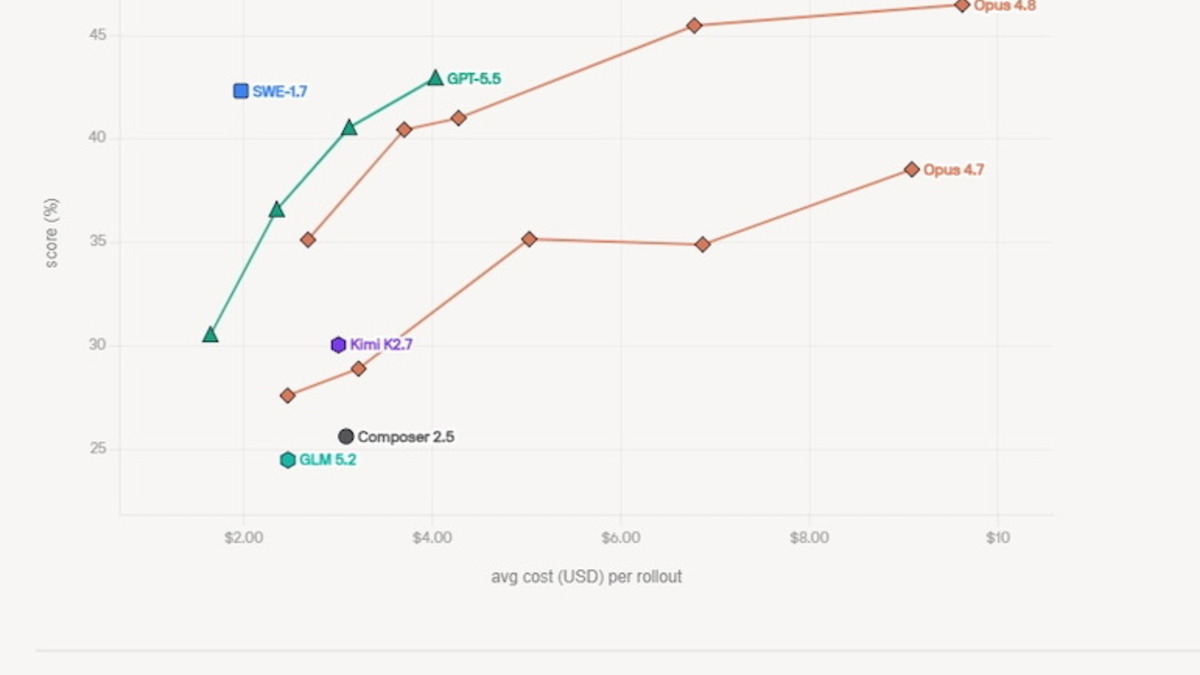 Cognition's own score-vs-cost plot shows SWE-1.7 clustered near GPT-5.5's accuracy at a fraction of the dollar cost per rollout.
Source: winbuzzer.com
Cognition's own score-vs-cost plot shows SWE-1.7 clustered near GPT-5.5's accuracy at a fraction of the dollar cost per rollout.
Source: winbuzzer.com
Worth flagging for skeptics: FrontierCode is Cognition's own benchmark, so a company scoring its own model competitively on a test it also designed and controls invites the obvious "grading its own homework" objection - a point independent outlets covering the launch raised directly. Terminal-Bench 2.1 and SWE-Bench Multilingual are third-party benchmarks, and SWE-1.7's relative position holds up similarly on both, which is at least a partial check on the FrontierCode number.
Key Capabilities
SWE-1.7's headline technical feature is self-compaction: the model periodically summarizes its own working state mid-task and resumes from that summary rather than the raw conversation history, letting a single session run for up to six hours without hitting a hard context wall. Cognition also describes training interventions aimed at long-horizon stability - preserving sampling entropy so the model doesn't collapse into repetitive, low-exploration behavior partway through a long reinforcement-learning run, and distributing training across clusters on three continents with fault tolerance for hardware failures mid-run.
In practice, that long-horizon focus is aimed squarely at Devin's core use case: asynchronous tasks where you hand off a migration or a multi-file refactor and check back later rather than pair-programming turn by turn. SWE-1.7 is also served through Cerebras's wafer-scale inference hardware at 1000 tokens per second, which is the throughput number Cognition advertises most prominently with the accuracy figures - a "Lightning" variant trades a small model-selection premium for that speed tier.
 SWE-1.7 runs on Cerebras wafer-scale inference chips, which Cognition credits for the model's 1000 tokens/sec serving speed.
Source: cerebras.ai
SWE-1.7 runs on Cerebras wafer-scale inference chips, which Cognition credits for the model's 1000 tokens/sec serving speed.
Source: cerebras.ai
SWE-1.7 also became the recommended default model inside Devin Desktop, the IDE formerly known as Windsurf before Cognition's June 2026 rebrand. Devin Desktop's local agent, Devin Local, is a from-scratch Rust rewrite of Windsurf's old Cascade agent, shipped as the same over-the-air update that retired the Windsurf name. Cognition claims Devin Local is up to 30% more token-efficient than Cascade on comparable refactoring work and adds sub-agent support for parallel task handling that Cascade lacked outright. That efficiency figure is vendor-stated and describes the agent harness rewrite itself rather than being specific to SWE-1.7 as a model - independent confirmation is thin, though one developer's spot check (roughly 18,000 tokens against Cascade's 24,000 on a comparable task) lines up directionally with the claim.
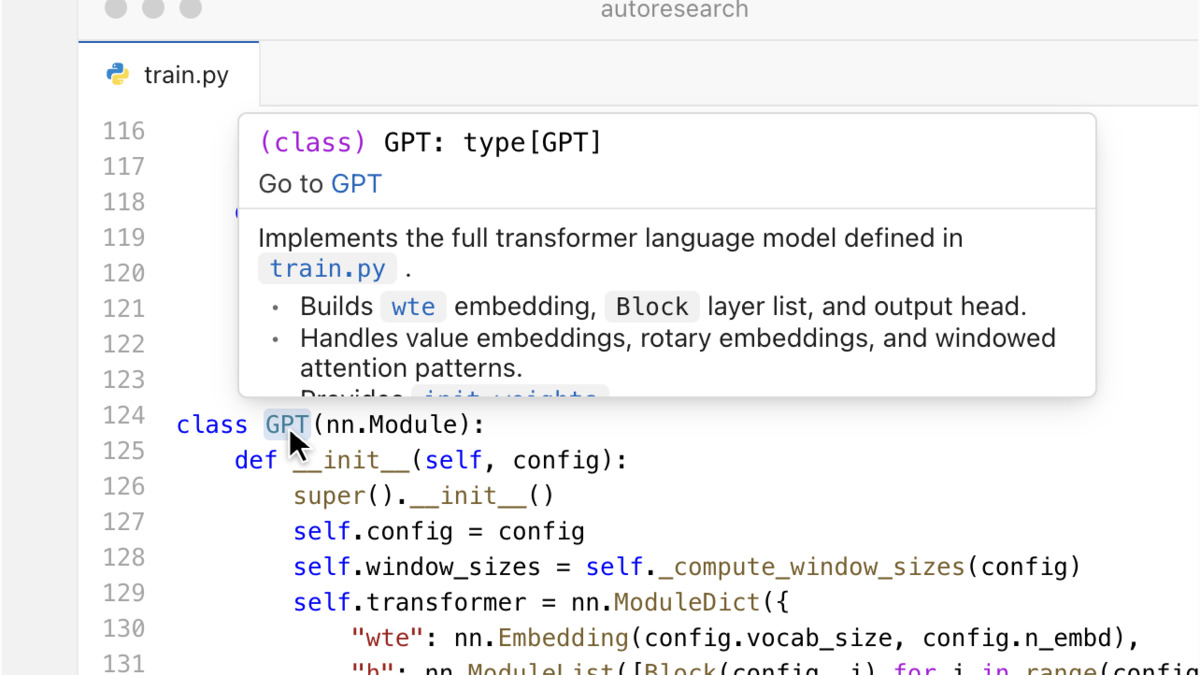 Devin Desktop, the rebranded Windsurf IDE, now defaults to SWE-1.7 for its local Devin Local agent.
Source: devin.ai
Devin Desktop, the rebranded Windsurf IDE, now defaults to SWE-1.7 for its local Devin Local agent.
Source: devin.ai
Pricing and Availability
SWE-1.7 is not available as a standalone API model with per-token pricing - Cognition has not published one, and third-party model trackers confirm no independent API listing exists. Access runs entirely through Devin's subscription tiers:
- Free - light usage quota, limited model availability
- Pro ($20/month) - full model availability, including free use of SWE-1.7 and Devin's cloud agents
- Max ($200/month) - the same access at substantially higher usage quotas
- Teams ($80/month base + $40/month per full seat) - centralized billing, admin dashboard, priority support
- Enterprise - custom pricing, VPC deployment, SSO, dedicated support
Inside Devin Desktop's credit system, the standard SWE-1.7 model runs at a 0x credit multiplier (effectively free against quota), while "SWE-1.7 Lightning" - the faster Cerebras-accelerated tier - carries a 6x multiplier equivalent to $2.50/M input and $12.50/M output tokens for usage beyond the included quota. As of launch, SWE-1.7 was offered as a free preview through August 8, 2026, after which standard plan quotas apply. That structure puts SWE-1.7 in a different pricing category from openly-priced coding models like Kimi K2.7 Code itself, which is sold per-token through the usual inference providers - SWE-1.7 is a platform feature of Devin, not a model you can call directly from your own code.
Strengths and Weaknesses
Strengths
- Strong cost-per-task economics - near-frontier scores at roughly a third of what GPT-5.5 or Opus 4.8 cost per FrontierCode rollout
- Beats GPT-5.5 on SWE-Bench Multilingual, a meaningful result given that benchmark spans seven languages beyond Python
- Self-compaction lets sessions run up to six hours without a hard context cutoff, well-suited to Devin's asynchronous task model
- 1000 tokens/sec serving speed via Cerebras is a genuine latency advantage over standard GPU-served frontier models
Weaknesses
- Trails both GPT-5.5 and Claude Opus 4.8 on FrontierCode 1.1 Main and Terminal-Bench 2.1 - it's a value play, not a capability leader
- Not available as a standalone API or open-weight model - locked entirely to the Devin ecosystem
- FrontierCode is Cognition's own benchmark, and using it as the headline cost-efficiency metric while also designing and controlling it is a real conflict of interest worth weighing
- Context window and parameter count for SWE-1.7 itself are not independently disclosed by Cognition, only inferred from the Kimi K2.7 Code base
Related Coverage
Our Devin review covers the broader agent product SWE-1.7 now powers, and our Windsurf review covers the IDE that became Devin Desktop before this model shipped. For competitive context, see Devin vs Cursor and our best Devin alternatives roundup, plus the $1B raise that valued Cognition at $25B two months before this launch. SWE-1.7's base model has its own profile at Kimi K2.7 Code, reviewed separately here.
Sources
- SWE-1.7: Frontier Intelligence at a Fraction of the Cost - Cognition
- Cognition Launches SWE-1.7 in Devin AI Agent, Claiming Near-Frontier Level Coding Scores at a Discount - Winbuzzer
- Cognition SWE-1.7: Devin Coding Model Near Frontier Benchmarks at Lower Cost - Mervin Praison
- AI Models - Devin Docs
- Devin Local Agent - Devin Docs
- Windsurf is now Devin Desktop - Devin
- Devin Pricing
- Terminal-Bench 2.1 Leaderboard
- SWE-Bench Multilingual
✓ Last verified July 24, 2026

