
Sora 2
OpenAI's Sora 2 generates physics-accurate video with synchronized audio from text or images, available API-only until its September 24, 2026 sunset.
 7 min read
Sora 2 is OpenAI's second-generation video generation model, launched September 30, 2025 with an iOS consumer app and simultaneous API access. It produces videos up to 25 seconds at up to 1080p with native synchronized audio - dialogue, sound effects, and ambient sound baked into the output. The core claim at launch was the best physics simulation among commercially available video models, which independent testing largely supported at release.
TL;DR
- Physics-accurate video generation with native synchronized audio, text-to-video and image-to-video
- Sora 2: 4/8/12s at 720p, $0.10/s standard or $0.05/s batch; Sora 2 Pro: up to 25s at 1080p, $0.70/s standard
- App discontinued April 26, 2026; API sunset September 24, 2026 - competitors Veo 3.1 and Kling 3.0 have since surpassed it on quality benchmarks
The model runs on a diffusion transformer (DiT) architecture, treating video as spacetime patches similar to tokens in a language model. This lets the architecture handle both spatial detail within frames and temporal relationships across them. OpenAI hasn't disclosed the parameter count or specific training details for Sora 2.
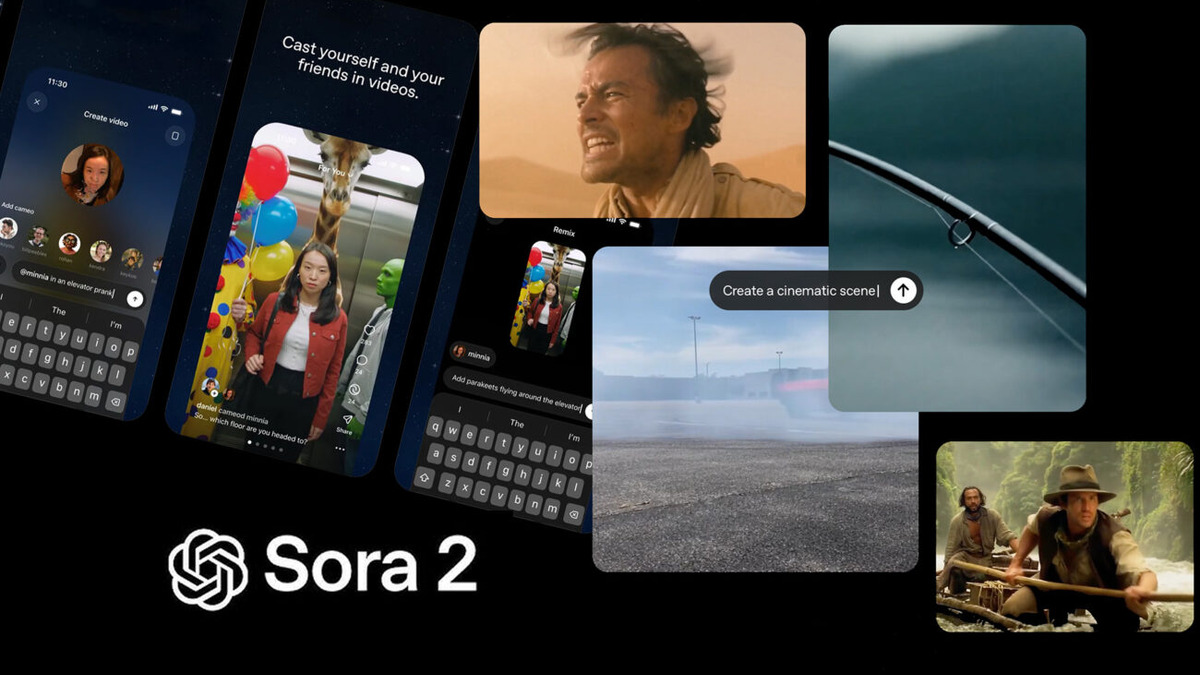 Sora 2 launched alongside a new iOS app in September 2025, offering a TikTok-style social feed of AI-generated clips.
Source: cined.com
Sora 2 launched alongside a new iOS app in September 2025, offering a TikTok-style social feed of AI-generated clips.
Source: cined.com
Key Specifications
| Specification | Details |
|---|---|
| Provider | OpenAI |
| Model Family | Sora |
| Parameters | Not disclosed |
| Architecture | Diffusion Transformer (DiT) |
| Input Modalities | Text prompt, image |
| Output | Video with synchronized audio |
| Release Date | September 30, 2025 |
| API Sunset | September 24, 2026 |
| License | Proprietary |
Resolution and Duration
Sora 2 comes in two tiers with distinct duration and resolution limits:
| Tier | Resolutions | Durations | Standard Price | Batch Price |
|---|---|---|---|---|
| Sora 2 | 720p (1280x720 or 720x1280 portrait) | 4s, 8s, 12s | $0.10/s | $0.05/s |
| Sora 2 Pro | 720p, 1024p (1792x1024), 1080p (1920x1080) | 10s, 15s, 25s | $0.30/s - $0.70/s | $0.15/s - $0.35/s |
Batch pricing carries a 24-hour SLA in exchange for roughly 50% off standard rates.
Benchmark Performance
Sora 2 doesn't appear in the current video generation benchmarks leaderboard top five. By April 2026, when the app shut down, Alibaba's HappyHorse-1.0 (Elo: 1,361) and ByteDance's Seedance 2.0 (Elo: 1,268) had taken the top slots, with Kling 3.0 at #3. One tracker puts Sora 2 at approximately Elo 1,206 in text-to-video pairwise comparisons - around 7th place.
That said, the competitive situation at launch (late 2025) was different. Reviewers from CineD, VentureBeat, and AI Magicx all noted that Sora 2 led on physics plausibility and prompt-following for complex motion. Specific strengths documented at release:
- Modeled physics failure states correctly (a missed basketball rims out instead of "teleporting" through the hoop)
- Handled Olympic gymnastics routines, triple axels, and paddleboard backflips with believable momentum and buoyancy
- Generated synchronized dialogue with accurate lip-sync, not just background music or ambient sound
By early 2026, Kling 3.0 added three-minute clips at native 4K, and Veo 3.1 hit 60fps 4K with stronger temporal consistency. Sora 2 Pro's 25-second cap and 1080p ceiling looked limiting by comparison.
| Quality Dimension | Sora 2 (at launch) | Veo 3.1 (2026) | Kling 3.0 (2026) |
|---|---|---|---|
| Max Resolution | 1080p | 4K / 60fps | 4K native |
| Max Duration | 25s (Pro) | Not disclosed | 3 minutes |
| Physics | Best at launch | Strong | Strong |
| Audio | Native sync | Native sync | Native sync |
| Arena Elo (approx) | ~1,206 | Top 3 | Top 3 |
Key Capabilities
Physics and Motion
The standout feature at launch was physics accuracy. Sora 2 doesn't just produce plausible-looking motion - it models cause and effect. A ball that misses a hoop rebounds. Liquid poured from a container follows surface tension. A triple axel figure skater rotates correctly in the air. These weren't reliable in other 2025 video models.
OpenAI described the capability in terms of Sora 2 handling "scenarios that are exceptionally difficult or outright impossible for prior systems." Independent testing confirmed this held for complex motion and fluid dynamics, though hand-to-object interactions and rapid camera motion remained weak spots across all video models at the time.
Synchronized Audio
Both Sora 2 and Sora 2 Pro produce synchronized audio natively - this isn't a post-processing step. The audio output includes dialogue with lip-sync, sound effects that match on-screen action, and ambient soundscapes. Sora 2 Pro's longer duration options (10s to 25s) made this more useful for actual scene-length content.
Cameo / Character Insertion
The consumer app shipped with a feature called "Cameos" (internally referred to as "characters") that let users record a short video and audio sample to capture their likeness. After a one-time identity verification step, users could insert themselves or approved contacts into any generated scene. Permissions were granular: users chose whether their likeness was available only to themselves, to selected contacts, or to anyone. OpenAI built in consent controls including the ability to delete any video featuring your likeness, including drafts made by others.
The Cameo feature didn't ship with the API.
 Sora 2 represented OpenAI's first serious push into video generation - but the app closed six months after launch.
Source: unsplash.com
Sora 2 represented OpenAI's first serious push into video generation - but the app closed six months after launch.
Source: unsplash.com
Pricing and Availability
Sora 2 is API-only as of April 26, 2026, when OpenAI shut down the consumer app and the sora.com web experience. The API runs until September 24, 2026, after which OpenAI will delete all stored user content.
API pricing summary:
- Sora 2 at 720p: $0.10/s standard, $0.05/s batch
- Sora 2 Pro at 720p: $0.30/s standard, $0.15/s batch
- Sora 2 Pro at 1024p (1792x1024): $0.50/s standard, $0.25/s batch
- Sora 2 Pro at 1080p (1920x1080): $0.70/s standard, $0.35/s batch
At standard rates, a single 12-second Sora 2 clip costs $1.20. A 25-second Sora 2 Pro clip at 1080p runs $17.50. Batch mode halves these costs at the price of a 24-hour turnaround SLA - reasonable for batch creative production pipelines that don't need real-time output.
During the consumer app's active period, pricing was credits-based: ChatGPT Plus ($20/month) gave around 1,000 credits, with standard 720p clips consuming roughly 16 credits per second. ChatGPT Pro ($200/month) provided 10,000 credits and unlocked Sora 2 Pro.
Rate limits on the API run from unsupported at the free tier up to 375 requests per minute at Tier 5.
Shutdown Context
OpenAI announced the discontinuation on March 24, 2026. The stated reason was reallocation of compute toward coding tools and enterprise products. Reported figures suggested the app was running at a daily compute cost of $1 million or more, with user retention below 8% at 30 days for Pro users. The consumer app had peaked at roughly one million active users before dropping below 500,000. TechCrunch reported the decision was also tied to competitive pressure from Claude Code and enterprise AI tools pulling OpenAI's engineering resources away from consumer video.
The technology itself isn't being abandoned completely - OpenAI has suggested Sora continues as a research project focused on world modeling.
Strengths and Weaknesses
Strengths
- Physics simulation quality was best-in-class at September 2025 launch
- Native synchronized audio including lip-synced dialogue - no separate audio generation step
- Cameo identity insertion with strong consent controls (consumer app only)
- Batch API at 50% off standard pricing for non-realtime pipelines
- Both text-to-video and image-to-video supported at all tiers
- Portrait and landscape orientations supported
Weaknesses
- API sunset September 24, 2026 - can't be adopted for long-term production use
- No 4K output; competitors reached 4K with longer clips before the shutdown
- Maximum 25s duration (Pro) while Kling 3.0 now does three-minute clips
- Cameo feature never reached the API
- Parameters and architecture details not disclosed
- Human hands and fast camera motion remain problematic (shared limitation across all video models)
- Arena Elo of ~1,206 trails HappyHorse-1.0, Seedance 2.0, and Kling 3.0 by early 2026
Related Coverage
- OpenAI Drops Sora to Chase Enterprise Revenue - Background on why OpenAI discontinued the product
- Video Generation Benchmarks Leaderboard 2026 - Current rankings including Sora 2's position
- Veo 3.1 - Google DeepMind's competing video generation model
- GPT Image 2 - OpenAI's image generation model still in active development
Sources:
- Sora 2 is here - OpenAI
- Sora 2 Model Documentation - OpenAI API
- Sora 2 API Pricing Calculator & Sunset Guide - CostGoat
- What to know about the Sora discontinuation - OpenAI Help
- OpenAI sets two-stage Sora shutdown - The Decoder
- Why OpenAI really shut down Sora - TechCrunch
- OpenAI debuts Sora 2 - CineD
- Sora 2 vs Veo 3.1 vs Kling 3.0 - AI Magicx
- Sora 2 vs Sora 2 Pro comparison - MindStudio
✓ Last verified June 24, 2026

