
Snowflake Arctic-Text2SQL-R1-32B
Snowflake's reasoning-first text-to-SQL model tops the BIRD benchmark at 71.83% execution accuracy, trained with GRPO and a reward that only checks if the SQL runs correctly.
 9 min read
Snowflake AI Research built Arctic-Text2SQL-R1 to do one thing: turn a natural language question into SQL that actually runs and returns the right rows. Not chat, not code review, not general reasoning - just SQL, assessed the way a database engineer would evaluate it, by executing the query and checking the result set.
TL;DR
- The 32B model hit 71.83% execution accuracy on BIRD, the top score of any open or proprietary model at the time
- Trained with GRPO using a reward that only checks execution correctness - no elaborate scoring, no LLM judge
- Only the 7B checkpoint has public weights on Hugging Face; the 14B and 32B numbers come from Snowflake's own benchmark reporting
Overview
Text-to-SQL has been a stubborn problem for general-purpose LLMs. Models that write excellent Python routinely produce SQL that parses fine but returns the wrong rows, misses a JOIN condition, or picks the wrong aggregate function. Snowflake's AI Research team took a narrower approach with Arctic-Text2SQL-R1: instead of asking a large general model to get better at everything, they fine-tuned Qwen2.5-Coder checkpoints specifically for SQL generation, using reinforcement learning with a reward tied directly to whether the query executes and matches the expected output.
The result, published in the paper "Arctic-Text2SQL-R1: Simple Rewards, Strong Reasoning in Text-to-SQL" (arXiv:2505.20315) and announced on Snowflake's engineering blog on May 29, 2025, is a three-model family - 7B, 14B, and 32B parameters - built on Qwen2.5-Coder-Instruct bases. The 32B variant reached 71.83% execution accuracy on the BIRD test set, beating the previous BIRD leader, XiYan-32B, by 2.8 percentage points and beating every general-purpose model Snowflake compared it against, according to the engineering blog post.
What makes the family remarkable isn't just the top score. It's how little machinery it took to get there. Competing systems in the text-to-SQL literature often stack schema linking, candidate generation, execution filtering, and multi-agent voting on top of a base model - see our text-to-SQL leaderboard for examples like CHESS and DIN-SQL. Arctic-Text2SQL-R1 gets competitive results from a single fine-tuned model with a three-value reward function.
Key Specifications
| Specification | Details |
|---|---|
| Provider | Snowflake AI Research |
| Model Family | Arctic-Text2SQL-R1 |
| Parameters | 7B, 14B, 32B (three separate checkpoints) |
| Base Model | Qwen2.5-Coder-Instruct (7B/14B/32B variants) |
| Context Window | 32K native, extendable to 128K via YaRN |
| Training Method | GRPO (Group Relative Policy Optimization) with execution-based reward |
| Public Weights | 7B only, on Hugging Face |
| Release Date | May 29, 2025 |
| License | Apache 2.0 (7B checkpoint) |
The context window figure is inherited from the Qwen2.5-Coder base rather than stated separately in Snowflake's model card, so treat it as the practical ceiling rather than an Arctic-specific spec. It's plenty for most text-to-SQL prompts, which need schema context and a question, not hundreds of thousands of tokens.
Benchmark Performance
Snowflake assessed all three sizes across six datasets: BIRD, Spider, Spider 2.0, Spider-DK, EHRSQL, and ScienceBenchmark. Numbers below are execution accuracy percentages, pulled from Table 7 of the arXiv paper and cross-checked against the Hugging Face model card and engineering blog.
| Benchmark | Arctic-Text2SQL-R1-32B | Arctic-Text2SQL-R1-14B | Arctic-Text2SQL-R1-7B | GPT-4o (avg) | DeepSeek-V3 (avg) |
|---|---|---|---|---|---|
| BIRD-dev EX | 70.5% | 70.1% | 68.9% | - | - |
| BIRD-test EX | 71.83% | 70.04% | 68.47% | - | - |
| Spider-test EX | 88.7% | 89.4% | 88.8% | - | - |
| Spider 2.0-DK | 16.3% | 16.3% | 15.6% | - | - |
| EHRSQL EX | 40.1% | 40.7% | 36.7% | - | - |
| ScienceBenchmark EX | 60.9% | 58.2% | 51.8% | - | - |
| Six-benchmark average | 59.5% | 59.0% | 57.2% | 55.9% | 55.6% |
GPT-4o and DeepSeek-V3 are reported here as six-benchmark averages because that's how the paper presents the comparison - not as isolated BIRD scores. Even the smallest Arctic checkpoint, at 7B parameters, beats both of those far larger general-purpose models on average across the six datasets. The 32B model's BIRD-test score of 71.83% is the headline number, but the more interesting result for practitioners is how flat the curve is between 14B and 32B - 70.04% versus 71.83% on BIRD-test. Most of the accuracy gain over the 7B baseline happens by 14B, which matters if you're deciding how much GPU to budget for self-hosting.
Compared against current-generation frontier models tracked on our text-to-SQL leaderboard, Arctic-32B's 71.83% BIRD-test score edges out GPT-5's zero-shot 70.4%, though GPT-5 scores slightly higher on BIRD-dev (71.8% versus Arctic's 70.5%). Claude 4 Opus and Gemini 2.5 Pro trail both models on BIRD. Those leaderboard numbers come from a separate evaluation round in 2026, so treat the comparison as directional rather than an apples-to-apples rerun - different harnesses and sampling settings can move BIRD scores by a couple of points either way.
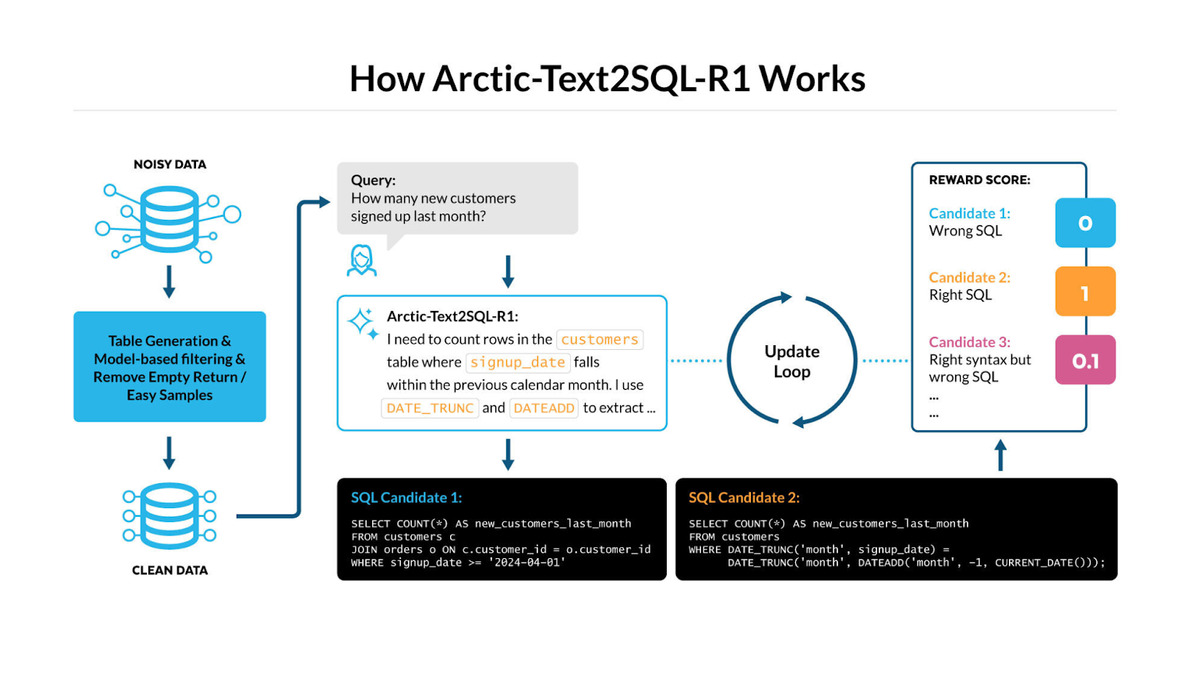 Snowflake's own diagram of the training loop: candidate SQL gets executed, and the reward is 1 for a correct result, 0.1 for syntactically valid but wrong SQL, and 0 for anything that fails to run.
Source: snowflake.com
Snowflake's own diagram of the training loop: candidate SQL gets executed, and the reward is 1 for a correct result, 0.1 for syntactically valid but wrong SQL, and 0 for anything that fails to run.
Source: snowflake.com
Key Capabilities
The core design choice behind Arctic-Text2SQL-R1 is a reward function with exactly three outcomes: 1 point if the produced SQL executes and returns results matching the ground truth, 0.1 points if the SQL is syntactically valid and executable but wrong, and 0 otherwise. Snowflake's researchers found this simple scheme beat the more elaborate multi-component rewards used elsewhere in the literature, which blend execution correctness with syntax scoring, n-gram overlap, and LLM-as-judge assessments. Fewer moving parts meant less reward hacking and more stable GRPO training.
Data curation mattered as much as the reward design. The team stripped roughly 1,400 BIRD and 1,700 Spider examples that had empty result sets or execution times over five seconds, since noisy reward signals from broken examples degrade RL training badly. They also filtered a synthetic dataset (Gretel-Synth) by keeping only examples where at least one of ten model-produced completions was verified correct, discarding the rest. Notably, LLM-based paraphrasing of training questions - a common augmentation trick - produced almost no diversity gain and led to overfitting, so Snowflake dropped it rather than force it into the pipeline.
The practical result is a model that reasons through schema linking and join logic in its own chain-of-thought before emitting SQL, without needing an external agent scaffold to do that work for it. For teams comparing this to broader AI SQL tools that wrap general-purpose LLMs with retrieval and schema-matching layers, Arctic-Text2SQL-R1 pushes more of that reasoning into the weights themselves.
Pricing and Availability
Arctic-Text2SQL-R1-7B is open-weight on Hugging Face under Apache 2.0, with no usage restrictions and no per-query API fee - you pay for the GPU, not the tokens. Community quantizations (GGUF variants down to Q2_K) are already available for running it on consumer hardware.
 Self-hosting the 7B checkpoint means running it on your own GPU infrastructure rather than paying per-token API pricing.
Source: unsplash.com
Self-hosting the 7B checkpoint means running it on your own GPU infrastructure rather than paying per-token API pricing.
Source: unsplash.com
The 14B and 32B checkpoints are a different story. Their benchmark numbers are published in the paper and the engineering blog, but as of this writing, Snowflake hasn't listed public download links for those two sizes on Hugging Face - only the 7B model appears in Snowflake's official model listing. If your evaluation depends specifically on the 32B checkpoint's accuracy, confirm current availability directly rather than assuming it's downloadable; Snowflake may make it available through its own Cortex AI platform rather than as open weights.
For self-hosting the 7B model, expect single-GPU deployment (24GB VRAM comfortably covers it in fp16, less with quantization) and no ongoing API cost beyond compute. That compares favorably against proprietary text-to-SQL wrappers that charge per query on top of the underlying model's token pricing - see our database management tools comparison for what those wrapper products cost. For a broader look at what self-hosting text-to-SQL buys you versus API-based options, our self-hosted open-weight LLMs guide covers the general tradeoffs.
Strengths
- 32B checkpoint posts the best published BIRD execution accuracy of any model Snowflake tested, open or proprietary, at time of release
- Minimal reward design (execution correctness only) trains cleanly with GRPO and generalizes across six different SQL benchmarks
- 7B model beats far larger general-purpose models like GPT-4o and DeepSeek-V3 on average across those benchmarks
- No per-query API cost for the openly released 7B checkpoint - self-hosted inference only
- Apache 2.0 license permits unrestricted commercial use and fine-tuning
Weaknesses
- Only the 7B checkpoint has confirmed public weights; the 14B and 32B numbers can't currently be independently reproduced by third parties
- Spider 2.0-DK scores (15.6-16.3%) show the model struggles on genuinely hard, multi-database enterprise queries, consistent with what the field sees broadly on that benchmark
- Narrow specialization means no general chat, no code review, no non-SQL reasoning - it's a single-purpose tool
- BIRD and Spider have been public long enough that some schema contamination in training data is plausible, a limitation acknowledged across the text-to-SQL research field
What's Next: R1.5 and R2
Snowflake didn't stop at R1. A May 14, 2026 engineering blog post, "Real-Time Text-to-SQL Behind Snowflake Intelligence," introduced Arctic-Text2SQL-R1.5, a version specialized for Snowflake's own SQL dialect rather than generic SQLite-style syntax. On an internal "Snowflake Text-to-SQL HARD" benchmark, R1.5 reached 45% single-turn execution accuracy, ahead of Claude Sonnet 4.5 at 44% and Gemini 2.5 Flash, Claude Haiku 4.5, and GPT-5 Codex all in the 40-41% range. R1.5 now powers the text-to-SQL layer behind Snowflake Intelligence, handling Snowflake-specific quirks like secure functions and QUALIFY clauses that generic models tend to get wrong.
A follow-up post on May 27, 2026, "Arctic-Text2SQL-R2: Beating Frontier Models on Enterprise SQL," claims R2 outperforms Gemini 3.1 Pro, Claude Opus 4.7, and other frontier LLMs on that same HARD benchmark while being, per Snowflake's characterization, 30 to 150 times smaller than the models it's compared against. Snowflake states Qwen3.6, described as the nearest-sized general model, trails R2 by roughly 15 points. I couldn't find an independently verified numeric score for R2 on the HARD benchmark beyond Snowflake's own claim - no third-party reproduction or leaderboard entry was available as of this writing, so treat the R2 comparison as a vendor claim rather than a confirmed result until independent evaluation catches up.
Related Coverage
- Text-to-SQL LLM Leaderboard - full BIRD, Spider 2.0, CoSQL, and SParC rankings
- Data Analysis capability hub - where Arctic-Text2SQL-R1 sits among other SQL and analytics-focused models
- Best AI SQL Tools 2026 - tool-level comparisons of text-to-SQL products
- Best AI Database Management Tools 2026 - database tooling that integrates text-to-SQL
- Best Open-Source LLMs to Self-Host 2026 - where self-hosted specialists like this one fit against general-purpose open weights
Sources:
- Snowflake Engineering Blog - Arctic-Text2SQL-R1 Tops BIRD
- Arctic-Text2SQL-R1: Simple Rewards, Strong Reasoning in Text-to-SQL (arXiv:2505.20315)
- Snowflake/Arctic-Text2SQL-R1-7B on Hugging Face
- snowflakedb/ArcticTraining on GitHub
- Smaller Models, Smarter SQL - Snowflake AI Research on Medium
- VentureBeat - How Snowflake's Open-Source Text-to-SQL and Arctic Inference Models Solve Enterprise AI's Deployment Headaches
- Real-Time Text-to-SQL Behind Snowflake Intelligence
- Arctic-Text2SQL-R2: Beating Frontier Models on Enterprise SQL
- BIRD Benchmark
✓ Last verified July 15, 2026

