
Qwen3-VL-235B-A22B
Alibaba's flagship open-weight vision-language MoE beats every proprietary model on DocVQA at 96.5% and MathVista at 85.8%, but trails GPT-5.4 and Gemini 3.1 Pro on broad MMMU-Pro reasoning.
 9 min read
Qwen3-VL-235B-A22B is the flagship of Alibaba's Qwen3-VL family, and it's the model actually responsible for the "Qwen dominates open-source visual reasoning" line you'll see repeated across benchmark roundups this year. The Qwen team shipped both Instruct and Thinking variants on Hugging Face on September 23, 2025, then followed with a full technical report on arXiv two months later detailing the architecture changes behind the jump.
TL;DR
- Beats every proprietary model we track on DocVQA (96.5%) and MathVista (85.8%), open weight under Apache 2.0
- 235B total parameters, 22B active per token (MoE), 256K native context window, extendable to 1M
- Trails GPT-5.4 (81%) and Gemini 3.1 Pro (82%) by 12-13 points on MMMU-Pro, the harder graduate-level reasoning benchmark
Overview
The number that gets cited most is DocVQA: Qwen3-VL-235B-A22B posts 96.5% in Thinking mode, according to the official benchmark tables Alibaba published on GitHub. That's the highest confirmed score of any model on our own vision-language benchmarks leaderboard, open or closed. It also leads MathVista at 85.8%, a benchmark measuring math reasoning over charts, geometry diagrams, and statistical tables, ahead of GPT-5's 81.3% as reported in the same comparison set.
Architecturally, this is a Mixture-of-Experts model: 235 billion parameters total, but only 22 billion active per forward pass, paired with a vision encoder that processes images at native resolution rather than forcing them into fixed tiles. Three specific upgrades separate it from the previous generation. DeepStack injects visual features from multiple layers of the vision transformer into corresponding layers of the language model, instead of only feeding in the final-layer output. Interleaved-MRoPE spreads positional information more evenly across time, height, and width, which matters for video. And text-based timestamp alignment replaces the older T-RoPE scheme, letting the model reference "at 47 seconds" directly in its output rather than inferring position from relative frame order.
It's worth being precise about what "beats every proprietary model" actually means here, because the comparisons in Alibaba's own technical report are against Gemini 2.5 Pro, GPT-5 (high effort), and Claude Opus 4.1, the frontier models available when the report was written in November 2025. Both GPT-5.4 and Gemini 3.1 Pro have since shipped, and on MMMU-Pro specifically, a benchmark testing broad multi-discipline graduate-level reasoning rather than document extraction, both newer models now lead by a wide margin. The document and chart lead holds up; the general-reasoning gap has actually widened since the paper was published.
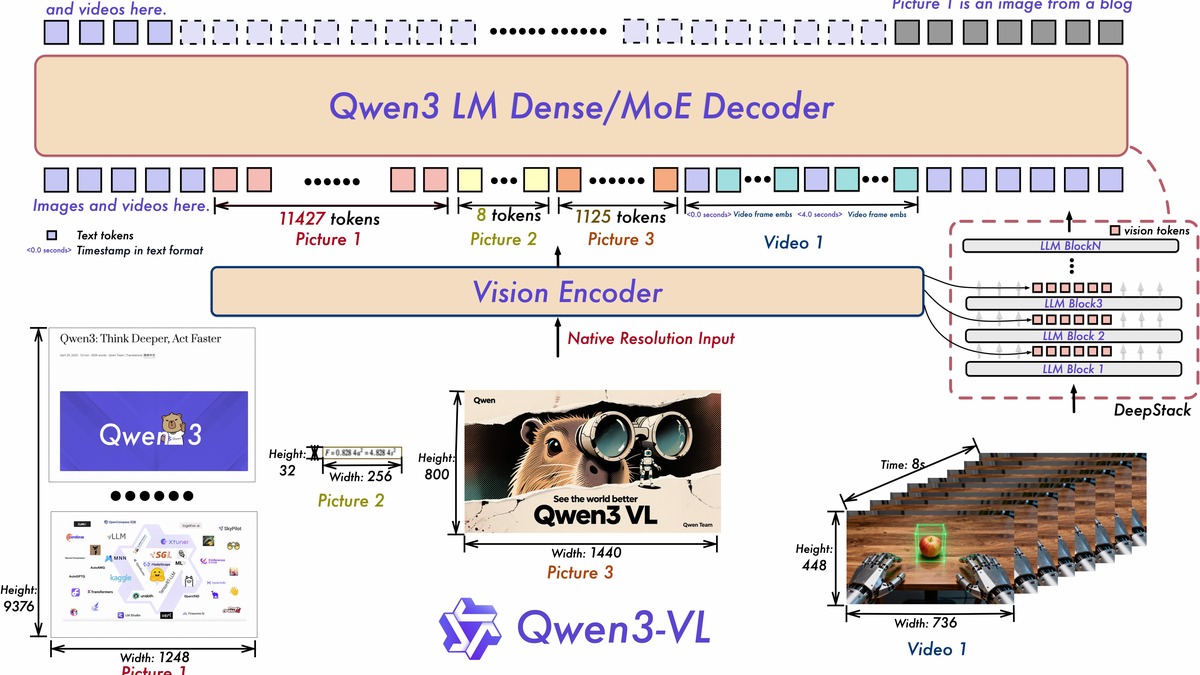 Official architecture diagram: the vision encoder tokenizes images and video at native resolution, DeepStack fuses features from multiple encoder layers into the LLM decoder, and interleaved-MRoPE handles spatial-temporal alignment.
Source: github.com
Official architecture diagram: the vision encoder tokenizes images and video at native resolution, DeepStack fuses features from multiple encoder layers into the LLM decoder, and interleaved-MRoPE handles spatial-temporal alignment.
Source: github.com
Key Specifications
| Specification | Details |
|---|---|
| Provider | Alibaba Cloud (Qwen team) |
| Model Family | Qwen3-VL |
| Architecture | Mixture-of-Experts LLM backbone + native-resolution ViT with DeepStack fusion |
| Parameters | 235B total, 22B active per token |
| Context Window | 256,000 tokens native (text, image, video interleaved); extendable to 1M |
| Input Modalities | Text, image, video |
| Output Modalities | Text, structured output (JSON, bounding boxes) |
| Input Price | $0.20/M tokens (OpenRouter, Instruct); $0.40/M tokens (DashScope, Thinking) |
| Output Price | $0.88/M tokens (OpenRouter, Instruct); $4.00/M tokens (DashScope, Thinking) |
| Release Date | September 23, 2025 |
| License | Apache 2.0 (open weight, no usage cap) |
Two editions ship for this size: Instruct, a standard chat-tuned model, and Thinking, which reasons through a chain of thought before answering. That's a meaningful license upgrade over the family's own predecessor. Qwen2.5-VL-72B shipped under a custom Qwen license capped at 100 million monthly active users; Qwen3-VL-235B-A22B is plain Apache 2.0, no cap, no attribution clause.
Benchmark Performance
| Benchmark | Qwen3-VL-235B-A22B (Thinking) | Qwen2.5-VL-72B | GPT-5.4 | Gemini 3.1 Pro |
|---|---|---|---|---|
| DocVQA | 96.5% | 96.4% | 95% | 92% |
| MathVista (mini) | 85.8% | 74.8% | 78.4% | - |
| MMMU-Pro | 69.3% | - | 81% | 82% |
| OCRBench (/1000) | 875 | 885 | - | - |
Scores for Qwen3-VL-235B-A22B come from Alibaba's own published tables; GPT-5.4 and Gemini 3.1 Pro figures are pulled from our vision-language benchmarks leaderboard, which tracks the current generation independently. Cells marked "-" point to no verified public score.
Two things stand out. First, the OCRBench row is a genuine surprise: the plain Instruct variant actually scores 920 on OCRBench, ahead of both the Thinking variant shown here (875) and Qwen2.5-VL-72B (885). Chain-of-thought reasoning helps math and chart questions, evident in the 11-point MathVision jump between Instruct (66.5) and Thinking (74.6) reported in the same tables, but it doesn't help raw character recognition, and on this particular benchmark it modestly hurts. That's a useful data point if your workload is pure OCR rather than document reasoning: skip the Thinking variant and save the extra tokens.
Second, the MMMU-Pro gap is the real ceiling. Qwen3-VL-235B-A22B's 69.3% sits well below GPT-5.4 and Gemini 3.1 Pro's 81-82%, and this isn't a benchmark quirk. MMMU-Pro spans 30 academic subjects with 10-option answers specifically designed to punish pattern-matching over reasoning, and the closed frontier models still hold a clear edge there. Alibaba doesn't report a ChartQA score for this generation either, unlike Qwen2.5-VL-72B's 89.5%, opting instead for CharXiv, where Qwen3-VL-235B-A22B-Thinking scores 66.1% on the reasoning split against real arXiv chart figures.
Key Capabilities
Long-video understanding is the headline addition over the previous generation. In needle-in-a-haystack testing, the flagship model located target frames with 100% accuracy inside 30-minute videos and held 99.5% accuracy out to two-hour videos, which run close to the model's full 1M-token extended context. The text-based timestamp alignment means it can answer "what happens at the 47-minute mark" directly rather than describing frames in relative order, a capability that matters for anyone building video search or compliance-review tooling rather than just video captioning.
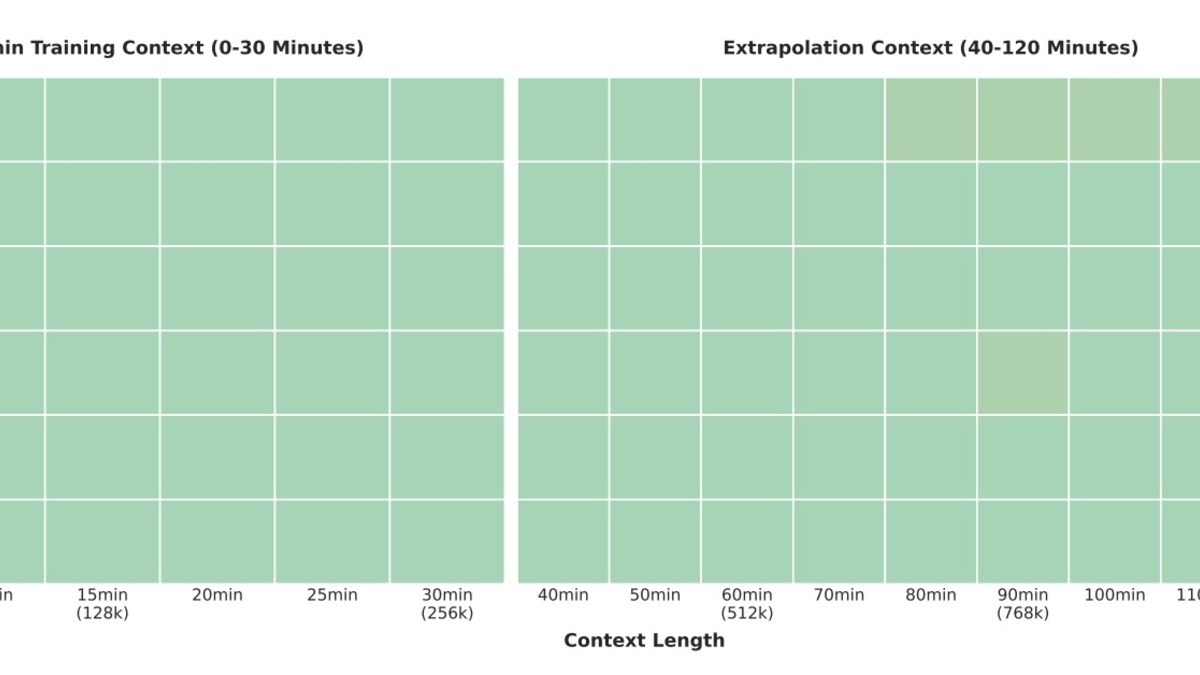 Needle-in-a-haystack accuracy stays at or near 100% from 5 minutes out to 2 hours of video context, with only minor degradation around the 90-minute mark.
Source: the-decoder.com
Needle-in-a-haystack accuracy stays at or near 100% from 5 minutes out to 2 hours of video context, with only minor degradation around the 90-minute mark.
Source: the-decoder.com
Document and OCR work is the other clear strength, and it extends past English. OCRBench testing covers 39 languages, and the model's 96.5% DocVQA and 89.5% InfoVQA scores put it ahead of every closed model on our document understanding coverage and competitive with Qwen2.5-VL-72B on our OCR and Document AI leaderboard, the previous open-weight benchmark leader in this category.
GUI and computer-use agent tasks round out the profile. The Instruct variant scores 95.4% on ScreenSpot (element grounding), 62.0% on the harder ScreenSpot Pro, and 63.7% on AndroidWorld, a full end-to-end mobile agent benchmark. Those numbers make it a plausible perception backbone for computer-use and mobile-automation agents, not just a captioning or Q&A model, in the same category as the agentic tooling we cover in our guide to understanding AI benchmarks.
Pricing and Availability
Weights for both Instruct and Thinking editions are free to download from Hugging Face and ModelScope under Apache 2.0, no monthly-active-user cap and no attribution requirement, a meaningfully cleaner license than the one covering Qwen2.5-VL-72B. Self-hosting is free beyond compute costs, though 235 billion total parameters, even with only 22 billion active, means holding every expert in memory for serving, which puts real hardware behind that "free" label.
For teams that don't want to run their own inference stack, pricing splits by host and by variant. OpenRouter lists the Instruct model at $0.20/M input and $0.88/M output tokens, aggregating third-party hosts like Fireworks and DeepInfra that compete the price down. Alibaba's own DashScope Model Studio, per its official international pricing page, lists the Thinking variant at $0.40/M input and $4.00/M output tokens through its Singapore region, roughly double the input cost and 4.5x the output cost of the aggregated Instruct rate. That gap is standard for a first-party API versus commodity third-party rehosting of an open checkpoint, but it's worth checking both before committing to a provider, especially since output tokens are where Thinking-mode costs compound fastest.
Either way, this remains far cheaper than the proprietary models it benchmarks against. GPT-5.4 lists at $2.50/$15.00 per million tokens and Claude Opus 4.6 at $5.00/$25.00; even DashScope's own Thinking-mode pricing undercuts both by a wide margin on input, though the output gap narrows once you factor in how many tokens a reasoning model burns per response. See our multimodal vision API pricing comparison for the full picture across providers.
Strengths and Weaknesses
Strengths
- Highest verified DocVQA (96.5%) and MathVista (85.8%) scores of any model we track, open or closed
- Apache 2.0 license with no user cap, a clean upgrade over Qwen2.5-VL-72B's capped custom license
- Native 256K context handles 2-hour video with 99.5% needle-in-haystack accuracy
- Strong GUI agent scores (95.4% ScreenSpot, 63.7% AndroidWorld) make it usable as a computer-use perception layer
- Aggressive third-party hosting pricing ($0.20/$0.88 per M tokens on OpenRouter) versus proprietary API rates
Weaknesses
- Trails GPT-5.4 and Gemini 3.1 Pro by 12-13 points on MMMU-Pro, the broad graduate-reasoning benchmark
- No published ChartQA score for this generation, breaking easy comparison with the model it replaced
- Thinking mode underperforms plain Instruct on raw OCRBench, so the "reasoning helps everything" assumption doesn't hold here
- 235B total parameters demands serious multi-GPU infrastructure to self-host despite only 22B active per token
- Official DashScope API pricing runs several times higher than third-party aggregated hosting of the same open weights
Related Coverage
- Best AI for Document Understanding - ranks vision-language models on DocVQA and related benchmarks
- Vision-Language Benchmarks Leaderboard - full rankings across MMMU-Pro, MathVista, DocVQA, and more
- OCR and Document AI Leaderboard 2026 - dedicated document and OCR benchmark comparison
- Qwen2.5-VL-72B-Instruct - the previous open-weight document understanding leader
- Qwen 3 Review - our review of the broader Qwen 3 text model family
- Multimodal Vision API Pricing - cost comparison across vision-language providers
FAQ
Is Qwen3-VL-235B-A22B free to use?
The weights are free under Apache 2.0 with no usage cap. Running it yourself requires substantial GPU infrastructure; hosted access through OpenRouter or DashScope costs $0.20-$0.40 per million input tokens.
Is Qwen3-VL-235B-A22B better than GPT-5.4 for documents?
Yes, on DocVQA specifically (96.5% versus GPT-5.4's 95%). On MMMU-Pro, a broader multi-discipline reasoning benchmark, GPT-5.4 leads by about 12 points.
What's the difference between the Instruct and Thinking variants?
Thinking reasons through a chain of thought before answering, which improves math and chart benchmarks by 6-11 points but slightly underperforms Instruct on raw OCR tasks like OCRBench.
What is the context window?
256,000 tokens natively across interleaved text, images, and video, extendable to 1 million tokens.
Does it support long video?
Yes. It handles up to two hours of video with 99.5% needle-in-haystack retrieval accuracy and can align answers to specific timestamps rather than just describing frames in order.
Sources
- Qwen3-VL Technical Report - arXiv
- QwenLM/Qwen3-VL - Official GitHub Repository and Benchmark Tables
- Qwen3-VL-235B-A22B-Instruct - Hugging Face
- Qwen3 VL 235B A22B Instruct - Pricing - OpenRouter
- Alibaba Cloud Model Studio Pricing
- Qwen3-VL Can Scan Two-Hour Videos and Pinpoint Nearly Every Detail - The Decoder
- Alibaba Releases Qwen3-VL Technical Report Detailing Two-Hour Video Analysis - Unite.AI
✓ Last verified July 22, 2026

