
Qwen2.5-VL-72B-Instruct
Alibaba's dense 72B vision-language model tops the open-weight DocVQA leaderboard at 96.4% and remains the default self-hosted choice for document and chart understanding.
 9 min read
Qwen2.5-VL-72B-Instruct is Alibaba's flagship open-weight vision-language model, and more than a year after release it's still the model people reach for when they need to self-host document understanding at frontier accuracy. The Qwen team published the weights on Hugging Face on January 27, 2025, alongside 7B and 3B siblings, and followed up with a full technical report three weeks later.
TL;DR
- Tops the open-weight DocVQA leaderboard at 96.4%, beating every proprietary API model on that specific benchmark
- 72B dense parameters, 32K native context (128K via YaRN), Qwen license (free below 100M MAU)
- Self-hosted inference runs roughly $0.25/$0.75 per million tokens on aggregated hosting versus $3-5/M+ for comparable proprietary vision APIs
Overview
The 72B is the largest of three Qwen2.5-VL sizes (3B, 7B, 72B) and the one Alibaba positions as matching GPT-4o and Claude 3.5 Sonnet on visual understanding. That claim holds up unevenly - it's genuinely ahead on document parsing and OCR-heavy tasks, roughly at parity on general visual QA, and behind on some pure reasoning benchmarks - but the headline number that matters for practitioners is DocVQA: Qwen2.5-VL-72B posts 96.4%, the highest score of any model tracked on llm-stats.com's DocVQA leaderboard, open or closed. Our own document understanding coverage and OCR and Document AI leaderboard both rank it as the top open-weight option in the category.
Architecturally, it's a dense (non-MoE) transformer pairing a redesigned Vision Transformer encoder with the Qwen2.5 language model backbone. The vision encoder was trained from scratch to handle native dynamic resolution - images are processed at their actual pixel dimensions rather than being force-resized into a fixed grid - and window attention keeps the compute cost manageable at that resolution. An upgraded multimodal RoPE (mRoPE) implementation adds absolute time alignment, which is what lets the model reason about "when" something happens across a long video rather than just "what" is in a given frame.
It shipped into a market that, in January 2025, still treated open-weight vision models as a tier below GPT-4o and Claude 3 for anything beyond basic image captioning. Qwen2.5-VL-72B was one of the first open checkpoints to close that gap on document-specific tasks specifically, which is why it still shows up as the reference open-weight VLM in comparisons like our best open-weights models roundup, more than a year and several Qwen VL generations later.
Key Specifications
| Specification | Details |
|---|---|
| Provider | Alibaba Cloud (Qwen team) |
| Model Family | Qwen2.5-VL |
| Architecture | Dense transformer with native dynamic-resolution ViT + mRoPE |
| Parameters | 72B |
| Context Window | 32,768 tokens native; extends to 128K with YaRN (used by most API hosts) |
| Input Modalities | Text, image, video |
| Output Modalities | Text (including structured JSON, bounding boxes) |
| Input Price | $0.25/M tokens (OpenRouter); free to self-host |
| Output Price | $0.75/M tokens (OpenRouter); free to self-host |
| Release Date | January 27, 2025 |
| License | Qwen license (custom; free below 100M MAU, "Built with Qwen" attribution required) |
The vision encoder in this generation is a genuine rebuild, not a bolt-on. Earlier Qwen-VL releases resized every image to a fixed set of resolutions before encoding; Qwen2.5-VL processes images at native resolution and maps each one to a variable number of visual tokens, which is why the model handles everything from a phone screenshot to a full magazine spread without the usual downsampling artifacts that hurt small-text OCR.
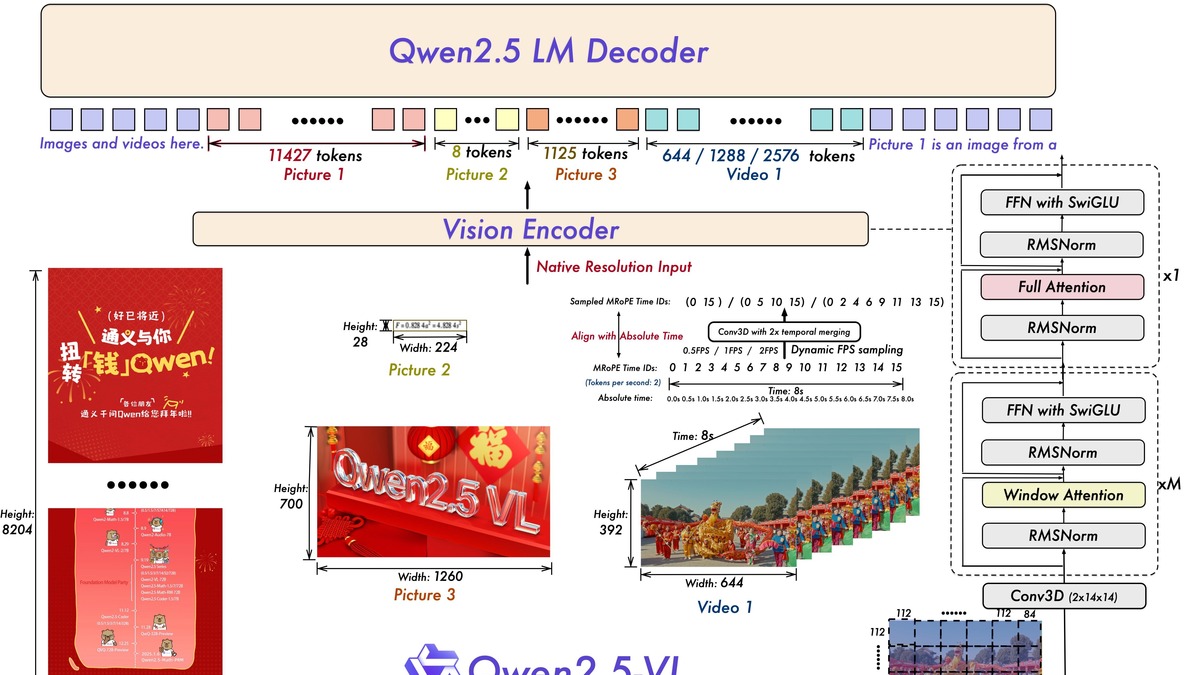 Official architecture diagram: native-resolution ViT with window attention feeds the Qwen2.5 LM decoder, while mRoPE aligns visual tokens to absolute time for video understanding.
Source: qwenlm.github.io
Official architecture diagram: native-resolution ViT with window attention feeds the Qwen2.5 LM decoder, while mRoPE aligns visual tokens to absolute time for video understanding.
Source: qwenlm.github.io
Benchmark Performance
| Benchmark | Qwen2.5-VL-72B | GPT-4o | Claude 3.5 Sonnet | Llama 4 Maverick |
|---|---|---|---|---|
| DocVQA | 96.4 | 92.8 | 95.2 | 94.4 |
| OCRBench (/1000) | 885 | - | - | - |
| ChartQA | 89.5 | - | - | - |
| MMMU (val) | 70.2 | 69.1 | 68.3 | - |
| MathVista (mini) | 74.8 | - | - | 73.7 |
Scores are as reported in the Qwen2.5-VL Technical Report and the model's Hugging Face card; GPT-4o and Claude 3.5 Sonnet figures are independently reported contemporary comparisons, and Llama 4 Maverick numbers come from its own model page. Cells marked "-" indicate no verified public score was found for that pairing.
The pattern across these numbers is consistent: Qwen2.5-VL-72B's advantage is concentrated in document-heavy tasks - DocVQA, OCRBench, ChartQA - where dense text and structured layout dominate the input. On MMMU, a broader academic visual-reasoning benchmark that leans less on OCR and more on multi-step reasoning across STEM subjects, it's essentially tied with GPT-4o and Claude 3.5 Sonnet rather than clearly ahead. That's the honest read on the "matches GPT-4o" claim: true for document parsing, roughly true for general visual QA, not obviously true for hard multi-step visual reasoning.
Our OCR and Document AI leaderboard tracks a slightly different snapshot of these same benchmarks (OCRBench 877, DocVQA 96.1%) sourced from a broader independent evaluation pass rather than the vendor's own reported numbers - the small deltas are normal given how much eval configuration (resolution settings, prompt format, few-shot vs zero-shot) affects VLM scores run-to-run.
Key Capabilities
Document parsing is the standout use case, and it goes well beyond plain OCR. The model outputs structured data - key-value pairs from invoices, cell-level table extraction, layout-aware reading order for multi-column PDFs - directly as JSON, which removes a whole post-processing step that plain OCR-then-parse pipelines still need. On scanned textbook pages, financial reports, and forms with embedded stamps or handwriting, it holds up noticeably better than models that were never specifically trained on document layouts.
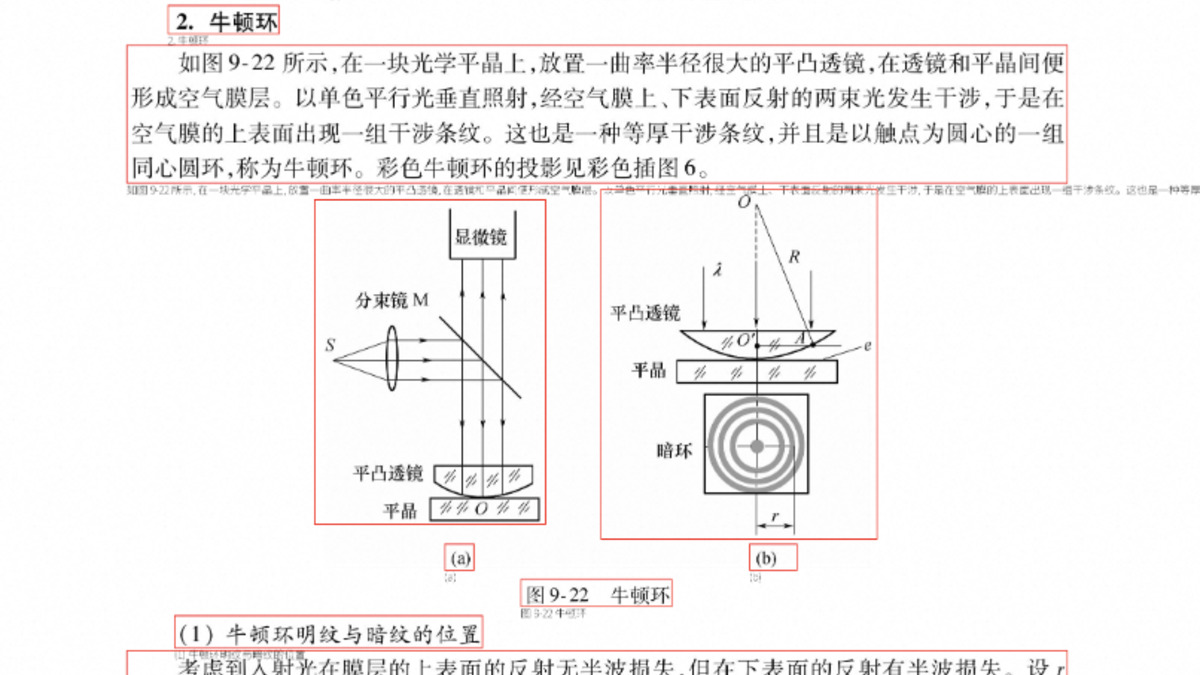 Example document parsing output: the model identifies and separates text blocks, diagrams, and mathematical notation on a dense textbook page rather than treating the page as one undifferentiated image.
Source: qwenlm.github.io
Example document parsing output: the model identifies and separates text blocks, diagrams, and mathematical notation on a dense textbook page rather than treating the page as one undifferentiated image.
Source: qwenlm.github.io
Visual grounding is the second capability worth calling out. The model can return bounding boxes and points for objects it identifies, in stable JSON format, which makes it usable as the perception layer for computer-use and phone-use agents rather than just a captioning tool. Combined with long-video support (native handling of hour-plus footage via dynamic FPS sampling and absolute time encoding), that grounding ability extends to timestamped event localization in video, not just static images. Our guide to vision model resolution limits covers how its configurable min_pixels/max_pixels parameters compare to the fixed tiling schemes used by other vision APIs - Qwen2.5-VL gives you the most direct control of any mainstream VLM over the resolution/token tradeoff.
Pricing and Availability
The core value proposition is that Qwen2.5-VL-72B is free to run under the Qwen license as long as your product stays under 100 million monthly active users - above that threshold you need a separate commercial license from Alibaba. For teams without the hardware to self-host a 72B-parameter model (practically speaking, four A100/H100-class GPUs or equivalent), it's also available through aggregated hosts: OpenRouter lists it at $0.25/M input and $0.75/M output tokens with a 128K context window (extended from the native 32K via YaRN), and it's also served by Fireworks, Together, and DeepInfra at broadly similar rates. Alibaba Cloud's own DashScope Model Studio also exposes the model under its international and China-region API endpoints, though headline API pricing there's not consistently published in English and varies by region.
At those hosted rates, Qwen2.5-VL-72B is dramatically cheaper than the proprietary vision APIs it benchmarks against - both GPT-4o and Claude 3.5 Sonnet list at several times the per-token price for comparable image workloads. The tradeoff is operational: you're either managing your own inference stack or trusting a third-party host with your documents, whereas the closed APIs are a single account and a rate limit away.
One standout downstream effect: Jina AI's v4 embedding model is built on top of Qwen2.5-VL, and because that base model carries the Qwen license rather than a fully permissive one, Jina had to ship v4 under a research-only license and rate-limit its own API as a result - a good illustration of how the license terms here propagate into anything built on top of the checkpoint.
Strengths and Weaknesses
Strengths
- Highest verified DocVQA score of any model, open or closed, at 96.4%
- Native dynamic resolution avoids the downsampling artifacts that hurt small-text OCR in fixed-tiling vision models
- Structured JSON output for tables, key-value pairs, and bounding boxes reduces post-processing work
- Truly free to self-host for most commercial deployments (under 100M MAU)
- Strong long-video understanding via dynamic FPS sampling and absolute time-aligned mRoPE
Weaknesses
- Roughly a year old at this point; newer Qwen3-VL and other 2026-era open VLMs have since matched or exceeded it on several benchmarks
- 32K native context window is thin by 2026 standards; the common 128K figure quoted by hosts depends on YaRN extension, not the model's trained context
- Qwen license isn't a standard permissive license (Apache 2.0/MIT) - the 100M MAU cap and attribution requirement are real constraints for some commercial users
- 72B dense parameter count means serious hardware requirements for self-hosting versus MoE alternatives with similar quality at lower active-parameter cost
- Falls behind on general multi-step visual reasoning (MMMU) relative to its document-task lead
Related Coverage
- Best AI for Document Understanding - ranks it the top open-weight model on DocVQA
- OCR and Document AI Leaderboard 2026 - full benchmark comparison against hosted and open models
- Best Open-Weights AI Models 2026 - names it the dominant open VLM pick
- AI Vision Image Resolution Limits - compares its configurable resolution handling to other vision APIs
- Embedding Models Pricing - covers Jina v4, which is built on this model's weights
FAQ
Is Qwen2.5-VL-72B-Instruct free to use?
Yes, the weights are free to download and self-host under the Qwen license, which permits commercial use for products under 100 million monthly active users. Above that, a separate license from Alibaba is required.
Is Qwen2.5-VL-72B better than GPT-4o for documents?
On DocVQA specifically, yes - it scores 96.4% versus GPT-4o's 92.8%. On broader visual reasoning benchmarks like MMMU, the two are roughly tied.
What hardware do I need to self-host it?
Practically, four A100 or H100-class GPUs (or equivalent VRAM via quantization) for reasonable throughput at full precision. Quantized versions reduce that requirement markedly.
What is the context window?
32,768 tokens natively. Most hosted providers (OpenRouter, Fireworks) extend this to 128K using YaRN, a length-extrapolation technique, rather than the model's original training context.
Does it support video?
Yes. It handles long-form video via dynamic FPS sampling and an mRoPE implementation aligned to absolute time, allowing it to localize specific events within footage rather than just describing frames.
Sources
✓ Last verified July 22, 2026

