
Muse Spark 1.1
Meta's second Muse model ships a public API at $1.25/$4.25 per million tokens, a 1M-token context window, and the top score on Meta's own tool-use benchmarks.
 10 min read
Overview
Muse Spark 1.1 is Meta Superintelligence Labs' second model release, and the first to ship with a public API. Meta launched it on July 9, 2026, exactly three months after Muse Spark debuted as the lab's first proprietary frontier model. Where the original Spark was a consumer-only release with no programmatic access, 1.1 flips that: it targets agentic coding, computer use, and tool orchestration, and it's available to developers through the new Meta Model API in public preview.
TL;DR
- Best-in-class on Meta's own tool-use benchmarks (MCP Atlas 88.1, JobBench 54.7), but a step behind on pure coding
- 1M-token actively managed context, $1.25/$4.25 per million input/output tokens, $20 free credit for new accounts
- Meta Model API is US-only in public preview; everywhere else joins a waitlist
Mark Zuckerberg announced the release on X - his first post there in three years - calling it "a strong agentic and coding model at a very low price." That framing matters more than usual marketing copy, because it's an honest description of where Muse Spark 1.1 sits in the market: not a peak-quality contender against Claude Opus 4.8 or GPT-5.5, but a materially cheaper model built specifically for agents that click through interfaces, call tools, and coordinate other agents. The pricing undercuts most frontier competitors by 4x or more, and the benchmark mix Meta chose to publish reflects the bet: agentic and tool-use categories where Muse Spark 1.1 leads, and coding categories where it trails.
Alexandr Wang, Meta's Chief AI Officer since the company's $14.3 billion investment in his startup Scale AI, called it "our strongest model yet for agentic and coding work" in his own announcement post. The release lands with Muse Image, giving Meta Superintelligence Labs three product lines in the span of a few months - a pace that signals Zuckerberg's AI spending is starting to produce a public API business, not just consumer chatbot features.
Key Specifications
| Specification | Details |
|---|---|
| Provider | Meta (Meta Superintelligence Labs) |
| Model Family | Muse |
| Parameters | Not disclosed |
| Context Window | 1,000,000 tokens, actively managed |
| Input Price | $1.25 per million tokens |
| Output Price | $4.25 per million tokens |
| Release Date | July 9, 2026 |
| License | Proprietary |
| Open Source | No |
| Input Modalities | Text, image, video, PDF documents |
| Output Modalities | Text |
| API Compatibility | OpenAI and Anthropic SDK-compatible |
| API Availability | Meta Model API, public preview, US-only at launch |
Benchmark Performance
Meta published its own comparison table against Muse Spark 1.0, Claude Opus 4.8, Gemini 3.1 Pro, and GPT-5.5, split across agent, coding, and multimodal categories. The pattern is consistent: Muse Spark 1.1 wins agentic tool-use benchmarks outright and lands mid-pack on coding and vision.
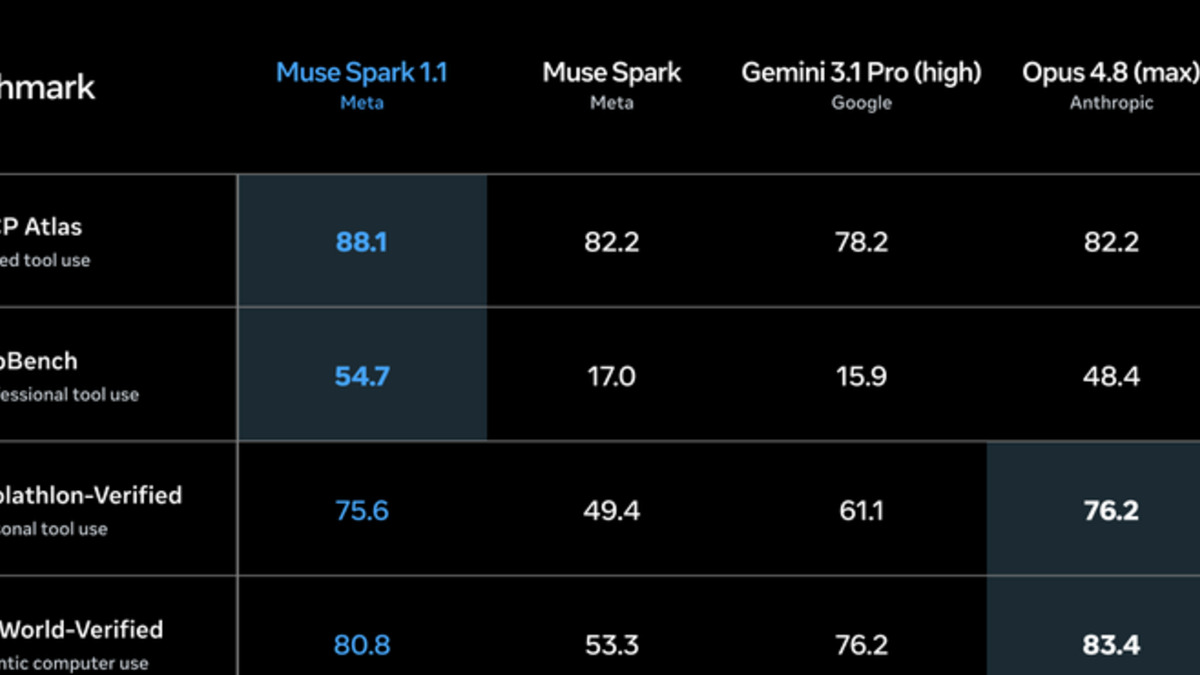 Meta's published agent benchmark scores for Muse Spark 1.1 against the original Muse Spark, Gemini 3.1 Pro, Opus 4.8, and GPT-5.5.
Source: ai.meta.com
Meta's published agent benchmark scores for Muse Spark 1.1 against the original Muse Spark, Gemini 3.1 Pro, Opus 4.8, and GPT-5.5.
Source: ai.meta.com
Agent and Tool Use
| Benchmark | Muse Spark 1.1 | Muse Spark (1.0) | Opus 4.8 | GPT-5.5 | Gemini 3.1 Pro |
|---|---|---|---|---|---|
| MCP Atlas (scaled tool use) | 88.1 | 82.2 | 82.2 | 75.3 | 78.2 |
| JobBench (professional tool use) | 54.7 | 17.0 | 48.4 | 38.3 | 15.9 |
| Humanity's Last Exam (w/ tools) | 62.1 | 50.4 | 57.9 | 52.2 | 51.4 |
| Finance Agent v2 | 57.2 | - | 53.9 | 51.8 | 43.0 |
| Toolathlon-Verified | 75.6 | 49.4 | 76.2 | 73.5 | 61.1 |
| OSWorld-Verified (computer use) | 80.8 | 53.3 | 83.4 | 78.7 | 76.2 |
Coding and Multimodal
| Benchmark | Muse Spark 1.1 | Muse Spark (1.0) | Opus 4.8 | GPT-5.5 | Gemini 3.1 Pro |
|---|---|---|---|---|---|
| Terminal-Bench 2.1 | 80.0 | 67.3 | 82.7 | 83.4 | 70.3 |
| SWE-Bench Pro | 61.5 | 55.0 | 69.2 | 58.6 | 54.2 |
| DeepSWE 1.1 | 53.3 | 10.0 | 59.0 | 67.0 | 12.0 |
| CharXiv Reasoning | 88.4 | 88.9 | 89.9 | 84.8 | 81.6 |
| BabyVision (visual reasoning) | 76.3 | 39.9 | 81.2 | 83.6 | 51.5 |
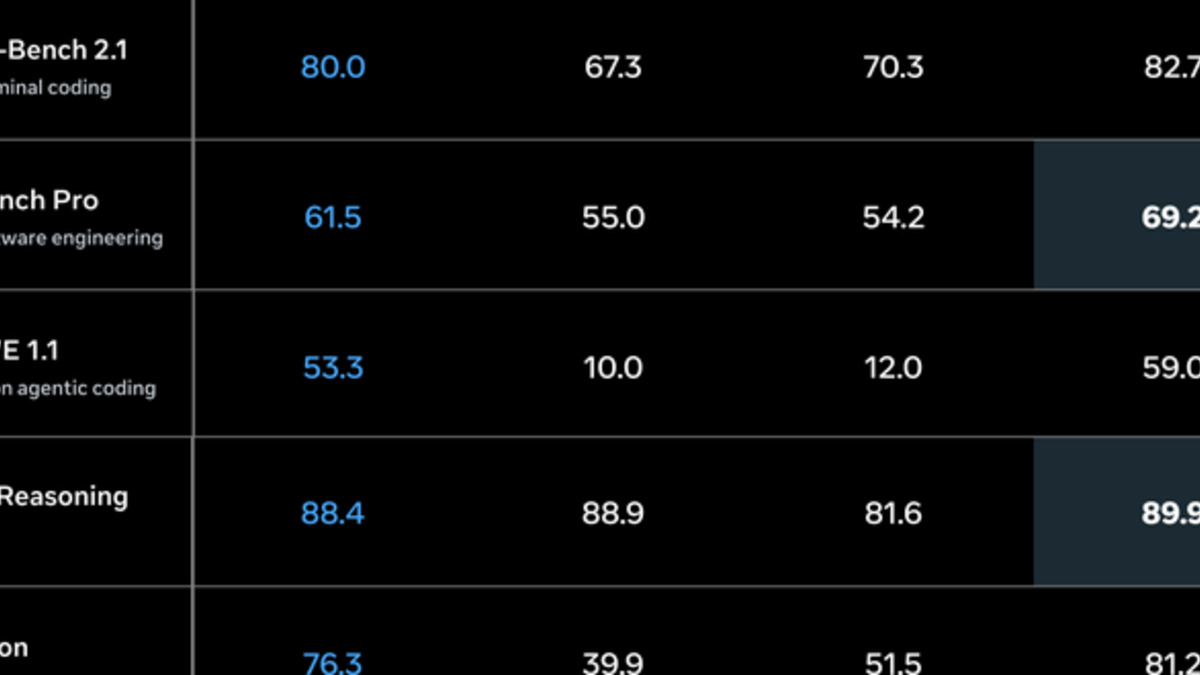 Meta's published coding and multimodal scores: Muse Spark 1.1 trails Opus 4.8 and GPT-5.5 on every row in this section.
Source: ai.meta.com
Meta's published coding and multimodal scores: Muse Spark 1.1 trails Opus 4.8 and GPT-5.5 on every row in this section.
Source: ai.meta.com
The agent-benchmark wins are the headline, and they're not marginal - a 54.7 on JobBench against Opus 4.8's 48.4 and GPT-5.5's 38.3 is a real gap, and JobBench aims to mimic actual professional workflows rather than synthetic tool-calling tests. The jump from the original Muse Spark is even starker: 1.0 scored 17.0 on JobBench and 10.0 on DeepSWE 1.1, numbers that made it barely usable as an agent. Whatever Meta restructured in the agentic training pipeline between April and July produced a truly different model, not a gradual patch.
Coding tells a different story. Terminal-Bench 2.1 at 80.0 trails GPT-5.5's 83.4, and SWE-Bench Pro at 61.5 sits nearly eight points behind Opus 4.8's 69.2 - a gap that matters on the SWE-Bench leaderboard since Pro is the harder, multi-file-patch subset. Independent tracking from the AI research newsletter circuit puts Muse Spark 1.1 further back still against models Meta didn't include in its own comparison: one third-party aggregation had it at 61.5 on SWE-Bench Pro against 64.6 for GPT-5.6 Sol, 64.7 for Grok 4.5, and roughly 80% for Claude Fable 5 - a fifteen-point spread on the hardest public coding benchmark that Meta's own launch materials don't surface. Every number in the tables above comes from Meta's own evaluation harness; treat the coding comparisons as directional until independent labs publish their own runs on the Terminal-Bench leaderboard.
One additional data point undercuts the "mid-pack" reading somewhat: against Kimi K3, a third-party comparison put Muse Spark 1.1's blended agentic score well behind Moonshot's open-weight flagship (91.2 vs 59 on agentic tasks specifically), while Muse Spark 1.1 held its own on tool-use and health-professional categories. The takeaway across all these comparisons is the same: Muse Spark 1.1 is a specialist, not a generalist frontier model, and it should be evaluated against the specific workload rather than an aggregate leaderboard position.
Key Capabilities
Muse Spark 1.1's defining feature is its dual role as orchestrator and subagent. As the main agent, it gathers context, builds a plan, and delegates execution across parallel subagents to cut end-to-end latency on complex tasks. As a subagent, it stays within its assigned scope, understands the tools it's been given, and escalates back to the main agent when it hits something outside its remit. That's architecturally similar to how Grok 4.5 and other agent-oriented models approach multi-agent decomposition, though Meta's implementation is built into the base model's training rather than layered on through a separate orchestration framework.
The model zero-shot generalizes to new tools without fine-tuning - native tools, MCP servers, and custom skills all work without integration-specific training. Parallel tool calling, structured output, a Files API, and prompt caching round out the API surface, and the whole thing is OpenAI and Anthropic SDK-compatible via base-URL configuration. Simon Willison shipped a plugin for his llm CLI tool the same afternoon Meta released the model - a fast turnaround that reflects how low the integration bar is. In his testing, Willison counted roughly 16 built-in tools exposed through the API, including a Python interpreter with pandas, numpy, and OpenCV, web search, image generation, and visual grounding with bounding-box and count outputs, and compared the overall experience favorably to Claude's Artifacts ecosystem.
"Meta is clearly building for serious agentic coding - strong tool use at a price point that makes it viable to run real coding workloads at scale." - Saoud Rizwan, CEO of Cline
Computer use is the other major push. The model chooses between writing automation scripts and direct interface interaction depending on which is faster for a given step, and it maintains context across extended sessions as conditions change mid-task - Meta's own example has the model placing a dinner order across multiple apps, then adapting when new information arrives partway through. On OSWorld-Verified, the standard benchmark for this category, Muse Spark 1.1 scores 80.8, trailing Opus 4.8's 83.4 but well ahead of the 53.3 the original Muse Spark managed on the same test.
The 1M-token context window is actively managed rather than passively stored: the model summarizes earlier steps, retrieves information from much earlier in a session, and compacts context to preserve what later work will actually need. That distinction matters for anyone running long agentic sessions - a raw context ceiling is a different capability from a model that reliably remembers the right five things from three hundred steps ago.
Pricing and Availability
Muse Spark 1.1 costs $1.25 per million input tokens and $4.25 per million output tokens through the Meta Model API, with $20 in free credit for new accounts (a one-time allocation, not recurring). That pricing sits above budget models like Claude Haiku 4.5 but well below Opus-tier and GPT-5.5-tier per-token rates - Meta is positioning this as a mid-tier price for what it claims is a near-frontier agentic capability.
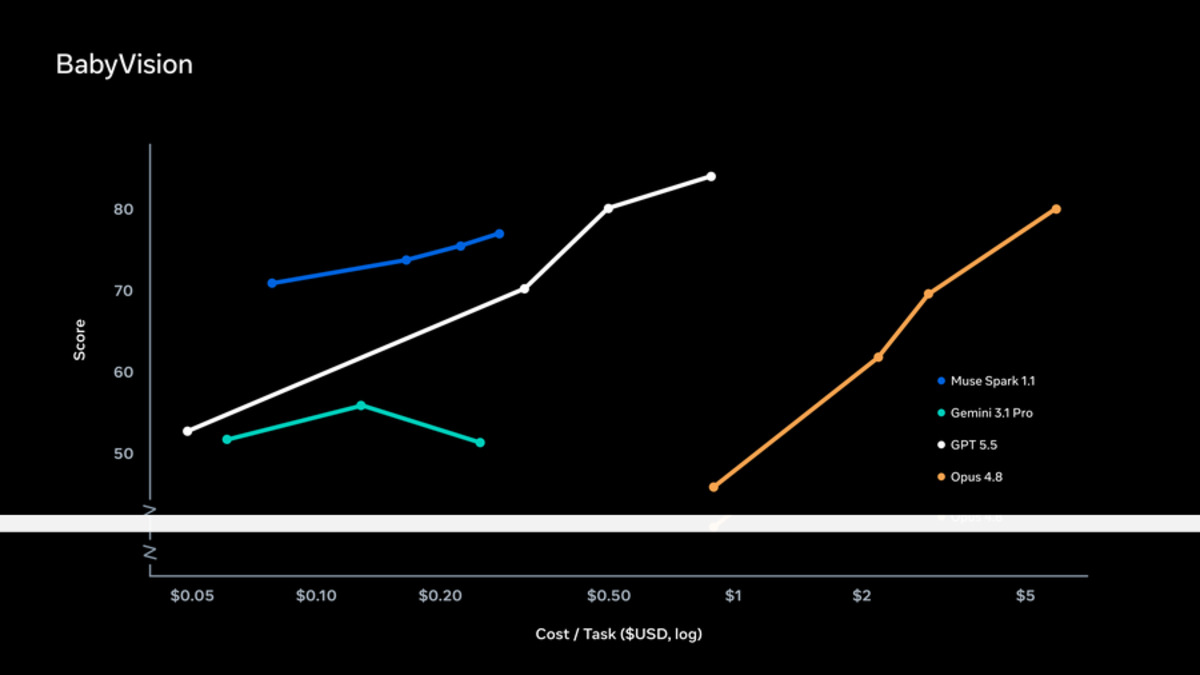 Meta's cost-efficiency framing: Muse Spark 1.1 (blue) achieves BabyVision scores in the 70s at a fraction of the per-task cost of Opus 4.8 (orange) or GPT-5.5 (white).
Source: ai.meta.com
Meta's cost-efficiency framing: Muse Spark 1.1 (blue) achieves BabyVision scores in the 70s at a fraction of the per-task cost of Opus 4.8 (orange) or GPT-5.5 (white).
Source: ai.meta.com
That chart is Meta's central pricing argument, and it's a reasonable one on its own terms: score-per-dollar rather than score-in-isolation. Whether it holds for a specific workload depends completely on whether that workload looks more like JobBench (where Muse Spark 1.1 leads) or SWE-Bench Pro (where it doesn't).
The public preview is currently restricted to developers in the United States; everyone else joins a waitlist with no announced timeline for expansion, including the EU. Free access continues through "Thinking" mode in the Meta AI app and at meta.ai, unchanged from the original Muse Spark's consumer availability. For anyone tracking total cost against output quality on real coding tasks, the coding benchmarks leaderboard is the place to watch as independent evaluations replace Meta's self-selected comparison set.
Strengths and Weaknesses
Strengths
- Leads Meta's own comparison set on tool-use and agentic benchmarks - MCP Atlas (88.1), JobBench (54.7), Humanity's Last Exam with tools (62.1)
- First Muse-series model with public, developer-facing API access
- 1M-token context with active compaction, not just a larger passive window
- Aggressive pricing at $1.25/$4.25 per million tokens, roughly a quarter of top-tier competitor rates
- OpenAI and Anthropic SDK-compatible, minimizing integration friction
- Dramatic improvement over the original Muse Spark on every agentic and coding benchmark Meta published
Weaknesses
- Trails Claude Opus 4.8 and GPT-5.5 on hard coding benchmarks (SWE-Bench Pro, Terminal-Bench 2.1, DeepSWE 1.1)
- Independent third-party benchmarks (outside Meta's chosen comparison set) show a wider coding gap against GPT-5.6 Sol, Grok 4.5, and Claude Fable 5
- Public API preview is US-only; international developers wait on an unannounced timeline
- Most published benchmarks come from Meta's own evaluation harness, not independent labs
- Still text-only output, no native image or audio generation
- Parameter count and architecture details remain undisclosed
FAQ
Is Muse Spark 1.1 the same model as Muse Spark?
No. Muse Spark 1.1 is a separate, later release from July 9, 2026, three months after the original Muse Spark shipped in April. It's a sizable retrain focused on agentic tool use, computer use, and coding, and it added the first public API for the Muse series.
Does Muse Spark 1.1 have a public API?
Yes. The Meta Model API launched in public preview alongside Muse Spark 1.1, priced at $1.25 per million input tokens and $4.25 per million output tokens. Access is currently limited to developers in the United States; other regions join a waitlist.
Is Muse Spark 1.1 better than Claude Opus 4.8 or GPT-5.5 at coding?
Not on Meta's own numbers. It trails both on SWE-Bench Pro, Terminal-Bench 2.1, and DeepSWE 1.1. It leads both on agentic tool-use benchmarks like MCP Atlas and JobBench, which measure a different skill than patching code.
Is Muse Spark 1.1 open source?
No. Like the original Muse Spark, it's proprietary and closed-weight. Meta has said it plans to open-source future Muse series models, but no timeline has been confirmed for either version.
How big is the context window?
1 million tokens, up from 262,000 in the original Muse Spark. Meta describes it as actively managed rather than passively stored - the model compacts and retrieves context rather than just holding it all in a fixed window.
Related Coverage
- Meta Opens Muse Spark 1.1 API for Agentic Coding - our launch coverage
- Muse Spark - the April 2026 predecessor this model replaces for developer use cases
- Meta Muse Spark Launches, Ranks 4th Among Frontier Models - background on the original Spark release
- Coding Benchmarks Leaderboard - where Muse Spark 1.1 fits on SWE-Bench and Terminal-Bench
- Terminal-Bench Leaderboard - full CLI agent rankings including Terminal-Bench 2.1
- SWE-Bench Coding Agent Leaderboard - SWE-Bench Pro and Verified rankings across models
Sources:
- Introducing Muse Spark 1.1 - Meta AI Blog
- Meta enters the crowded AI coding battle with Muse Spark 1.1 - TechCrunch
- Introducing Muse Spark 1.1 - Simon Willison
- Meta releases latest update of AI model Muse Spark - Fortune
- Meta Announces Muse Spark 1.1, Beats Claude Opus 4.8 And GPT 5.5 On Some Benchmarks - OfficeChai
- Meta Superintelligence Labs Releases Muse Spark 1.1 - MarkTechPost
- Meta jumps into AI coding market to chase Anthropic and OpenAI - CNBC
- The July 2026 Frontier: Muse Spark 1.1, GPT-5.6 Sol, Fable 5, Grok 4.5 - Ken Huang
- Mark Zuckerberg announcement post - X
✓ Last verified July 29, 2026

