
Muse Glimmer
Meta's 30B open-weight agentic model distilled from Muse Spark runs on a single consumer GPU, ships under Apache 2.0, and leads Gemma4-31B and Qwen3.6-27B on 5 of 8 agentic benchmarks.
 9 min read
Overview
Meta Superintelligence Labs shipped Muse Glimmer on August 10, 2026, and it reverses a call the lab made just four months earlier. When Muse Spark launched in April, Meta treated it as a closed, proprietary frontier model with no public weights. Glimmer is the opposite bet: a 30-billion-parameter dense model, distilled from Muse Spark, released under Apache 2.0 with full weights on Hugging Face, built specifically to run on a single consumer GPU rather than a data center.
TL;DR
- Distilled 30B agentic model that runs locally on a 24-32GB consumer GPU, beating Gemma 4 31B and Qwen3.6-27B on 5 of 8 agentic benchmarks
- 131,072+ token context, Apache 2.0 license, quantized GGUF variants fit under 20GB versus 55GB+ at full precision
- Meta also announced an open-weight release of Muse Spark 1.2 "in the coming weeks" - Glimmer is the model that actually shipped today
Chief AI Officer Alexandr Wang announced the release with Mark Zuckerberg, who used the moment to publish a roughly 6,500-word essay titled "The Future Is for Everyone," arguing that restricting open-weight AI in the US risks ceding ground to Chinese labs. Wang's own framing was narrower and more useful for evaluating the model itself: Glimmer runs on 24GB of VRAM "without losing agentic reliability," a claim this page checks against Meta's published numbers below. The model targets a specific niche Meta had mostly ceded to Qwen and Gemma: a dense, local-first model built for multi-step tool use, not chat.
Muse Glimmer's training pipeline is itself remarkable. Meta describes a three-phase process: logit distillation from Muse Spark during pretraining, agent-heavy long-context data during mid-training, and a post-training mix of on-policy distillation plus reinforcement learning. That's a smaller model inheriting a larger one's judgment rather than being trained from scratch, similar in spirit to how Qwen3.6-27B outscored its own 397B predecessor on agentic coding.
Key Specifications
| Specification | Details |
|---|---|
| Provider | Meta (Meta Superintelligence Labs) |
| Model Family | Muse |
| Architecture | Dense causal transformer with dedicated perception encoder |
| Parameters | ~29.6B total (27.8B language model + ~1.8B ViT-G/14 vision encoder) |
| Layers | 52 |
| Hidden Dimension | 6,656 |
| Attention Pattern | [Local, Local, Local, Global] repeating, 2,048-token sliding window on local layers |
| Attention Heads | 32 query / 2 KV heads (16:1 GQA), head dim 128 |
| FFN | SwiGLU, 19,968 intermediate dimension |
| Vocabulary | 202,048 tokens (200K BPE + 2,048 special) |
| Context Window | 131,072+ tokens |
| Knowledge Cutoff | January 4, 2026 |
| Modalities | Input: text + image; Output: text |
| Release Date | August 10, 2026 |
| License | Apache 2.0 |
Benchmark Performance
Meta compared Muse Glimmer directly against Gemma 4 31B and Qwen3.6-27B, the two open-weight models closest to it in size and positioning. All three numbers below come from Meta's own evaluation harness unless noted.
| Benchmark | Muse Glimmer | Gemma4-31B | Qwen3.6-27B |
|---|---|---|---|
| MCP Atlas (tool use) | 75.5 | 54.2 | 62.5 |
| DeepSearch QA | 74.6 | 61.7 | 71.1 |
| AIME 2026 | 94.7 | 89.2 | 94.1 |
| AA-LCR | 80.0 | 68.3 | Not reported |
| GPQA Diamond | 83.5 | 85.7 | 84.2 |
| Charxiv Reasoning | 78.8 | 77.7 | 78.4 |
| SWE-Bench Verified | 76.0 | Not reported | 77.2 |
| SWE-Bench Pro | 51.2 | 36.9 | Not reported |
| Terminal-Bench 2.1 | 51.7 | Not reported | 60.7 |
| OSWorld-Verified | 65.9 | Not reported | 75.6 |
Meta's own summary is that Glimmer leads on 5 of 8 published general-agentic benchmarks against these two competitors, and the pattern in the table backs that up with a caveat. The margin on MCP Atlas (75.5 vs 54.2 for Gemma 4) is the widest gap in the entire comparison, and it's the benchmark Meta built its agentic pitch around. AIME 2026 at 94.7 edges out Qwen3.6-27B's 94.1, a genuinely close race at the top of math reasoning for this size class.
The trade-offs show up in the categories that involve extended tool sessions rather than single-shot tool calls. Terminal-Bench 2.1 (51.7 vs Qwen's 60.7) and OSWorld-Verified (65.9 vs Qwen's 75.6) both favor Qwen3.6-27B by wide margins, and SWE-Bench Verified is a near-tie that Qwen edges by 1.2 points. GPQA Diamond also goes to Gemma 4. Read together, Glimmer is the stronger pick for scoped tool-calling and search-style agent tasks, and the weaker one once a task runs long inside a terminal or a full desktop environment. See the open-source LLM leaderboard for how these three stack up against the wider open-weight field.
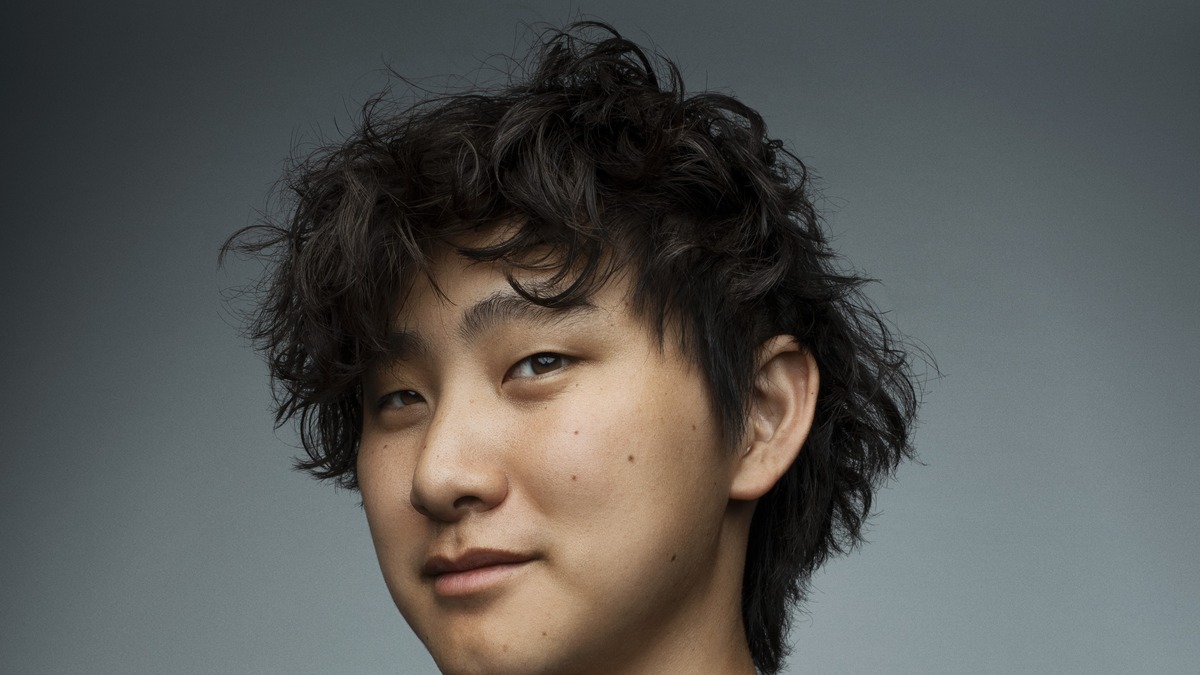 Alexandr Wang, Meta's Chief AI Officer since the company's Scale AI investment, led the Muse Glimmer announcement.
Source: commons.wikimedia.org
Alexandr Wang, Meta's Chief AI Officer since the company's Scale AI investment, led the Muse Glimmer announcement.
Source: commons.wikimedia.org
Key Capabilities
Glimmer's headline feature is that all of the above runs without a network call. Meta built it for "always-on local agent workflows" - multi-step reasoning, tool calling against precise schemas, multimodal understanding through the built-in perception encoder, and failure recovery, packaged into a single model that stays entirely on-device. That distinguishes it from most agent-oriented releases this size, which normally assume an API round-trip for the reasoning-heavy parts of a task even when the tools themselves run locally.
The perception encoder is a genuine architectural addition, not a bolted-on adapter. It's a 50-layer, 1536-width ViT-G/14 vision transformer at roughly 1.8B parameters, handling up to 4,096 visual tokens per image. Combined with the 131K+ context window, that's enough to keep a coding agent's screenshots, terminal output, and file diffs in the same working memory across a long session, which matters more for agentic workflows than raw token count alone.
Inference speed on local hardware is the other engineering story here. Glimmer ships with a DFlash speculative decoding "drafter" model that proposes whole blocks of tokens instead of creating one at a time. On an RTX 5090, Meta reports the drafter taking throughput from 74.9 to 233 tokens per second, a 3.1x speedup. Apple Silicon gains are smaller but still meaningful: 1.8x on an M5 Max (topping 50 t/s) and 1.5x on an M4 Max (38 t/s). Meta verified all three platforms directly rather than only publishing simulated numbers, which is worth noting given how often local-inference claims go unverified on real hardware.
Pricing and Availability
There's no per-token pricing because there's no API to buy tokens from. Weights are free to download from Hugging Face under Apache 2.0, with no usage restrictions on commercial deployment, fine-tuning, or redistribution. That's a meaningfully more permissive license than Llama 4 Maverick shipped under, and it puts Glimmer in the same licensing tier as Gemma 4 and the Qwen 3.6 family.
Meta published three weight formats at launch: the base BF16 checkpoint, GGUF k-quants for llama.cpp-based runtimes, and an ExecuTorch PTE build for mobile and edge deployment. Two GGUF variants ship specifically for consumer hardware: a dynamic k-quant for high-VRAM setups and a 17GB build sized to fit comfortably inside a 24GB card. Full BF16 precision needs 55GB or more; the quantized path drops that under 20GB, which is what makes the "single consumer GPU" claim hold up rather than requiring a workstation card. An unofficial Unsloth GGUF mirror is already live alongside Meta's own quantized repo.
Runtime support was broad on day one: Ollama, LM Studio, and Unsloth for local use, llama.cpp, ExecuTorch, and MLX for edge deployment, and vLLM and SGLang for serving Glimmer at scale. Together AI, Fireworks AI, and OpenRouter are listed as launch-day hosted-inference partners for anyone who wants Glimmer's behavior without managing local weights.
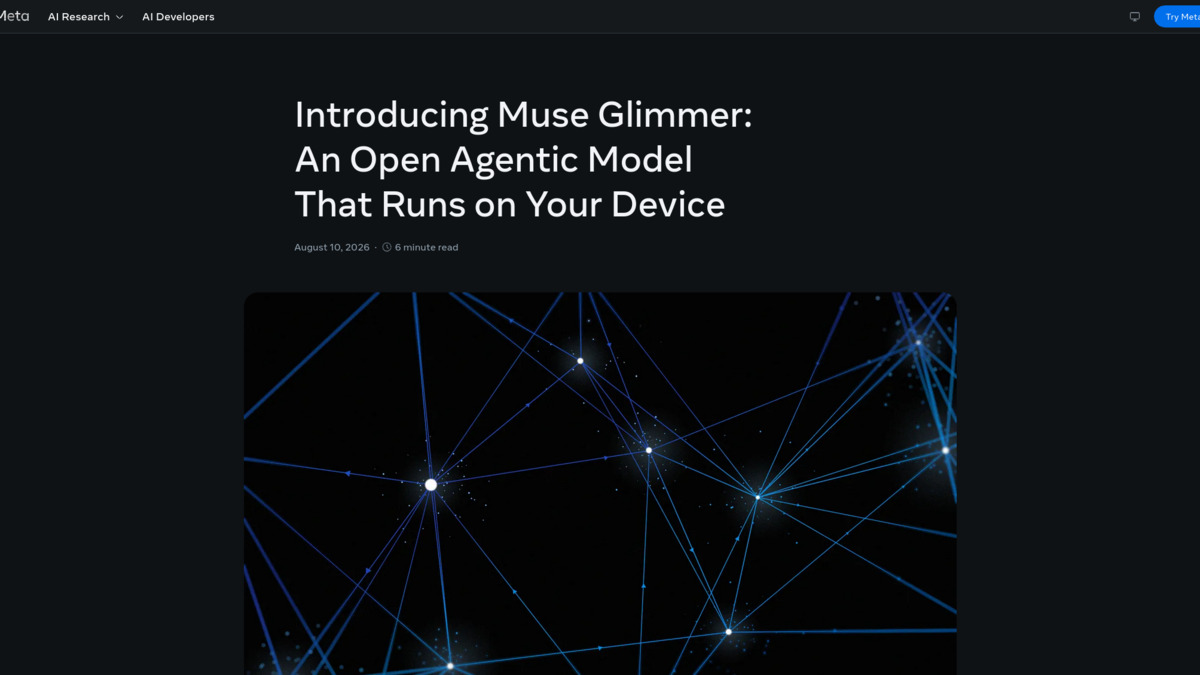 Meta Superintelligence Labs' official announcement blog for Muse Glimmer.
Source: research.meta.ai
Meta Superintelligence Labs' official announcement blog for Muse Glimmer.
Source: research.meta.ai
Strengths and Weaknesses
Strengths
- Leads Gemma4-31B and Qwen3.6-27B on 5 of 8 published agentic benchmarks, with a wide margin on MCP Atlas (75.5 vs 54.2 and 62.5)
- Apache 2.0 license with no commercial restrictions, distilled from a genuine frontier model rather than trained from scratch
- Runs on a single consumer GPU: under 20GB quantized versus 55GB+ at full precision, verified on RTX 5090, M5 Max, and M4 Max
- DFlash speculative decoding delivers a verified 3.1x throughput gain on RTX 5090
- Built-in 1.8B-parameter perception encoder for multimodal input, not a bolted-on adapter
- Broad day-one runtime support across Ollama, LM Studio, llama.cpp, vLLM, SGLang, and three hosted-inference partners
Weaknesses
- Trails Qwen3.6-27B clearly on extended-session agentic tasks: Terminal-Bench 2.1 (51.7 vs 60.7) and OSWorld-Verified (65.9 vs 75.6)
- GPQA Diamond goes to Gemma4-31B (85.7 vs 83.5), so it isn't a clean sweep on reasoning either
- No hosted first-party API from Meta; anyone who doesn't want to self-host depends on third-party providers
- Text-only output despite multimodal input - no native image or audio generation
- Benchmark comparisons come from Meta's own harness; independent reproduction hadn't landed as of this writing
FAQ
Is Muse Glimmer open source?
Yes. Meta released full weights under Apache 2.0 on Hugging Face, with no restrictions on commercial use, fine-tuning, or redistribution, with GGUF and ExecuTorch quantized builds.
Can Muse Glimmer run on a single GPU?
Yes. Quantized to roughly 4-bit precision, the model fits under 20GB of VRAM, within a 24-32GB consumer GPU envelope. Meta verified this on an RTX 5090 and on Apple M5 Max and M4 Max systems.
Is Muse Glimmer related to Muse Spark?
Yes. Glimmer is distilled from Muse Spark using logit distillation during pretraining, followed by agent-focused mid-training and a reinforcement-learning post-training stage. It's a compressed, locally-deployable derivative, not a separate model line.
Is Muse Glimmer better than Qwen3.6-27B or Gemma4-31B?
It depends on the task. Glimmer leads on tool-use benchmarks like MCP Atlas and on AIME 2026 math reasoning. Qwen3.6-27B leads on extended terminal and desktop-control tasks (Terminal-Bench 2.1, OSWorld-Verified) and edges it on SWE-Bench Verified. Gemma4-31B leads on GPQA Diamond.
Will Meta open-source Muse Spark 1.2?
Meta says it plans to release open weights for Muse Spark 1.2 "in the coming weeks," announced alongside the Glimmer launch. As of August 10, 2026, only the announcement has shipped; the weights, license terms, and hardware requirements for Spark 1.2 aren't yet public.
Related Coverage
- Muse Glimmer Review: Fast, Free, Not Flawless - our hands-on review
- Meta Open-Sources Muse Glimmer for Local AI Agents - our launch coverage
- Muse Spark - the closed frontier model Glimmer distills from
- Muse Spark 1.1 - Meta's API-enabled agentic model from July 2026
- Muse Spark Review: Strong on Health, Weak on Code - our hands-on review of the parent model
- Google Gemma 4 - closest open-weight competitor on reasoning benchmarks
- Qwen3.6-27B - closest open-weight competitor on extended agentic tasks
- Open-Source LLM Leaderboard - full open-weight model rankings
Sources:
- Introducing Muse Glimmer: An Open Agentic Model That Runs on Your Device - Meta AI Research
- meta-models/Muse-Glimmer-30B - Hugging Face
- meta-models/Muse-Glimmer-30B-GGUF - Hugging Face
- unsloth/Muse-Glimmer-30B-GGUF - Hugging Face
- Meta Publishes Muse Glimmer As 30B Open Agentic Model - Phoronix
- Meta's Releases Muse Glimmer Local Model, Beats Google's Gemma4-31B On Most Benchmarks - OfficeChai
- Meta Muse Glimmer brings local AI agents to consumer GPUs - AI News
- Meta launches new AI model Muse Glimmer as Zuckerberg urges U.S. to remove barriers to open-source AI - Tech Startups
- Alexandr Wang announcement post - X
✓ Last verified August 10, 2026

