
MAI-Image-2-Efficient
Microsoft's production-focused image generation model - 41% cheaper and 22% faster than MAI-Image-2, optimized for high-volume enterprise workflows.
 Updated
7 min read
Updated
7 min read
Microsoft released MAI-Image-2-Efficient on April 14, 2026, twelve days after the original MAI-Image-2 launch - the company's first in-house image generation model after renegotiating its OpenAI partnership. Where the flagship targets precision work, Efficient targets throughput: the same foundational architecture, 22% faster generation, 4x better GPU use per H100, and a 41% cut in output token pricing. The math is straightforward - if you're producing hundreds of product shots a day and absolute photorealistic depth isn't the priority, Efficient gets you there at meaningfully lower cost.
TL;DR
- Best for high-volume image workflows (e-commerce, marketing assets, UI mockups) where speed beats perfection
- $5.00/M input, $19.50/M image output - 41% cheaper than MAI-Image-2; 22% faster; 4x GPU throughput
- MAI-Image-2 family ranks #3 on Arena.ai behind Gemini 3.1 Flash and GPT Image family; strong text rendering, square output only
The model runs on Microsoft's MAIA 200 inference chips with no OpenAI infrastructure anywhere in the stack - a point Microsoft's communications made explicit. It's the second model in a family architecture that positions MAI-Image-2 for precision work (smoother tonal transitions, photorealistic depth) and MAI-Image-2-Efficient for "assembly line" generation: product photography, UI mockups, branded assets, real-time creative experiences inside chatbots or design tools.
Our full review of the MAI model family covers all three models released April 2 - the image model, MAI-Transcribe-1, and MAI-Voice-1. This page focuses specifically on the Efficient variant and what it means for teams evaluating image generation APIs at scale.
Key Specifications
| Specification | Details |
|---|---|
| Provider | Microsoft |
| Model Family | MAI |
| Parameters | Not disclosed (10B-50B estimated) |
| Architecture | Diffusion-based with flow-matching loss |
| Max Resolution | 1024 x 1024 pixels |
| Output Format | Square (1:1) only |
| Text Input | Up to 32K tokens |
| Input Price | $5.00 per 1M tokens |
| Output Price | $19.50 per 1M image tokens |
| Training Period | January - March 2026 |
| Release Date | April 14, 2026 |
| License | Proprietary |
| Runs On | Microsoft MAIA 200 chips |
Benchmark Performance
Benchmarking image generation models is messier than text models - Arena.ai uses human preference votes rather than objective metrics, and different providers define "latency" differently. With that caveat, here's what the numbers show:
| Metric | MAI-Image-2-Efficient | MAI-Image-2 | GPT Image 2 | FLUX.2 Pro |
|---|---|---|---|---|
| Arena.ai Rank | #3 (family) | #3 (family) | #1-2 (family) | Top 5 |
| P50 Render Time | 13.70s | 17.50s | 41.41s (High) | Not published |
| GPU Throughput | 4x vs MAI-Image-2 (H100) | 1x baseline | Not disclosed | Not disclosed |
| Text Rendering | Strong (same as MAI-Image-2) | +115 pts vs MAI-Image-1 | Strong | Moderate |
| Max Resolution | 1024 x 1024 | 1024 x 1024 | 2048 x 2048 | 2000 x 2000 |
| Output Price | $19.50/M tokens | $33.00/M tokens | $30.00/M tokens | ~$30/M equiv |
The render times come from Microsoft's own benchmark data at p50 median across standardized prompts. MAI-Image-2-Efficient hits 13.70 seconds, down from 17.50 seconds for MAI-Image-2. For reference, Gemini 3.1 Flash Image clocks 19.68 seconds and GPT-Image-1.5 High comes in at 41.41 seconds - making Efficient roughly 30% faster than Gemini Flash and 3x faster than GPT-Image-1.5 High in this specific test.
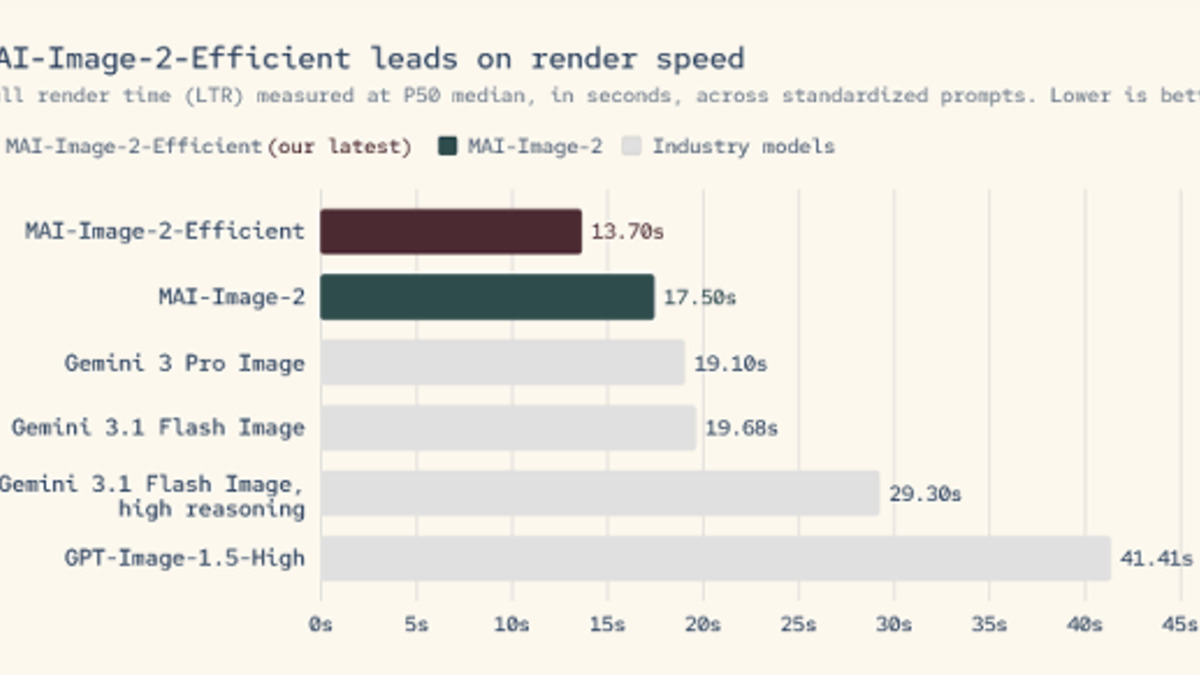 P50 render times in seconds across standardized prompts. MAI-Image-2-Efficient leads at 13.70s vs MAI-Image-2 at 17.50s and GPT-Image-1.5-High at 41.41s (lower is better).
Source: gigazine.net
P50 render times in seconds across standardized prompts. MAI-Image-2-Efficient leads at 13.70s vs MAI-Image-2 at 17.50s and GPT-Image-1.5-High at 41.41s (lower is better).
Source: gigazine.net
The family-level Arena.ai #3 ranking (behind Google's Gemini 3.1 Flash and OpenAI's GPT Image family) reflects the original MAI-Image-2 votes - the Efficient variant doesn't have enough independent vote history yet to separate out. Expect the ranking to shift as more comparisons build up, likely landing slightly lower than the flagship given the quality trade-off at ~85% parity. For current rankings, see our image generation leaderboard.
Visual Characteristics
Microsoft's own documentation draws a clear line between the two tiers. MAI-Image-2 produces "smoother, more nuanced contrast" suited to photorealistic depth and fine tonal gradients. MAI-Image-2-Efficient renders with "sharpness and defined lines" - better for illustration, animation, and marketing graphics where clean edges matter more than subtle light modeling. Neither is objectively superior; the choice depends on the output category.
Key Capabilities
High-Volume Production Workflows
 E-commerce product shoot produced by MAI-Image-2: multiple angles, consistent lighting, and clean texture detail across a single product session.
Source: microsoft.ai
E-commerce product shoot produced by MAI-Image-2: multiple angles, consistent lighting, and clean texture detail across a single product session.
Source: microsoft.ai
MAI-Image-2-Efficient was designed around e-commerce product photography, marketing creative generation, and internal asset pipelines. At $19.50 per million image output tokens, a team producing 10,000 product images per month (at roughly 300 tokens per 1024x1024 image) is looking at around $58 in output costs. That's well inside the per-image costs that dominated image generation pricing before API models became standard.
Microsoft claims 4x GPU throughput efficiency normalized by latency on NVIDIA H100 hardware at 1024x1024 resolution. That figure matters for enterprise customers buying dedicated inference capacity through Azure - fewer chips needed to hit the same throughput target means lower infrastructure spend, not just API spend.
Real-Time Creative Experiences
The "sharpness and defined lines" rendering characteristic makes Efficient a better fit for conversational creative tools than the flagship - chatbot interfaces where users iterate quickly benefit from the crisper output style. Microsoft is already rolling the model into Copilot and Bing Image Creator, and a PowerPoint integration is confirmed as upcoming. The API is available immediately through Microsoft Foundry.
Text Rendering
One of the persistent weak spots in image generation - rendering readable text inside images - is where the MAI family has invested visibly. MAI-Image-2 logged a +115 point improvement over MAI-Image-1 in text rendering evaluations. Efficient inherits the same text rendering stack, so brands creating infographics, signage, or any image with typography should see the same gains. This is a genuine differentiator against FLUX.2 Pro, which still struggles with in-image text at longer strings.
Pricing and Availability
MAI-Image-2-Efficient is available immediately with no waitlist, no preview period, and no approval process through two channels:
- Microsoft Foundry - API access for developers, enterprise customers, and existing Azure tenants
- MAI Playground - browser-based testing interface, US and select markets; EU availability coming soon
Pricing sits at $5.00 per million input tokens and $19.50 per million image output tokens. The input token price matches MAI-Image-2 exactly; the 41% reduction is completely on the output side, which is where the volume cost builds up in high-throughput workflows.
For comparison, GPT Image 2 charges $8.00 per million image input tokens and $30.00 per million output tokens - GPT Image's pricing bundles vision input separately. FLUX.2 Pro uses a per-image model at $0.03 per megapixel output, which translates to roughly $30 per million effective tokens at 1MP images. Efficient undercuts both on output cost.
Rate Limits and UI Constraints
The native UI (MAI Playground, Copilot, Bing Image Creator) ships with constraints that don't apply to Foundry API access:
- 30-second cooldown between generations in the UI
- 15-image daily cap in native interfaces
- 1:1 square output only (no portrait, landscape, or custom aspect ratios)
- No image-to-image, inpainting, or outpainting support
Enterprise customers accessing through Foundry get different rate limits based on their Azure tier. The aspect ratio restriction is the most significant operational constraint - it requires downstream cropping or compositing for any non-square output. Microsoft hasn't announced a timeline for non-square support.
Strengths and Weaknesses
Strengths
- 41% cheaper output tokens than MAI-Image-2 with ~85% quality parity
- 4x GPU throughput efficiency on H100 - measurable infrastructure cost savings for Azure deployments
- Strong in-image text rendering, better than FLUX.2 Pro at labels, headlines, and branded copy
- Immediate API availability through Foundry with no waitlist
- Deep Microsoft 365 and Azure ecosystem integration (Copilot, PowerPoint, Bing)
- Clean, sharp rendering style suited to marketing and UI assets
Weaknesses
- Square output only - no aspect ratio flexibility
- Maximum 1024x1024 resolution - GPT Image 2 and FLUX.2 Pro both go to 2K+
- No image-to-image, inpainting, or outpainting
- Arena.ai ranking reflects family average, not Efficient-specific votes
- EU availability lagging; enterprise compliance checks may add friction
- Content filtering reported as aggressive in early testing
Related Coverage
- Microsoft MAI Models: Voice, Speech and Image Reviewed - Full hands-on review of all three MAI models
- Microsoft MAI Models Signal Clearest OpenAI Break Yet - News coverage of the initial launch
- AI Image Generation Leaderboard - Where MAI-Image-2 sits against Midjourney, FLUX, GPT Image, and others
- Image Generation Capabilities Guide - Benchmark breakdown across use cases
Sources
- MAI-Image-2-Efficient announcement - Microsoft AI
- Microsoft releases a more efficient image generation model - Thurrott
- MAI-Image-2-Efficient - 41% cheaper and 22% faster - The Outpost
- MAI-Image-2-Efficient accelerates move away from OpenAI - SiliconAngle
- MAI-Image-2 Model Card - Microsoft AI
- MAI-Image-2 Arena ranking vs real-world limits - WinBuzzer
- Microsoft MAI-Image-2 review - Windows News
- Three new MAI models - TechCrunch
Last updated
✓ Last verified May 5, 2026

