
Ling-3.0-flash
InclusionAI's Ling-3.0-flash packs 124B parameters into a 5.1B-active hybrid-linear MoE that Ant Group claims matches its 1T flagship - but shipped with zero independently verifiable benchmark numbers.
 8 min read
InclusionAI, Ant Group's open-source AI lab, released Ling-3.0-flash today with a specific claim: a model at one-eighth the total size and roughly one-twelfth the active compute of the company's own trillion-parameter flagship that "matches or beats" it on most benchmarks shown. That's a bold efficiency claim from a lab that has shipped MIT-licensed, truly competitive open-weight models before - Ling-1T and Ling-2.6-flash among them. It's also a claim that, as of publication, comes with almost no way to independently check it.
TL;DR
- 124B total parameters, ~5.1B active per token, hybrid-linear MoE attention - built for high-volume agentic workloads, not raw benchmark chasing
- 262,144-token native context (256K), extendable to 1M; free API access through August 3, 2026 via Novita, Vercel AI Gateway, ZenMux, and OpenRouter
- InclusionAI claims parity with its own 1T-parameter flagship, but published no numeric benchmark table, technical report, or downloadable model card at launch - the claim is currently unverifiable
Overview
Ling-3.0-flash is the latest entry in InclusionAI's Ling series, the efficiency-focused sibling line to Ant Group's reasoning-heavy Ring models. The pitch, per the @AntLingAGI launch thread, is straightforward: "Today, we're releasing Ling-3.0-flash - a hybrid-reasoning MoE model built for production-scale agents. 124B parameters. Just 5.1B active per token. With 1/8 of the total and 1/12 of the active parameters, it matches or beats our 1T flagship model on most benchmarks shown."
That framing places Ling-3.0-flash squarely against the same problem Qwen3.5-35B-A3B and GLM-4.7-Flash are chasing - frontier-adjacent capability from a fraction of the compute a dense flagship needs, cheap enough to run at agent-scale where one task can burn through dozens of tool calls. InclusionAI's predecessor, Ling-2.6-flash, did this at 104B total / 7.4B active with a 1:7 MLA-to-Lightning-Linear attention mix. Ling-3.0-flash pushes further: more total parameters (124B), fewer active ones (5.1B), and - per the thread's follow-up post - a switch to "native hybrid-linear attention: KDA and MLA layers stacked 5:1," with roughly 1/64 of experts active per token.
The catch: InclusionAI shipped this through inference-provider integrations (Novita, Vercel, ZenMux, OpenRouter) before publishing a model card, technical report, or public Hugging Face repository. The Hugging Face page for inclusionAI/Ling-3.0-flash currently returns an authorization error instead of a public model card - a state predecessors like Ling-1T and Ling-2.6-flash never had. Independent observer @TeksEdge flagged this directly: "A mysterious new @TheInclusionAI model appears to have quietly gone live today... But they have not yet published details about the model."
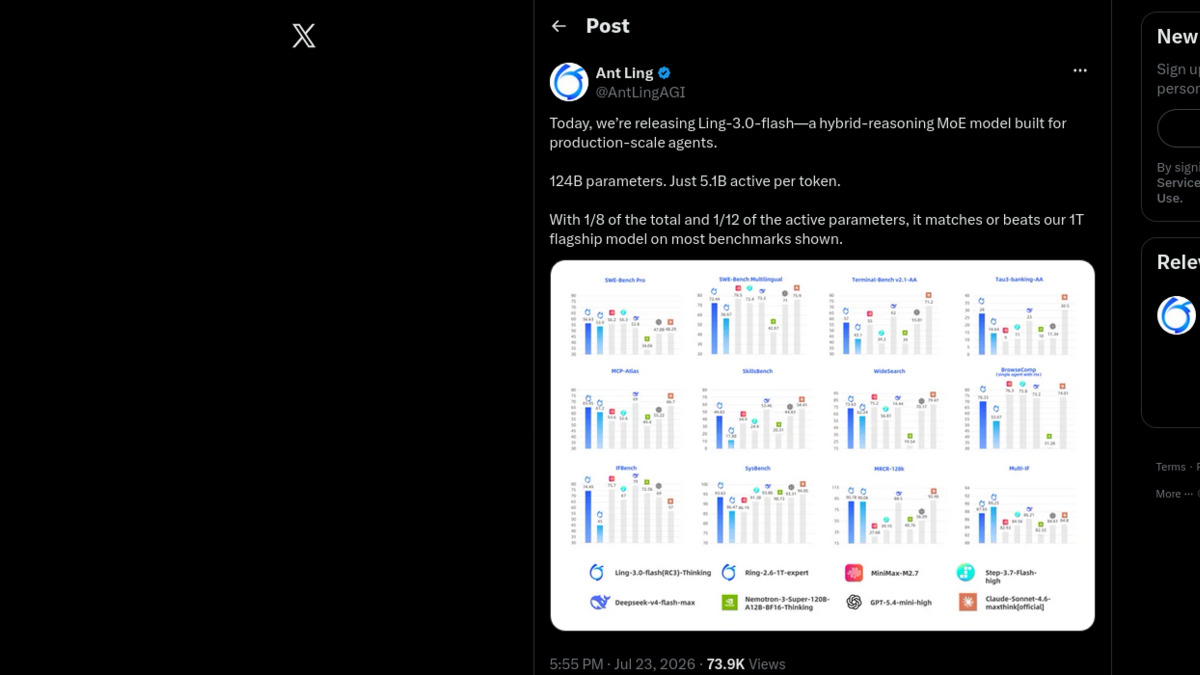 The official launch thread includes a benchmark grid across 12 categories (SWE-Bench Pro, Terminal-Bench, Tau3-banking, MCP-Atlas, WideSearch, BrowseComp and others), but the bar values aren't legible at chart resolution and no accompanying data table was published.
Source: x.com
The official launch thread includes a benchmark grid across 12 categories (SWE-Bench Pro, Terminal-Bench, Tau3-banking, MCP-Atlas, WideSearch, BrowseComp and others), but the bar values aren't legible at chart resolution and no accompanying data table was published.
Source: x.com
Key Specifications
| Specification | Details |
|---|---|
| Provider | InclusionAI (Ant Group) |
| Model Family | Ling |
| Architecture | Hybrid-linear MoE - KDA + MLA attention layers (self-reported 5:1 ratio), ~1/64 expert activation |
| Total Parameters | 124B |
| Active Parameters | ~5.1B per token |
| Context Window | 262,144 tokens native (256K); extendable to 1M |
| Modes | Thinking and non-thinking |
| Input Price | Free through August 3, 2026 (standard pricing not yet published) |
| Output Price | Free through August 3, 2026 (standard pricing not yet published) |
| Release Date | July 23, 2026 |
| License | Not yet published for this release; Ling-1T, Ling-2.6-flash, and Ling-flash-2.0 all shipped MIT |
The architecture details come from a follow-up post in InclusionAI's own launch thread, not from a technical report or model card - there's no arXiv paper for Ling-3.0-flash yet, unlike the Ling and Ring 2.6 Technical Report that accompanied the previous generation. Take the layer-ratio and expert-activation figures as self-reported until an official document lands.
Benchmark Performance
This is where Ling-3.0-flash comes up short on transparency. InclusionAI's launch thread includes a 12-panel chart - SWE-Bench Pro, SWE-Bench Multilingual, Terminal-Bench v2.1, Tau3-banking, MCP-Atlas, SkillsBench, WideSearch, BrowseComp, IFBench, SysBench, MRCR-128K, and Multi-IF - benchmarking "Ling-3.0-flash(RC3)-Thinking" against Ring-2.6-1T-expert, MiniMax-M2.7, Step-3.7-flash-high, DeepSeek-v4-flash-max, Nemotron-3-Super-1208-A128-BF16-Thinking, GPT-5.4-mini-high, and Claude-Sonnet-4.6-maxthink. That's a legitimate, broad agentic eval suite, but the bars in the published image are too small to read precise scores and no data table was released. Notably, the chart's own "1T flagship" comparison point appears to be Ring-2.6-1T-expert, the reasoning-focused sibling model, not Ling-1T as the launch tweet's text implies - which model InclusionAI actually means is never clarified.
What we can verify, from published model cards, is how the last generation stacked up against today's competitive set:
| Benchmark | Ling-2.6-flash (predecessor) | GLM-4.7-Flash | Qwen3.5-35B-A3B |
|---|---|---|---|
| SWE-bench Verified | 61.2% | 59.2% | 69.2% |
| GPQA Diamond | Not disclosed | 75.2% | 84.2% |
| AIME (2025/2026) | 73.85% (2026) | 91.6% (2025) | - |
| HMMT Feb | 49.29% (2026) | - | 89.0% (2025) |
| Agent tool-use (tau2/TAU2-Bench) | Not disclosed | 79.5% | 81.2% |
Ling-2.6-flash was already competitive but not dominant against this generation's 30-35B-active-parameter open models. If Ling-3.0-flash genuinely closes the gap to a 1T-class flagship while cutting active parameters further to 5.1B, that would be a meaningful jump over its own predecessor - but until InclusionAI publishes a real benchmark table, this stays an unverified claim rather than a verified result. Treat the "matches or beats our 1T flagship" line as a company statement, not a finding, for now.
Key Capabilities
Ling-3.0-flash is built for the token-volume end of agentic work rather than single-shot reasoning depth. The benchmark categories InclusionAI chose to highlight - MCP-Atlas, SkillsBench, WideSearch, BrowseComp, Tau3-banking, SysBench - all point at multi-step, tool-calling, long-horizon agent tasks rather than one-off math or trivia benchmarks. That tracks with the architecture's stated goal: more useful agent work per token, latency unit, and dollar, which matters when a single agent run involves dozens of tool calls before a final answer.
The dual thinking/non-thinking mode switch (also present in GLM-5.1 and other recent hybrid-reasoning releases) lets a deployment pick fast, low-latency responses for routine agent steps or a deeper reasoning pass when a task needs it, without swapping models. Combined with the 262,144-token native context (extendable to 1M), it's positioned for long multi-turn agent sessions and large document or codebase ingestion in a single pass, similar to the long-context play made by DeepSeek V4.
The MoE routing, at roughly 1/64 expert activation per the self-reported figures, is aggressive sparsity even by 2026 standards - Ling-2.0's published scaling law recommended 1/32 as the efficiency sweet spot up to 1T parameters, so a further-sparsified 1/64 in the 124B-parameter class is worth watching for quality trade-offs once independent evaluations appear.
Pricing and Availability
Ling-3.0-flash launched simultaneously across four inference channels rather than through a single official API - unusual for a from-scratch model release. It's live on Novita with a free endpoint, on Vercel AI Gateway as inclusionai/ling-3.0-flash-free (free through August 3, 2026, then standard provider pricing with no gateway markup), on ZenMux, and on OpenRouter as inclusionai/ling-3.0-flash:free at $0 input / $0 output during the promotional window.
None of the four platforms list a post-promotional price yet. For comparison, Ling-2.6-flash settled at roughly $0.01/M input and $0.03/M output on OpenRouter after its own free window closed - if Ling-3.0-flash lands in a similar range, it'd undercut GLM-4.7-Flash's $0.07/M-$0.40/M Novita pricing and most of the cost-efficiency leaderboard. That's a projection based on the predecessor's pattern, though, not a confirmed number.
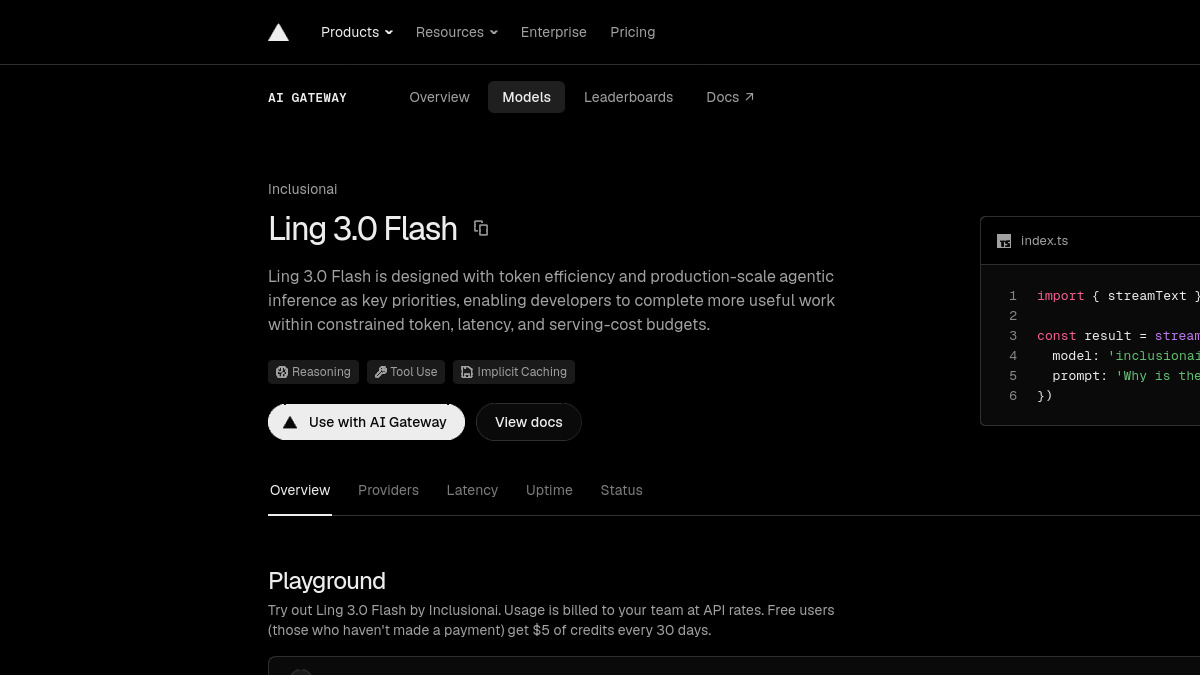 Vercel's AI Gateway listing is one of four simultaneous inference-provider integrations at launch - notably arriving before InclusionAI's own Hugging Face model card was publicly accessible.
Source: vercel.com
Vercel's AI Gateway listing is one of four simultaneous inference-provider integrations at launch - notably arriving before InclusionAI's own Hugging Face model card was publicly accessible.
Source: vercel.com
There's no confirmed self-serve download path yet either. The Hugging Face repository for the model returns an authorization error rather than a public card at time of writing, so anyone wanting to self-host on vLLM or SGLang will need to wait for InclusionAI to flip the repo to public - assuming, based on the rest of the Ling series, that it eventually will.
Strengths
- Extremely low active-parameter footprint (5.1B) relative to total capacity (124B), if the claimed benchmark parity holds up
- 262,144-token native context extendable to 1M, competitive with the top of the long-context leaderboard
- Free access across four major inference platforms on day one (Novita, Vercel, ZenMux, OpenRouter)
- Dual thinking/non-thinking modes for latency-sensitive vs. deep-reasoning agent steps
- InclusionAI's prior Ling releases (Ling-1T, Ling-2.6-flash, Ling-flash-2.0) have all shipped MIT-licensed - a strong precedent if Ling-3.0-flash follows suit
Weaknesses
- Zero independently verifiable benchmark numbers at launch - only a low-resolution company chart and a text claim of parity with an unspecified "1T flagship"
- No technical report or arXiv paper, unlike the previous generation's published Ling and Ring 2.6 Technical Report
- Hugging Face model card and weights aren't publicly accessible as of this writing - "open source" status for this specific release is unconfirmed despite the series' track record
- Ambiguity over which model the "1T flagship" comparison actually refers to (Ling-1T vs. Ring-2.6-1T-expert)
- Post-promotional pricing hasn't been published by any of the four launch platforms, making cost planning impossible right now
- Architecture details (5:1 KDA:MLA ratio, 1/64 expert activation) are self-reported from a social media thread, not a peer-reviewed or formally documented source
Related Coverage
- Open Source LLM Leaderboard
- State of Open-Source LLMs 2026
- GLM-4.7-Flash
- Qwen3.5-35B-A3B
- DeepSeek V4
- Agentic AI Benchmarks Leaderboard
- Cost Efficiency Leaderboard
Sources:
- Ant Ling launch thread on X (@AntLingAGI)
- David Hendrickson / @TeksEdge on X - independent observation of the quiet launch
- Ling 3.0 Flash - Vercel AI Gateway listing
- Ling 3.0 Flash is now available on AI Gateway - Vercel Changelog
- inclusionAI: Ling-3.0-flash - ZenMux
- inclusionai/ling-3.0-flash - OpenRouter
- inclusionAI/Ling-2.6-flash - Hugging Face model card
- inclusionAI/Ling-1T - Hugging Face model card
- inclusionAI/Ling-V2 - GitHub repository
- Ling and Ring 2.6 Technical Report (arXiv 2606.15079)
✓ Last verified July 23, 2026

