
Kimi K3
Moonshot AI's Kimi K3 is a 2.8 trillion parameter MoE model that tops LMArena's Frontend Code Arena and nears Claude Fable 5 on intelligence benchmarks, but at roughly triple Kimi K2.6's price and a higher hallucination rate.
 11 min read
TL;DR
- Kimi K3 tops LMArena's Frontend Code Arena at 1,679 points, a 17-place jump over Kimi K2.6, but lands a more modest #9 on the general Text Arena
- 2.8 trillion total parameters, 16 of 896 experts active per token (roughly 50B active), 1M token context, built on a new Stable LatentMoE architecture with Kimi Delta Attention
- Pricing roughly tripled versus K2.6, still cheaper than Claude Opus 4.8 per task but no longer "cheap Chinese AI" - and the hallucination rate rose with the accuracy gains
Overview
Kimi K3 is Moonshot AI's July 16, 2026 flagship release and the successor to Kimi K2.6. At 2.8 trillion total parameters it is, by Moonshot's own framing and independent counts, the largest open-weight model announced to date, arriving less than three months after K2.6 pushed the same line to the top of the open-weight SWE-Bench Pro rankings. Two configurations shipped at launch: K3 Max for general chat and agent work, and K3 Swarm Max for large-scale parallel processing. Both are live now on kimi.com, Kimi Work, Kimi Code, and the Kimi API. Full open weights are promised on Hugging Face "by July 27, 2026," but today they're not yet public, so K3 is best described as open-weight in commitment rather than in practice.
The architecture is a genuine departure from K2.6, not a scale-up of the same design. Moonshot calls it Stable LatentMoE, paired with two new attention mechanisms, Kimi Delta Attention (KDA) and Attention Residuals (AttnRes), plus a set of optimizer changes (per-head Muon, quantile-based load balancing, a Sigmoid Tanh Unit activation) that the company says together deliver a 2.5x improvement in scaling efficiency over K2. Independent coverage from MarkTechPost corroborates the headline numbers: KDA enables up to 6.3x faster decoding at million-token context lengths, and AttnRes adds roughly 25% training efficiency at under 2% extra compute cost.
Competitively, K3 lands in a crowded tier. Moonshot's own claim is that it performs "competitively" with Claude Fable 5 and substantially outperforms Claude Opus 4.8, GPT-5.6 Sol, and GPT-5.5. Independent benchmarking from Artificial Analysis and LMArena backs part of that claim and complicates the rest, which the Benchmark Performance section below covers in detail. Against open-weight peers like GLM-5.2 and DeepSeek V4, K3's coding-specific scores are a clear step up; its price isn't.
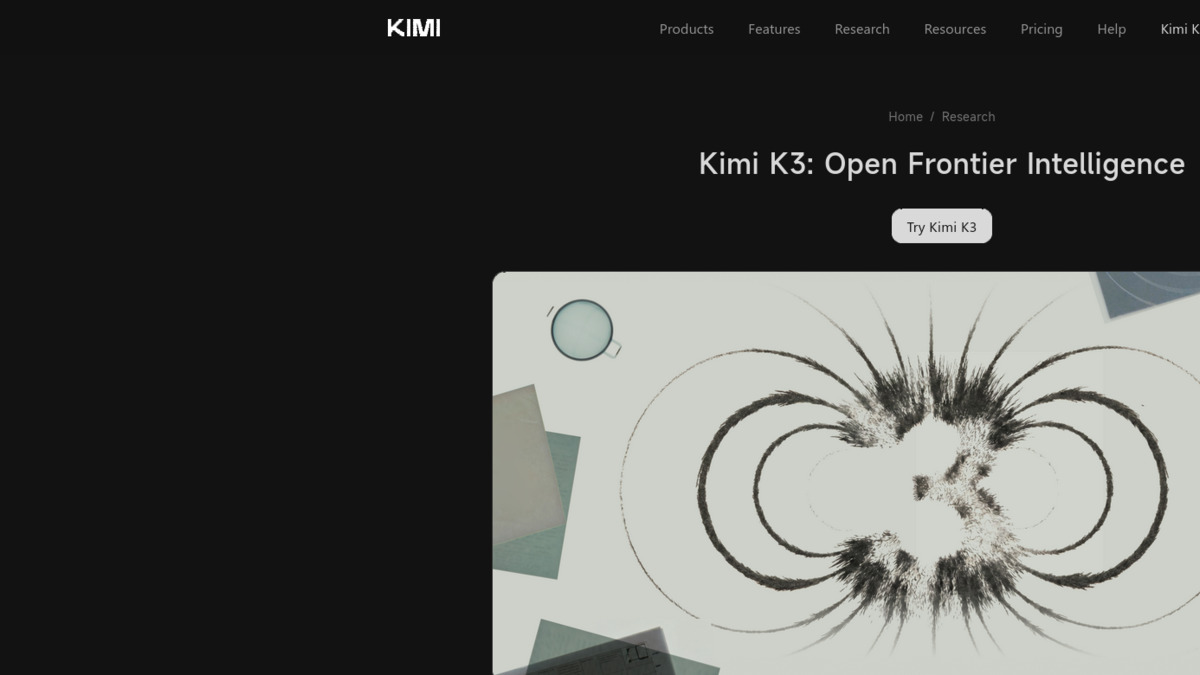 Moonshot AI's July 16 research blog post announcing Kimi K3 as "Open Frontier Intelligence."
Source: kimi.com
Moonshot AI's July 16 research blog post announcing Kimi K3 as "Open Frontier Intelligence."
Source: kimi.com
Key Specifications
| Specification | Details |
|---|---|
| Provider | Moonshot AI |
| Model Family | Kimi K3 |
| Architecture | Stable LatentMoE with Kimi Delta Attention (KDA) and Attention Residuals (AttnRes) |
| Total Parameters | ~2.8T |
| Active Parameters | ~50B per token |
| Experts | 896 total, 16 activated per token (under 2% activation ratio) |
| Optimizer | Per-head Muon with quantile-based load balancing |
| Activation Function | Sigmoid Tanh Unit (SiTU) |
| Context Window | 1,000,000 tokens |
| Multimodal | Native multimodal input (text and images); text-only output |
| Input Price (cache miss) | $3.00 per million tokens |
| Input Price (cache hit) | $0.30 per million tokens |
| Output Price | $15.00 per million tokens |
| Release Date | July 16, 2026 (weights promised by July 27, 2026) |
| License | Modified MIT (expected, following Moonshot's K2 precedent) - not yet formally published |
| Recommended Deployment | 64+ accelerator supernode configurations |
| Serving | Day-0 vLLM support with a Moonshot-contributed KDA prefix-caching implementation |
Benchmark Performance
K3's results split cleanly by venue. On coding-specific evaluations it leads or is competitive with the frontier. On general intelligence and knowledge, it sits third or fourth among the top proprietary models. On honesty, it moved backward.
| Benchmark | Kimi K3 | Claude Fable 5 | GPT-5.6 Sol | Claude Opus 4.8 |
|---|---|---|---|---|
| LMArena Frontend Code Arena | 1,679 | 1,631 | 1,618 | 1,562 |
| LMArena Text Arena | 1,486 (#9) | n/a | n/a | n/a |
| AA Intelligence Index | 57.1 | 60 | 59 | 56 |
| AA Coding Index | 76.24 | n/a | n/a | n/a |
| AA Agentic Index | 50.07 | n/a | n/a | n/a |
| GDPval-AA v2 (Elo) | 1,668 | 1,750 | 1,748 | 1,600 |
| AA-Briefcase (Elo) | 1,547 | n/a | n/a | n/a |
| AutomationBench-AA | 53% (#1) | n/a | n/a | n/a |
| Cost per AA Intelligence task | $0.94 | n/a | $1.04 | $1.80 |
The Frontend Code Arena result is the headline number, and it holds up under scrutiny: K3 jumped from #18 to #1, a 48-point lead over Fable 5, built on a 76% pairwise win rate and #1 finishes in six of seven judged domains (Brand & Marketing, Reference-Based Design, Data & Analytics, Consumer Product, Simulations, and Content Creation Tools). It placed second only in Gaming, behind Fable 5. The Text Arena tells a different story. K3 debuted there at #9 with 1,486 points on launch day, according to Arena's own announcement. By the time we checked the live leaderboard on July 17, the "Preliminary" score had already moved to #6 at 1,500 points on just 1,128 votes, a reminder that early Arena numbers on a freshly launched model are still settling and shouldn't be quoted as final.
On Artificial Analysis's composite indices, K3 scores 57.1 on Intelligence, fourth among tracked configurations behind Fable 5 (60), GPT-5.6 Sol (59), and just ahead of Opus 4.8 (56) when comparing each family's best public setting. The Coding Index tells the opposite story: K3's 76.24 leads Fable 5, GPT-5.6 Sol, and Opus 4.8 outright, the clearest evidence that Moonshot optimized this generation specifically for software work. In Moonshot's own internal suite of 35 evaluations, the company says K3 wins about seven outright, including Program Bench (77.8 vs. GPT-5.6 Sol's 77.6), SWE Marathon (42.0 vs. Opus 4.8's 40.0), and a state-of-the-art BrowseComp score of 91.2, and places second or third on most of the rest, trailing only Fable 5 and GPT-5.6 Sol overall. That's a vendor's own framing, but it's consistent with the independent Coding Index gap.
The weak spot is honesty under pressure. The Decoder's reporting on AA-Omniscience shows K3's accuracy climbing from K2.6's 33% to 46%, a real 13-point gain. But its hallucination rate climbed too, from 39% to 51%. A model that answers more questions correctly while also inventing more wrong answers with confidence isn't an unambiguous upgrade for any workflow where being right matters more than sounding right. Our hallucination benchmarks leaderboard tracks this trade-off across the field.
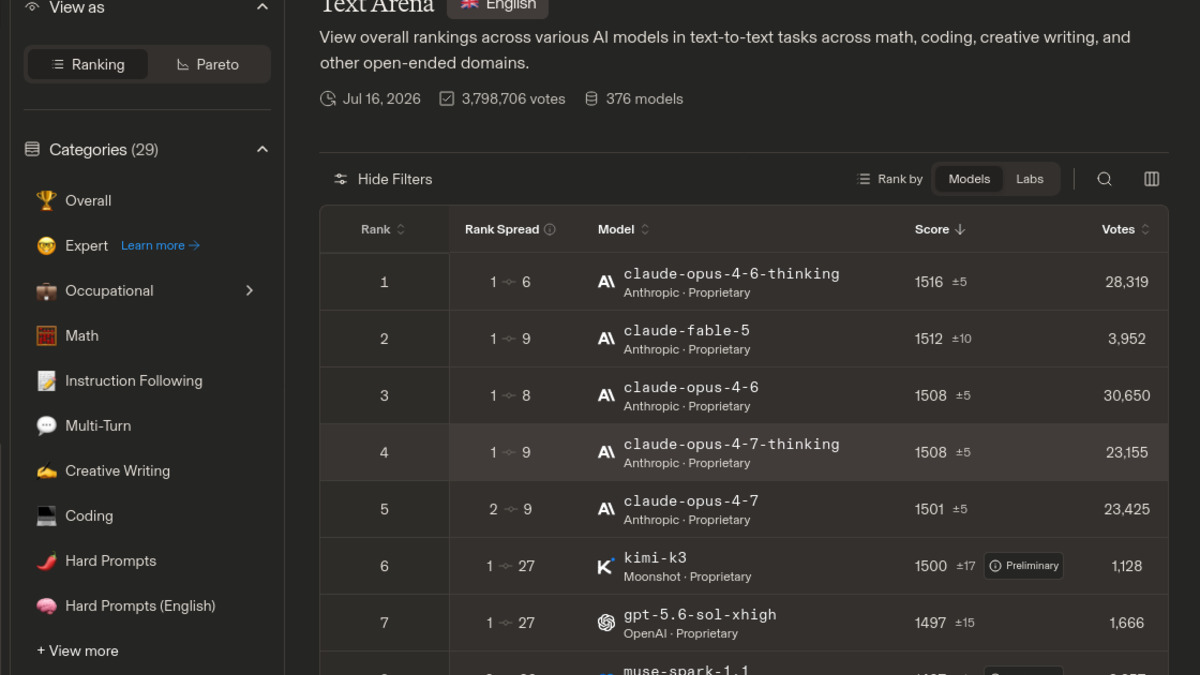 LMArena's live Text Arena standings as observed July 17, 2026. Kimi K3 sits at rank 6 with 1,500 points on 1,128 votes, still flagged Preliminary - up from its launch-day debut at #9 and 1,486 points.
Source: arena.ai
LMArena's live Text Arena standings as observed July 17, 2026. Kimi K3 sits at rank 6 with 1,500 points on 1,128 votes, still flagged Preliminary - up from its launch-day debut at #9 and 1,486 points.
Source: arena.ai
Key Capabilities
Long-context decoding speed. Kimi Delta Attention is the architectural centerpiece of this release. Moonshot's own documentation claims up to 6.3x faster decoding at million-token context lengths compared to the prior architecture, and the company built a custom KDA prefix-caching implementation that shipped to vLLM with the model so serving providers don't have to reimplement it themselves. That engineering investment is also what keeps token pricing from spiraling further given the model's size; without it, serving a 2.8T model with a 1M context window economically would be much harder.
Frontend and UI generation. The Frontend Code Arena sweep isn't a fluke confined to one narrow task type. Winning six of seven judged domains, from marketing pages to data dashboards to interactive simulations, suggests the coding gains are broad rather than benchmark-specific. For teams doing UI-heavy AI coding work, this is currently K3's strongest, most reproducible advantage over the closed frontier.
Deployment reality at 2.8T scale. Moonshot recommends supernode configurations with 64 or more accelerators for K3, a sharp step up from K2.6's more approachable multi-GPU footprint. Realistic self-hosting is limited to well-funded teams and cloud providers running dense accelerator clusters; this isn't a model most organizations will run on a handful of H100s the way they might with GLM-5.2 or Qwen's 35B-class models. MXFP4 weights with MXFP8 activations, carried through from quantization-aware training, help but don't change the order of magnitude.
Pricing and Availability
K3 is live now on kimi.com, Kimi Work, Kimi Code, and the Kimi API Platform. The API pricing represents a sharp break from Moonshot's prior positioning.
| Metric | Kimi K2.6 | Kimi K3 | Change |
|---|---|---|---|
| Input (cache miss) | $0.95/M | $3.00/M | +216% |
| Input (cache hit) | $0.16/M | $0.30/M | +88% |
| Output | $4.00/M | $15.00/M | +275% |
That $3.00 input / $15.00 output rate card lands almost exactly on Claude Sonnet 5's pricing, not the budget end of the market where Kimi has historically competed. The Decoder frames this correctly as signaling the end of rock-bottom Chinese frontier-model pricing: Moonshot is no longer undercutting Western labs by an order of magnitude, it's matching a mid-tier Western rate card. Open-weight competitors like DeepSeek V4 remain far cheaper on a per-task basis, so price-sensitive teams still have options; they just aren't Kimi anymore.
Real-world cost efficiency softens the sting somewhat. Artificial Analysis measured K3's average cost per Intelligence Index task at $0.94, cheaper than GPT-5.6 Sol's $1.04 and well below Claude Opus 4.8's $1.80, because K3 needs fewer output tokens per task despite the higher per-token rate. Our cost efficiency leaderboard has the fuller cross-model picture.
Speed is a mixed bag worth flagging before committing production traffic. Artificial Analysis's controlled benchmark measured 62.0 output tokens per second, below the roughly 70 t/s median for comparable models, with a time-to-first-token of 1.99 seconds, better than the ~2.58s median. Early independent serving reports from Latent.space/AINews observed considerably slower throughput in the first day, around 26-28 tokens per second via early Moonshot API and OpenRouter routes, with speculation that speculative decoding wasn't fully enabled yet. Treat AA's number as the ceiling and the early field reports as what you might actually see until providers finish tuning their serving stacks.
"Kimi K3's early performance is fueling awe across the AI world - and alarm in Silicon Valley and Washington - as China appears to be rapidly erasing America's lead in advanced AI." - Axios, July 16, 2026
Strengths
- #1 on LMArena's Frontend Code Arena across six of seven judged domains, a clear lead over Fable 5 and GPT-5.6 Sol
- Leading Artificial Analysis Coding Index score (76.24), ahead of every model it's compared against here
- KDA architecture delivers up to 6.3x faster decoding at million-token context, with day-0 vLLM prefix-caching support
- Real-world cost per task ($0.94) undercuts GPT-5.6 Sol and Claude Opus 4.8 despite higher list pricing
- Largest open-weight model announced to date, with a Modified MIT license expected to follow Moonshot's established precedent
Weaknesses
- Hallucination rate rose from 39% to 51% on AA-Omniscience with the accuracy gains, a real regression in reliability
- Pricing roughly tripled versus K2.6, landing at Claude Sonnet 5 rates rather than Kimi's traditional budget tier
- Open weights aren't yet public as of this writing; the July 27 date is a promise, not a shipped artifact
- Text Arena ranking (#9 to #6, still "Preliminary") trails the Frontend Code Arena result by a wide margin, suggesting general-purpose chat quality lags coding quality
- Recommended 64+ accelerator deployment puts realistic self-hosting out of reach for all but well-funded teams
- Early independent serving speed (26-28 t/s) came in well under Artificial Analysis's controlled 62.0 t/s measurement
- License terms haven't been formally published; the Modified MIT expectation is precedent-based, not confirmed
Related Coverage
- Kimi K2.6 model profile - Predecessor architecture, pricing, and swarm capabilities
- Kimi K2.5 review - Hands-on review of an earlier generation in the line
- Coding benchmarks leaderboard - Where K3 ranks against the full coding-model field
- Open source LLM leaderboard - Open-weight model rankings, pending K3's weight release
- Agentic AI benchmarks leaderboard - GDPval, AutomationBench, and related agentic scores across models
- Cost efficiency leaderboard - Performance-per-dollar rankings including K3's real-world cost per task
- Hallucination benchmarks leaderboard - Tracks the accuracy/hallucination trade-off K3 shows on AA-Omniscience
FAQ
Are Kimi K3's weights available yet?
No. K3 is live via API and the Kimi apps as of July 16, 2026, but Moonshot has only promised open weights on Hugging Face "by July 27, 2026." Check back closer to that date before assuming self-hosting is possible.
Is Kimi K3 cheaper than Kimi K2.6?
No, it's more expensive across the board. Cache-miss input pricing rose from $0.95 to $3.00 per million tokens and output pricing rose from $4.00 to $15.00 per million tokens, roughly tripling the cost of the prior generation.
How many parameters does Kimi K3 have active per token?
Roughly 50 billion active parameters out of 2.8 trillion total, with 16 of 896 experts activated per token, an activation ratio under 2%.
Does Kimi K3 beat Claude Fable 5?
It depends on the task. K3 leads Fable 5 on LMArena's Frontend Code Arena and the AA Coding Index, but trails on the AA Intelligence Index and GDPval-AA v2. Neither model leads the other across the board.
Why did Kimi K3's hallucination rate go up?
Moonshot hasn't published a technical explanation. Independent testing via AA-Omniscience shows accuracy rising from 33% to 46% between K2.6 and K3, but hallucination rate rising in parallel from 39% to 51%, suggesting the model got better at answering and worse at knowing when not to.
Sources:
- Kimi K3 Tech Blog: Open Frontier Intelligence - Moonshot AI - Official architecture and release announcement
- Kimi K3 Quickstart - Kimi API Platform - Official API pricing and documentation
- Kimi K3 - Intelligence, Performance & Price Analysis - Artificial Analysis - Independent benchmark scores, speed, and pricing
- Moonshot AI Releases Kimi K3: A 2.8 Trillion Parameter Open MoE Model - MarkTechPost - Architecture breakdown (KDA, AttnRes, Stable LatentMoE)
- Kimi's open model K3 nears GPT-5.6 Sol and Fable 5 while signaling the end of super cheap Chinese AI - The Decoder - Pricing analysis and AA-Omniscience hallucination data
- Moonshot AI launches Kimi K3 - Constellation Research - Independent industry analysis
- Moonshot's upcoming Kimi 3 is expected to close the gap with Anthropic's Opus 4.8 - TechCrunch - Pre-launch competitive analysis
- Moonshot's Kimi K3 pushes Chinese AI into Fable-level territory - Fortune - Market and geopolitical framing
- Kimi K3 Is Behind Only Fable 5 And GPT 5.6 Sol In Internal Evaluations, Says Moonshot AI - OfficeChai - Moonshot's internal 35-benchmark suite results
- Kimi K3 2.8T-A50B: the largest open model ever released - Latent.space/AINews - Early serving speed reports and cost-per-task figures
- Kimi K3, and what we can still learn from the pelican benchmark - Simon Willison - Independent hands-on testing notes
- Arena.ai Frontend Code Arena announcement - Official #1 ranking announcement with per-domain breakdown
✓ Last verified July 17, 2026

