
Ideogram 3.0
Ideogram 3.0 is Ideogram AI's most capable text-to-image model, leading the field in typography accuracy at ~90-95% and offering production-ready API access at $0.03-$0.09 per image.
 7 min read
Ideogram 3.0 is the current flagship from Ideogram AI, released March 26, 2025, with a significant feature update following on May 1, 2025. Where most text-to-image models treat in-image text as an afterthought - something to be cleaned up with post-processing or simply avoided - Ideogram has built its entire product identity around getting typography right. Version 3.0 is the most complete expression of that bet.
TL;DR
- Text-in-image accuracy of ~90-95%, versus ~30-40% for Midjourney v7 - the widest gap in the field
- Three API pricing tiers: Turbo ($0.03/image), Default ($0.06/image), Quality ($0.09/image)
- Style References accept up to 3 reference images; 4.3 billion style presets; character consistency across generations
The model scored highest in Ideogram's own ELO-rated human preference evaluations across realism, prompt alignment, and versatility, representing a 25% improvement over Ideogram 2.0 in head-to-head human tests. Architecture details aren't publicly disclosed - Ideogram hasn't published a technical paper, unlike Black Forest Labs or Stability AI. What the company has shared points to a diffusion transformer foundation with a specialized two-stage training process: large-scale pretraining for glyph recognition followed by fine-tuning on annotated typography datasets. The result is a model that handles text the way most image models handle faces - as a primary design concern rather than an edge case.
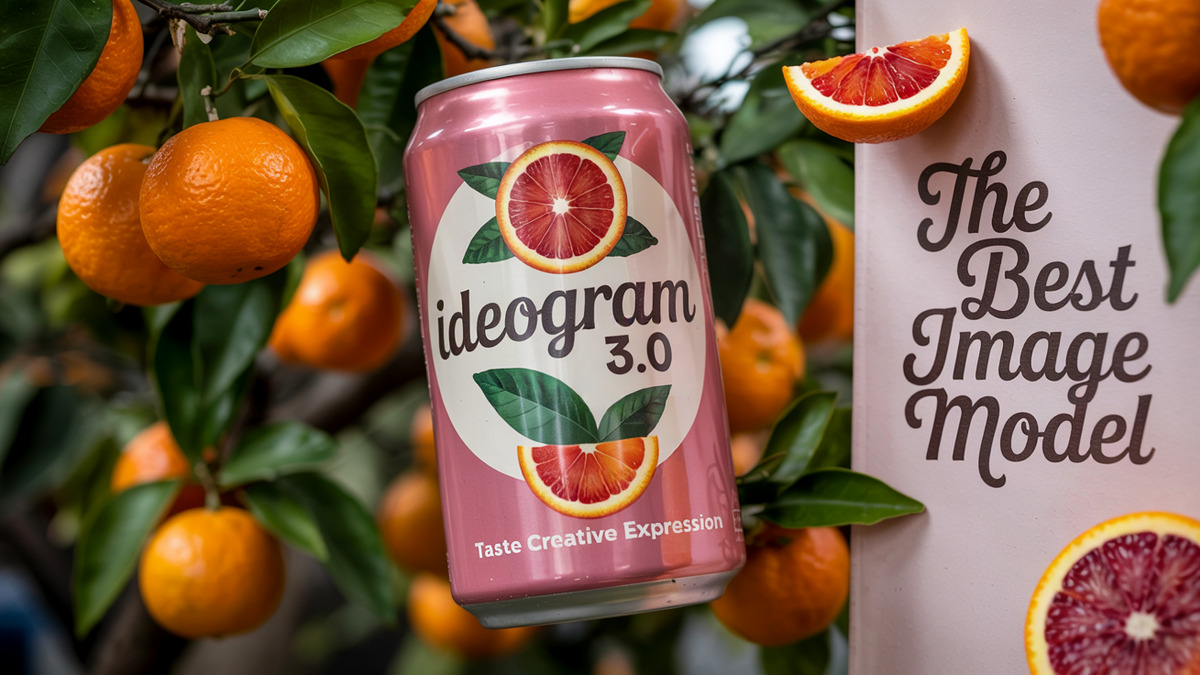 Ideogram 3.0 sample outputs demonstrating typography accuracy and photorealistic image quality across design use cases.
Source: ideogram.ai
Ideogram 3.0 sample outputs demonstrating typography accuracy and photorealistic image quality across design use cases.
Source: ideogram.ai
Key Specifications
| Specification | Details |
|---|---|
| Provider | Ideogram AI |
| Model Family | Ideogram |
| Parameters | Not disclosed |
| Context Window | Not applicable |
| API Input Price | $0.03/image (Turbo), $0.06/image (Default) |
| API Output Price | $0.09/image (Quality) |
| Release Date | March 26, 2025 (updated May 1, 2025) |
| License | Proprietary (closed) |
| API Availability | Yes - REST API at developer.ideogram.ai |
Benchmark Performance
Ideogram doesn't publish results on standardized text-to-image benchmarks. The company reports ELO-based human preference rankings from internal evaluations, where 3.0 ranks first among major commercial models. Independent testing across review sites confirms the text rendering numbers, though arena-style leaderboard placement on platforms like LM Arena reflects consumer preference rather than typography accuracy specifically.
The figure that matters for Ideogram's core use case is text rendering accuracy:
| Model | Text Rendering Accuracy | Photorealism | Artistic Quality |
|---|---|---|---|
| Ideogram 3.0 | ~90-95% | Very Good | Very Good |
| FLUX.2 [max] | ~65-70% | Very Good | Very Good |
| Midjourney v7 | ~30-40% | Excellent | Outstanding |
| DALL-E 3 | ~50-60% | Good | Good |
The 90-95% accuracy figure for Ideogram comes from multiple independent reviews testing the model on multi-word phrases, styled typography, and complex layouts. Midjourney's 30-40% comes from the same sources. This isn't a close race - for any workflow where readable text must appear in the created image, Ideogram is in a different category. For photorealism and artistic composition, Midjourney v7 and FLUX.2 [max] remain the more relevant comparisons.
One caveat: no third-party laboratory has published a systematic typography accuracy benchmark with consistent methodology across all four models. The 90-95% figure is consistent across independent reviewers, but it isn't a controlled scientific result. Treat it as a strong directional signal, not a precise measurement.
Key Capabilities
Typography and Text Rendering
Ideogram's text handling uses what the company describes as font token encoding through a variational autoencoder, rather than treating text characters as visual patterns to recall from training data. A secondary mechanism - Implicit Character Position Alignment - provides spatial control for curved text, angled lettering, and irregular layouts. The practical output is a model that consistently renders multi-line compositions, stylized display fonts, handwritten scripts, and 3D type effects without spelling errors. Magic Prompt, available in the API as an optional toggle, automatically expands prompts with typography specifications to improve legibility in complex layouts.
Style References and Presets
The May 2025 update formalized the Style Reference system: users can upload up to 3 reference images to control color palette, texture, composition, and mood. Each configuration can be saved as a reusable Style Code - a 8-character identifier you can pass in API calls to reproduce a consistent visual identity across a batch of images. The alternative is a library of 4.3 billion style preset combinations, which is the more useful number for production workflows where you're iterating on a specific look rather than starting fresh.
Character Reference - introduced as a distinct feature - maintains subject identity across generations. Combined with Style References, this lets design teams build brand-consistent content at scale: same product, same character, different scenes and copy.
API Endpoints and Editing
The v3 API exposes Generate, Edit, Remix, Upscale, Describe, Reframe, and Replace Background endpoints. The May 1, 2025 API launch also added Magic Fill (targeted area editing) and Extend (outpainting beyond the original frame) on the Canvas editor. Generation latency runs roughly 12 seconds on the Turbo tier. The API is available through Ideogram's developer portal and third-party platforms including Replicate, FAL, Picsart, Freepik, and Together AI.
 The May 2025 model update added editing features including Magic Fill and Extend, along with enhanced photorealism and more diverse outputs.
Source: the-decoder.com
The May 2025 model update added editing features including Magic Fill and Extend, along with enhanced photorealism and more diverse outputs.
Source: the-decoder.com
Pricing and Availability
The API uses per-image flat pricing with four render tiers:
- Flash: fastest (specific price not publicly listed)
- Turbo: $0.03/image (~12-second generation)
- Default: $0.06/image
- Quality: $0.09/image
Volume discounts are available for annual commitments. Enterprise pricing with custom model access requires a minimum of 1 million images per month and goes through [email protected].
Consumer subscription plans run $7/month (Basic), $15/month (Plus), $42/month (Pro), and $20/user/month (Team). The web interface includes free tier access with public generations. A free trial tier exists but rate-limited.
Compared to GPT Image 2 (billed per token, roughly $0.04-0.08 per image equivalent depending on resolution) and FLUX.2 [max] ($0.07/image at 1MP), Ideogram's Turbo tier at $0.03 is the cheapest option for high-volume generation among premium commercial models. Quality tier at $0.09 is competitive with the mid-range of the market.
One operational note: produced image URLs are temporary. If you're using the API, your pipeline must download and store images right away - there's no persistent hosting on Ideogram's side.
See the AI image generation leaderboard for how Ideogram 3.0 compares against other models on overall human preference rankings.
Strengths and Weaknesses
Strengths
- Text rendering accuracy (~90-95%) that no other commercial model matches
- Competitive Turbo pricing at $0.03/image
- Style References with Style Codes enable reproducible brand-consistent generation at scale
- Character Reference for subject consistency across generations
- Wide API endpoint coverage: Create, Edit, Remix, Upscale, Describe, Reframe, Replace Background
- Available through major third-party platforms (Replicate, FAL, Together AI, Picsart)
Weaknesses
- No published technical paper; architecture is entirely closed
- Photorealism trails Midjourney v7 and FLUX.2 [max] for scenes without text
- Multi-person scenes show consistency issues
- Image URLs are temporary - requires immediate download in production pipelines
- Flash tier pricing not publicly listed; forces contact with sales for full tier details
- No fine-tuning or LoRA support; customization limited to style references
Related Coverage
- AI Image Generation Leaderboard - where Ideogram 3.0 sits relative to GPT Image 2, Midjourney v7, and FLUX.2
- Midjourney v7 Review - the main alternative for artistic and photorealistic work
- FLUX.2 [max] Model Card - Black Forest Labs' open-architecture alternative
- Best AI Image Generators 2026 - full comparison of consumer and API options
- Best AI Tools for Designers 2026 - Ideogram's placement in the broader design workflow
FAQ
What is Ideogram 3.0 best at?
Text-in-image generation. It achieves ~90-95% typography accuracy on multi-word and multi-line compositions, versus ~30-40% for Midjourney v7. If your workflow requires readable text in generated visuals, Ideogram is the field leader.
How does Ideogram 3.0 pricing compare to competitors?
Turbo tier at $0.03/image is the cheapest among premium commercial models. FLUX.2 [max] runs $0.07/image, GPT Image 2 is roughly $0.04-0.08 per equivalent image. Quality tier at $0.09 is mid-market for high-fidelity generation.
Does Ideogram 3.0 have an API?
Yes. The REST API at developer.ideogram.ai exposes Generate, Edit, Remix, Upscale, Describe, Reframe, and Replace Background endpoints. API key access is available through the Ideogram dashboard under Settings.
Is Ideogram 3.0 open source?
No. Architecture and weights are closed. Ideogram hasn't published a technical paper. The model is accessible only through the web platform and API.
What are the Ideogram 3.0 render speed tiers?
Four tiers: Flash (fastest, price unlisted), Turbo ($0.03/image), Default ($0.06/image), and Quality ($0.09/image). Generation time on Turbo is roughly 12 seconds per image.
Sources:
- Ideogram 3.0 official announcement
- Ideogram API Pricing
- Ideogram Developer Documentation - Available Models
- Ideogram Generate v3 API Reference
- Ideogram 3.0 on Replicate
- Ideogram 3.0 realism update - The Decoder
- What Is Ideogram V3 - MindStudio
- Ideogram 3 Pricing and API Guide - UC Strategies
- Ideogram Releases Version 3.0 - Learn Prompting
- Ideogram 3.0 on Together AI
✓ Last verified April 27, 2026

