
Hermes 4.3
Nous Research's 36B open-weight model matches Hermes 4 70B on most benchmarks, tops RefusalBench on alignment, and is the first production model trained entirely on the Solana-secured Psyche network.
 9 min read
Hermes 4.3 is Nous Research's latest open-weight release, and it comes with a spec sheet that reads unlike anything else in the 36B class: a base model swapped out from Meta's Llama lineage, a context window stretched to 512K tokens, and a training run that ran across 24 machines scattered over the open internet instead of inside a single data center.
TL;DR
- 36B open-weight model that nearly matches Hermes 4 70B on most benchmarks at half the parameter count
- 512K token context, Apache 2.0 license, GGUF quantizations for consumer GPUs
- First production model trained entirely on Nous Research's Psyche network, a Solana-secured distributed training system
Overview
Nous Research built Hermes 4.3 on ByteDance's Seed-OSS-36B-Base rather than a Llama checkpoint, breaking from the lineage that produced Hermes 3 and Hermes 4. The company says the result nearly matches, and on several benchmarks passes, Hermes 4 70B while running at roughly half the parameter cost. That claim is unusually testable: Nous published two versions of Hermes 4.3 side by side, one trained the conventional way and one trained on its distributed Psyche network, so anyone can check the numbers rather than take the pitch on faith.
The bigger story is how the model got made. Hermes 4.3 is the first production release from Nous Research trained completely on Psyche, the company's distributed training network. Psyche uses a custom optimizer called DisTrO to synchronize 24 nodes spread across the public internet, with a Solana smart contract managing which nodes are participating and a separate peer-to-peer mesh carrying the actual gradient traffic. That's a different way to train a frontier-adjacent model entirely, and Nous ran the head-to-head comparison specifically to find out whether it produces a worse model than centralized training. It didn't.
Nous Research, founded in 2023 and known for the open-weight Hermes fine-tune series going back to Llama 2, has built a name on shipping models nobody else is willing to release: uncensored, high-context, and free of the guardrails that closed labs bake into their flagship chatbots. Hermes 4.3 continues that pattern while adding a distributed-training story that, until now, existed mostly as a research demo rather than something bundled into a model people can actually download and run.
 Nous Research's own release graphic frames Hermes 4.3 mainly as a Psyche network milestone, not just a model update.
Source: nousresearch.com
Nous Research's own release graphic frames Hermes 4.3 mainly as a Psyche network milestone, not just a model update.
Source: nousresearch.com
Key Specifications
| Specification | Details |
|---|---|
| Provider | Nous Research |
| Model Family | Hermes |
| Base Model | ByteDance Seed-OSS-36B-Base |
| Parameters | 36B |
| Context Window | 512K tokens |
| Input Price | Free (Apache 2.0, self-hosted) |
| Output Price | Free (Apache 2.0, self-hosted) |
| Release Date | December 2, 2025 |
| License | Apache 2.0 |
Benchmark Performance
Nous published a direct three-way comparison: the Psyche-trained Hermes 4.3, a centrally-trained Hermes 4.3 built on identical data with Torchtitan and FSDP+AdamW, and the older, larger Hermes 4 70B. The point was to isolate the effect of the training method itself, not just show off a new checkpoint.
| Benchmark | Hermes 4.3 36B (Psyche) | Hermes 4.3 36B (Centralized) | Hermes 4 70B |
|---|---|---|---|
| AIME 2024 | 71.9 | 70.6 | 73.5 |
| AIME 2025 | 69.3 | 66.8 | 67.4 |
| MATH-500 | 93.8 | 92.3 | 95.5 |
| MMLU | 87.7 | 86.5 | 88.4 |
| MMLU-Pro | 80.7 | 79.7 | 80.7 |
| GPQA Diamond | 65.5 | 64.8 | 66.1 |
| BBH | 86.4 | 84.7 | 87.8 |
| IFEval | 77.9 | 73.9 | 78.7 |
| DROP | 83.5 | 81.6 | 85.0 |
| SimpleQA | 6.0 | 5.6 | 17.9 |
| RefusalBench | 72.3 | 66.7 | 59.2 |
Two things stand out. First, the Psyche-trained checkpoint beats its own centralized twin on every single row, which is the actual headline: distributed training over the open internet didn't leave anything on the table compared to a conventional data-center run on identical data. Second, against Hermes 4 70B, the 36B model trails by a point or two on most academic benchmarks (MATH-500, MMLU, BBH, DROP) but pulls slightly ahead on AIME 2025 and ties on MMLU-Pro. That's a truly close race between models with a 2x parameter gap.
The SimpleQA gap is the honest exception. Hermes 4.3 scores 6.0 against Hermes 4 70B's 17.9, nearly a 3x difference on a benchmark that measures raw factual recall on obscure trivia. Fewer parameters mean less memorized knowledge, and no amount of post-training fixes that. Anyone using Hermes 4.3 for open-ended factual Q&A without retrieval should expect it to know less than the bigger model, even where it reasons just as well.
RefusalBench is where Hermes 4.3 clearly leads: 72.3% versus 59.2% for Hermes 4 70B, a result Nous frames around helpfulness and alignment to user intent rather than pure capability. See our reasoning benchmarks leaderboard for how AIME and GPQA scores stack up against the wider field, and the hallucination benchmarks leaderboard for how SimpleQA-style factuality gaps compare across model sizes.
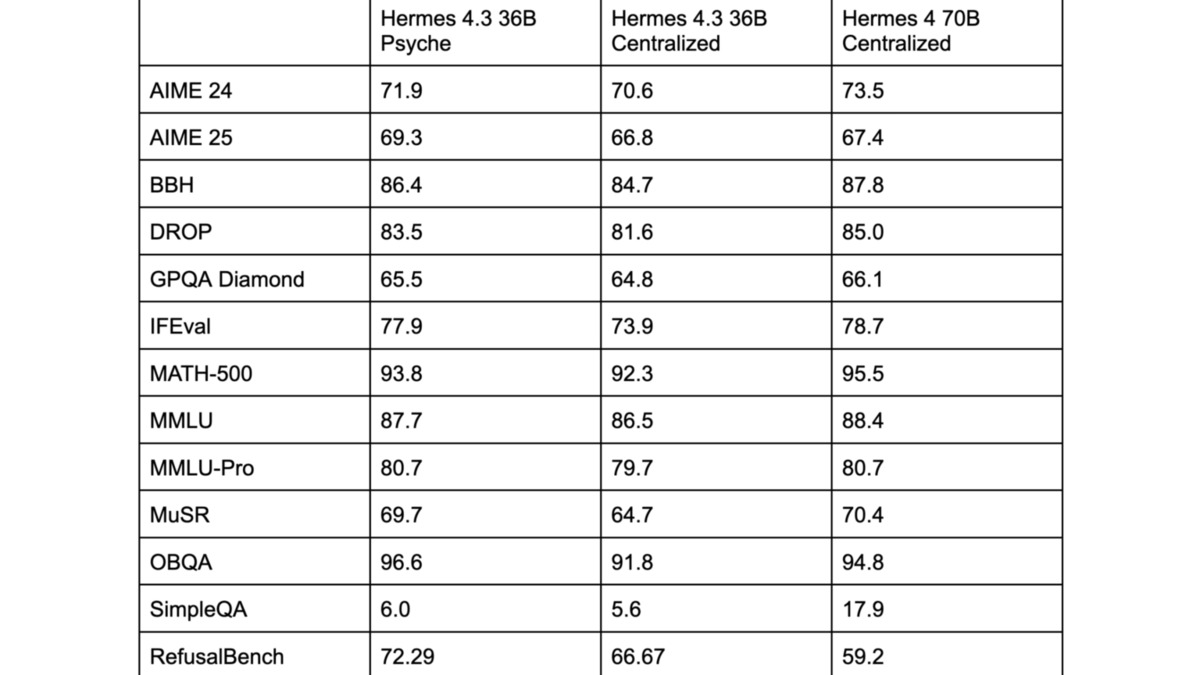 The three-column comparison Nous Research published with the release, isolating training method from model size.
Source: nousresearch.com
The three-column comparison Nous Research published with the release, isolating training method from model size.
Source: nousresearch.com
Key Capabilities
The Psyche training run is the feature that separates Hermes 4.3 from every other open-weight release this year. DisTrO, the optimizer behind Psyche, cuts down how much data needs to move between training nodes, which is what makes coordinating machines over consumer internet connections feasible instead of requiring the high-bandwidth interconnects a single data center provides. For this run, Nous coordinated 24 nodes and sustained an average of 144,000 tokens per second, with node participation and consensus handled by a Solana smart contract while the actual gradient exchange happened over a separate peer-to-peer mesh. Skeptics of decentralized training have asked Nous for exactly this kind of paired comparison before, and the released centralized checkpoint is the company's direct answer.
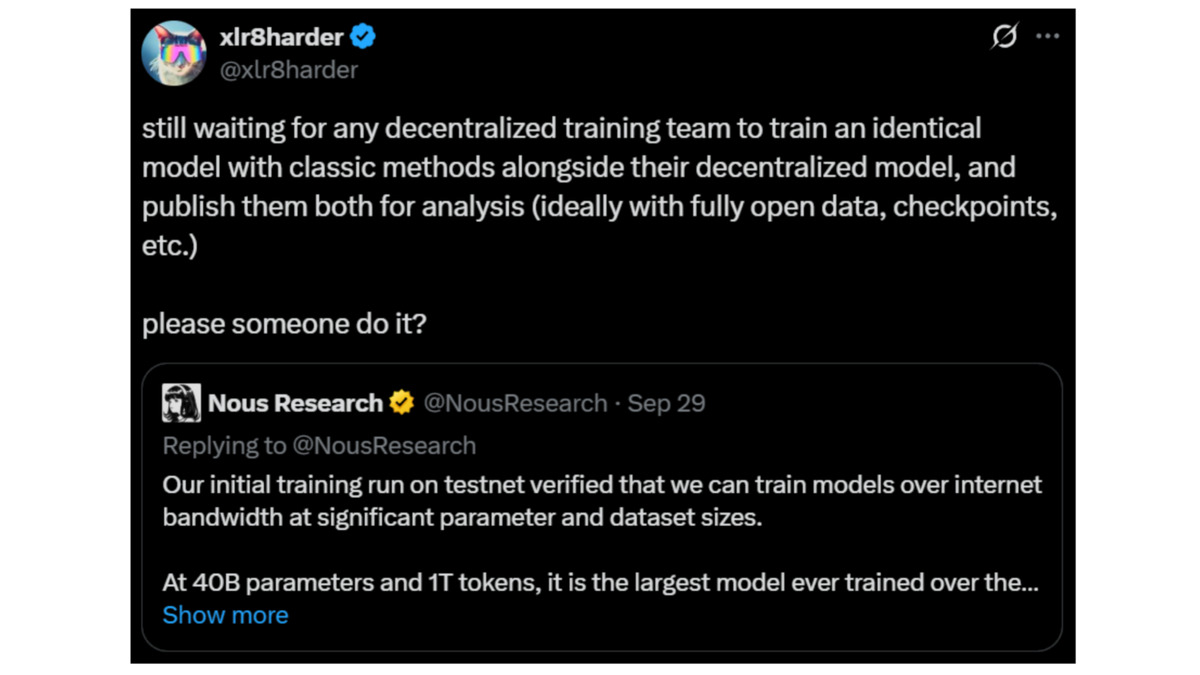 The kind of skepticism Nous Research has faced before shipping a production model on Psyche: show the paired comparison or it didn't happen.
Source: nousresearch.com
The kind of skepticism Nous Research has faced before shipping a production model on Psyche: show the paired comparison or it didn't happen.
Source: nousresearch.com
Post-training is also a big jump from Hermes 4. Nous scaled the instruction-tuning corpus from roughly 1 million samples and 1.2 billion tokens to about 5 million samples and 60 billion tokens, with heavier emphasis on verified reasoning traces across math, code, and logic. The model runs in a hybrid reasoning mode, emitting explicit <think> segments only when it decides deliberation helps, alongside function calling and structured output support. Its 512K context window carries over from the Seed-OSS-36B base rather than being a Nous-specific extension, but it puts Hermes 4.3 well ahead of most models in its weight class, including GPT-OSS-20B at 131K tokens.
The RefusalBench result reflects Nous's long-standing positioning: models that answer legitimate questions other vendors' safety tuning blocks. That's a deliberate trade-off, not an oversight, and it means Hermes 4.3 is not a drop-in replacement for teams that need conservative content moderation out of the box.
Pricing and Availability
Hermes 4.3 is Apache 2.0 licensed and free to download from Hugging Face, with GGUF quantizations in 4-, 5-, 6-, and 8-bit formats that fit comfortably on a single consumer GPU. Nous also released the centralized comparison checkpoint, Hermes-4.3-36B-centralized, plus the evaluation datasets used to score both versions.
For hosted inference, the model runs on vLLM and SGLang, and works with llama.cpp, Ollama, and LM Studio for local deployment. Nous Research's own Hermes-4-70B is priced on its Nous Portal at $0.05 per million input tokens and $0.20 per million output tokens, well under third-party routers charging $0.13/$0.40 for the same model, but at the time of writing Nous hadn't listed a hosted per-token price specifically for Hermes 4.3 36B on its own portal or on OpenRouter. Given the Apache 2.0 license and the GGUF availability, self-hosting is the primary path most teams will use, with the usual tradeoff of covering your own GPU costs instead of paying per token.
Strengths and Weaknesses
Strengths
- Nearly matches Hermes 4 70B across most benchmarks at half the parameter count, verified with a controlled comparison rather than marketing copy
- First production-scale proof that distributed, internet-coordinated training (Psyche/DisTrO) doesn't sacrifice model quality versus a centralized run on the same data
- 512K token context and Apache 2.0 licensing with day-one GGUF releases for consumer hardware
- Leads RefusalBench among non-abliterated models, useful for teams that find closed-model safety tuning too restrictive
Weaknesses
- SimpleQA factual recall trails Hermes 4 70B by nearly 3x, a real cost of the smaller parameter count
- No confirmed hosted API pricing for this specific model as of writing, unlike the well-established Hermes 4 70B and 405B listings on Nous Portal and OpenRouter
- Loosened refusal behavior by design means it needs its own moderation layer for public-facing deployments
- Trails Hermes 4 70B on most single-turn academic benchmarks (MATH-500, MMLU, BBH, DROP), even if the gap is small
Related Coverage
- Nous Research Launches Hermes Agent - the company's open-source CLI agent, built to run on top of models like Hermes 4.3
- Instruction Following Leaderboard - tracks how earlier Hermes models perform on IFEval and IFBench
- Hallucination Benchmarks Leaderboard - context for the SimpleQA gap discussed above
- Reasoning Benchmarks Leaderboard - AIME and GPQA rankings across the wider open and closed model field
- Open-Source LLM Leaderboard - where Hermes 4.3 sits against Qwen3.5-27B, GLM-4.7-Flash, and other open-weight models in its size class
FAQ
Is Hermes 4.3 free to use?
Yes. It is Apache 2.0 licensed and downloadable from Hugging Face, including GGUF quantizations that run on consumer GPUs. There's no confirmed per-token hosted price for this specific model as of writing.
What base model does Hermes 4.3 use?
ByteDance's Seed-OSS-36B-Base, a change from the Llama 3.1 base used in Hermes 3 and Hermes 4.
What is the Psyche network?
Nous Research's distributed training system. It uses the DisTrO optimizer to coordinate GPUs over the open internet, with a Solana smart contract managing node consensus and a separate peer-to-peer mesh carrying gradient data.
Does Hermes 4.3 beat Hermes 4 70B?
It nearly matches it. Hermes 4.3 leads on AIME 2025, MMLU-Pro, and RefusalBench, but trails slightly on MATH-500, MMLU, BBH, DROP, and by a wide margin on SimpleQA factual recall.
How big is Hermes 4.3's context window?
512K tokens, inherited from the Seed-OSS-36B-Base it's built on.
Is Hermes 4.3 uncensored?
It's tuned to be more broadly helpful than most closed models, topping RefusalBench among non-abliterated models. That means less built-in content moderation, which teams deploying it publicly need to account for separately.
Sources:
- Introducing Hermes 4.3: Local Intelligence Globally Trained - Nous Research
- NousResearch/Hermes-4.3-36B - Hugging Face model card
- NousResearch/Hermes-4.3-36B-GGUF - Hugging Face GGUF quantizations
- NousResearch/Hermes-4.3-36B-centralized - Hugging Face, centralized comparison checkpoint
- ByteDance-Seed/Seed-OSS-36B-Base - base model card
- Democratizing AI: The Psyche Network Architecture - Nous Research
- Hermes 4 Technical Report - arXiv
- Hermes-4-70B - API Pricing & Benchmarks - OpenRouter
✓ Last verified July 14, 2026

