
Haiper 2.x
Haiper 2.x is the cheapest per-second AI video API on the market at $0.033/sec, now run by NetMind.AI after Haiper's consumer app shut down and its founders joined Microsoft.
 8 min read
Overview
Haiper 2.x is the version bucket the vendor's own API docs use to group the Haiper Video 2.0 and 2.5 checkpoints, a text-to-video and image-to-video model out of London startup Haiper. It launched October 21, 2024 as "Haiper 2.0," a transformer-diffusion hybrid pitched on faster, more realistic generations than the company's earlier 1.0 and 1.5 models. Haiper 2.5 followed on December 18, 2024, adding keyframe conditioning and API integrations with platforms like VEED.
TL;DR
- Cheapest per-second API in this category at $0.033/sec (540p) and $0.05/sec (720p) - see our video generation pricing comparison
- Haiper's consumer app shut down in February 2025; the founders joined Microsoft AI and the models were sold to NetMind.AI, which now runs the API
- No public Artificial Analysis Elo score - Haiper never got tracked on the arena that ranks Kling 3.0 and Veo 3.1
What makes Haiper 2.x worth a model card isn't raw quality - it trails the field there - it's the company's arc. Haiper emerged from stealth in March 2024 with $13.8 million in seed funding (Octopus Ventures, 5Y Capital) on top of a $5.4 million pre-seed round, founded by ex-DeepMind researchers Yishu Miao and Ziyu Wang. By February 2025, less than a year after the 2.0 launch, the consumer web app was gone with no notice to its roughly 4.5 million registered users. The founders joined Microsoft AI in March 2025, and by mid-2025 the video models themselves were sold to NetMind.AI, a decentralized GPU compute provider that now serves "Haiper Text2Video 2.0" through its NetMind Power inference platform. The docs.haiper.ai API and pricing docs are still live and still branded Haiper - that's the version this card covers.
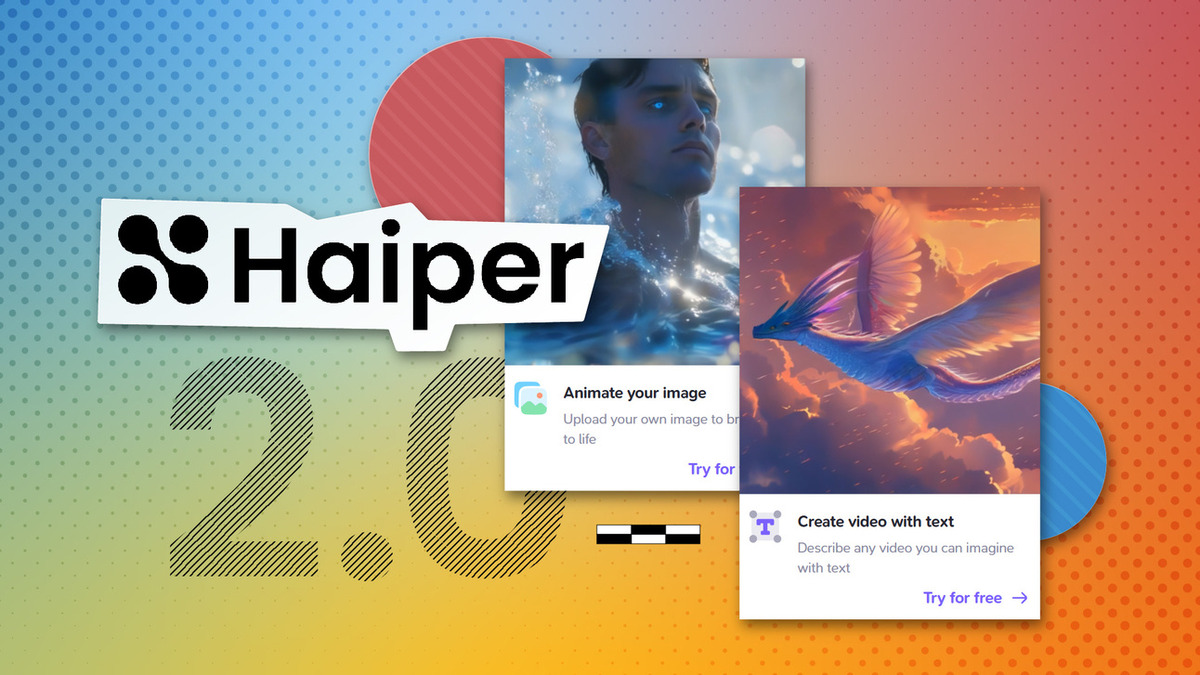 Haiper 2.0's October 2024 launch materials, showing sample outputs from the "Animate your image" and "Create video with text" flows.
Source: vp-land.com
Haiper 2.0's October 2024 launch materials, showing sample outputs from the "Animate your image" and "Create video with text" flows.
Source: vp-land.com
Key Specifications
| Specification | Details |
|---|---|
| Provider | Haiper (technology operated by NetMind.AI since mid-2025) |
| Model Family | Haiper Video (2.0, 2.5 bucketed as "2.x" in official pricing docs) |
| Parameters | Not disclosed |
| Architecture | Proprietary transformer + diffusion hybrid |
| Clip Length | Up to 6 seconds (4s or 6s presets via API) |
| Resolutions (video, priced) | 540p, 720p only - no 1080p or 4K video tier in current pricing docs |
| Native Audio | No |
| API Price | $0.033/sec (540p), $0.05/sec (720p) |
| Release Date | October 21, 2024 (2.0), December 18, 2024 (2.5) |
| License | Proprietary, API-only |
Benchmark Performance
Haiper has never appeared on the Artificial Analysis Video Arena, the blind-preference Elo leaderboard that ranks Kling 3.0, Veo 3.1, and Runway Gen-4.5 against each other - so there's no independent Elo score to report, and I'm not going to invent one. What's verifiable instead is API-side positioning: price per second, shipped resolution, and clip length against the competitors it's actually priced to undercut.
| Model | Provider | 720p API Price/sec | Max Video Resolution | Max Clip Length | Native Audio | Artificial Analysis Elo |
|---|---|---|---|---|---|---|
| Haiper 2.x | Haiper / NetMind | $0.05 | 720p (4K "coming soon") | 6s | No | Not ranked |
| Runway Gen-4 Turbo | Runway | $0.05 | 4K | Not disclosed | No | Not disclosed |
| LTX-2 Fast | Lightricks | $0.04 (1080p) | 4K | Not disclosed | No | 1,127 |
| Kling 3.0 1080p Pro | Kuaishou | $0.075 | Native 4K/60fps | 15s | Yes (multilingual) | 1,251 (no audio) |
| Veo 3.1 Fast | Google DeepMind | $0.10 | 4K | 8s | Yes | 1,205 |
The headline number is that Haiper's 720p rate is identical to Runway Gen-4 Turbo's $0.05/sec - but Runway ships true 4K output and Haiper doesn't. Haiper only undercuts on the 540p tier, where $0.033/sec is roughly a third of Runway's flat rate. Against Kling 3.0 and Veo 3.1, Haiper is cheaper across the board, but neither of those models is competing on price - they're competing on the resolution, duration, and audio Haiper lacks. See the video generation benchmarks leaderboard for the full Elo standings this table draws from.
Key Capabilities
Text-to-video and image-to-video
Haiper 2.x's core endpoints are straightforward: submit a text prompt or a source image and get back a 4- or 6-second clip. Image-to-video pricing matches text-to-video at the same resolution tier, which is standard across the category. There's no native video-to-video or reference-based generation in the current API - features like Kling's Omni reference-to-video or Veo's Ingredients to Video simply don't have a Haiper equivalent.
Video extension and repainting (legacy 1.5 endpoint)
The pricing docs list a video extension endpoint and a 1080p upscale endpoint, but both are scoped to the older 1.5 model, not 2.x, at $0.05/sec each. If you're building on the 2.x endpoints specifically, extension and upscaling aren't available to you without mixing model versions - a gap worth checking before committing a pipeline to it.
The 4K promise that still hasn't shipped
Haiper's October 2024 launch marketing said 4K resolution was "coming soon." As of the current docs.haiper.ai/api-reference/api-pricing page - nearly two years later - video generation pricing only lists 540p and 720p tiers; 4K video is still flagged as a future feature. (4K is live for Haiper's separate image-generation endpoint, at $0.12/image, which makes the video gap more conspicuous rather than less.) That's the kind of marketing-versus-shipped-product gap worth flagging before you plan a resolution-dependent workflow around it.
 Haiper 2.0's launch visual identity, since carried into the NetMind Power-hosted version of the API.
Source: prnewswire.com
Haiper 2.0's launch visual identity, since carried into the NetMind Power-hosted version of the API.
Source: prnewswire.com
Pricing and Availability
The current commercial surface for Haiper 2.x is API-only, accessed at api.haiper.ai with docs at docs.haiper.ai. There's no consumer web app anymore - haiper.ai's product pages that once listed Free/Explorer/Pro subscription tiers (referenced in older third-party reviews) 404 or redirect today, consistent with the February 2025 consumer shutdown. Treat any "$8/month Explorer" or "$24/month Pro" figures you see on review-aggregator sites as historical, not current.
| Tier | Price | Notes |
|---|---|---|
| Video, 540p | $0.033/sec | Text-to-video and image-to-video |
| Video, 720p | $0.05/sec | Text-to-video and image-to-video |
| Video extension (1.5 only) | $0.05/sec | Not available on 2.x endpoints per current docs |
| Upscale to 1080p (1.5 only) | $0.05/sec | Not available on 2.x endpoints per current docs |
| Image, 720p | $0.04/image | Haiper Image 2.x |
| Image, 1080p | $0.08/image | Haiper Image 2.x |
| Image, 4K | $0.12/image | Haiper Image 2.x |
A 6-second clip at 540p costs $0.20; at 720p it's $0.30. That's cheaper than a comparable clip on Runway Gen-4.5 ($1.50 at $0.25/sec) or Veo 3.1 Fast, and it's the reason Haiper still shows up as the "cheapest API" line item in our own AI video generation pricing comparison. Access today runs through the standard API key flow documented at docs.haiper.ai; there's no published subscription plan, credit system, or free tier in the current developer docs, a change from the consumer-app era. For teams evaluating tools rather than raw API integration, our best AI video generation tools roundup covers the platforms - Runway, Kling, Pika, HeyGen - that replaced Haiper as the default consumer pick after the shutdown.
Strengths and Weaknesses
Strengths
- Cheapest per-second video generation API in the category at $0.033/sec (540p)
- Image-to-video priced identically to text-to-video - no premium for conditioning on a source image
- Simple, documented REST API still actively serving requests despite the parent company's consumer shutdown
- Image generation endpoints (separate from video) do ship real 4K output at $0.12/image
Weaknesses
- No public benchmark presence - not tracked on the Artificial Analysis Video Arena that ranks every major competitor
- Video output caps at 720p in the current pricing docs; the 4K video tier promised at the October 2024 launch still isn't live
- No native audio, and the video extension/upscale endpoints only apply to the older 1.5 model, not 2.x
- 6-second maximum clip length is short next to Kling 3.0's 15 seconds or Veo 3.1's 8 seconds
- Consumer product is dead; anyone relying on the old web app, subscription tiers, or saved cloud projects lost access completely in February 2025
- Company continuity risk - the founding team left for Microsoft and the technology changed hands to NetMind.AI within about a year of the 2.0 launch
Related Coverage
- AI Video Generation Pricing Comparison - Haiper 2.x's per-second rate benchmarked against Sora 2, Veo, Runway, and Kling
- Video Generation Benchmarks Leaderboard 2026 - Elo and VBench standings for the models that are ranked
- Best AI Video Generation Tools in 2026 - hands-on comparison of the tools that picked up Haiper's former consumer audience
- Kling 3.0 Model Card - the closest budget-tier competitor with a public Elo score
- Runway Gen-4.5 Model Card - matches Haiper's 720p rate but ships 4K
FAQ
Is Haiper AI still available?
The consumer web app shut down in February 2025. The underlying Haiper Video 2.x model is still accessible as a developer API at docs.haiper.ai, now operated through NetMind.AI's infrastructure after the June 2025 acquisition.
What happened to Haiper's founders?
Cofounders Yishu Miao and Ziyu Wang, both former Google DeepMind researchers, joined Microsoft AI in March 2025 along with machine learning researcher Edward Hayes, reporting to Nando de Freitas.
Why is Haiper 2.x so much cheaper than Runway or Veo?
Haiper trades resolution, duration, and audio for price. At $0.033/sec (540p) it's roughly a third of Runway Gen-4 Turbo's flat rate, but it caps at 720p and 6-second clips with no native audio, versus Runway's 4K or Veo 3.1's synchronized audio track.
Does Haiper 2.x support 4K video?
No. Despite marketing 4K as "coming soon" at the October 2024 launch, the current API pricing docs only list 540p and 720p video tiers. Haiper's separate image-generation endpoint does support 4K at $0.12/image.
Is there a free tier for Haiper's API?
The current developer documentation doesn't list a free tier or credit system - it's straight per-second API pricing. Free-tier and subscription details found on third-party review sites describe the discontinued consumer web app, not the current API.
Sources
- Haiper API Pricing - docs.haiper.ai
- AI Platform Haiper Launches Powerful 2.0 Video Model - PR Newswire
- Haiper 2.0: Advancing AI-Driven Video Generation - VP Land
- Haiper debuts new flagship video generation model - SiliconANGLE
- Competition in AI video generation heats up as DeepMind alums unveil Haiper - TechCrunch
- Haiper emerges from stealth with $13.8M seed - Tech.eu
- Microsoft recruits founders of AI video startup Haiper - Sifted
- Changing the Inference Game: Haiper Text2Video 2.0 on NetMind Power - NetMind.ai Blog
- NetMind.ai's Pioneering Collaboration with Haiper AI
- London AI video generation startup Haiper raises £11m - UKTN
✓ Last verified July 20, 2026

