
Hailuo 02
MiniMax's Hailuo 02 pairs a physics-aware architecture with some of the cheapest per-second video pricing in the industry, though newer rivals have since passed it on raw quality.
 9 min read
Overview
Hailuo 02 is the video generation model MiniMax unveiled on June 18, 2025 during "MiniMax Week," the Shanghai company's flagship release event. It replaced Hailuo 01 with a rebuilt training pipeline called Noise-aware Compute Redistribution (NCR), which MiniMax says delivers 2.5x better training and inference efficiency at comparable compute cost, backed by 3x more parameters and 4x more training data than the prior generation.
TL;DR
- Launched at #2 on the Artificial Analysis Image-to-Video Arena (Elo ~1,332), behind ByteDance's Seedance 1.0 and ahead of Google's Veo 3 without audio
- 768p at 6 or 10 seconds, or 1080p at 6 seconds, from about $0.045/s Standard to $0.08/s Pro via third-party APIs - among the cheapest per-second rates in the category
- No native audio, and it has since fallen off Artificial Analysis's current leaderboards as Kling 3.0, Veo 3.1, and Dreamina Seedance 2.0 took the top slots - now positioned as MiniMax's budget, high-volume tier rather than its quality flagship
MiniMax built its reputation for this model line on physics fidelity. At launch, the company claimed Hailuo 02 was "currently the only model globally capable" of rendering complex physical sequences like full gymnastics routines without the joint-warping and limb-merging artifacts that plagued earlier video diffusion systems. That claim held up well enough in independent testing to put Hailuo 02 in second place on Artificial Analysis's Image-to-Video Arena within days of release, ahead of Veo 3's audio-free variant.
More than a year on, the picture has shifted. MiniMax followed up with Hailuo 2.3 in October 2025, which formally inherited the "Physics Champion" title on WorldModelBench and picked up the character-consistency and micro-expression work that Hailuo 02 lacked. Neither Hailuo 02 nor 2.3 currently appears on Artificial Analysis's live leaderboards as of July 2026 - the arena has cycled through several generations of Seedance, Kling, and Veo since. Hailuo 02 survives in the market today as the cost-efficient, fast-turnaround option third-party API providers still sell under its original name, which is why it's still the model referenced in per-second pricing comparisons like our own AI video generation pricing guide.
Key Specifications
| Specification | Details |
|---|---|
| Provider | MiniMax |
| Model Family | Hailuo |
| Architecture | Noise-aware Compute Redistribution (NCR) diffusion transformer |
| Parameters | Not disclosed (3x Hailuo 01, per MiniMax) |
| Resolutions | 768p, 1080p |
| Max Clip Duration | 10 seconds (768p), 6 seconds (1080p) |
| Frame Rate | 25 fps |
| Modes | Text-to-video (T2V), image-to-video (I2V) |
| Native Audio | No |
| Tiers | Standard (768p-focused), Pro (1080p, improved temporal coherence) |
| Release Date | June 18, 2025 |
| License | Proprietary, API and consumer app only |
Benchmark Performance
Hailuo 02 predates the current wave of formal video-generation benchmarks like VBench-2.0, so the cleanest comparison point is blind pairwise Elo voting - specifically the Artificial Analysis Image-to-Video Arena, which is where MiniMax staked its original quality claim.
| Model | Provider | Launch-Era I2V Elo | Native Audio | Current AA Leaderboard Status (Jul 2026) |
|---|---|---|---|---|
| Dreamina Seedance 1.0 | ByteDance | ~1,340 (Jun 2025) | Partial | Superseded by Seedance 2.0 |
| Hailuo 02 | MiniMax | ~1,332 (Jun 2025) | No | Not listed |
| Veo 3 (no audio) | Below Hailuo 02 | N/A (variant tested) | Superseded by Veo 3.1 | |
| Dreamina Seedance 2.0 720p | ByteDance | - | Yes | 1,197 |
| Veo 3.1 | - | Yes | 1,088 | |
| Kling 3.0 1080p (Pro) | Kuaishou | - | Partial | 1,073 |
Hailuo 02's #2 launch ranking in June 2025 was a real result, verified independently by Artificial Analysis and reported at the time by The Decoder. It's worth being direct about what's changed since: now, neither Hailuo 02 nor its 2.3 successor shows up on Artificial Analysis's active image-to-video or text-to-video leaderboards, which are now topped by Gemini Omni Flash, Seedance 2.0, and a rotating cast of newer checkpoints. That doesn't mean the model got worse - the arena simply moved on to newer entrants, and MiniMax hasn't resubmitted the 02 checkpoint for re-scoring. For a like-for-like read on where today's frontier video models rank, see our video generation benchmarks leaderboard, which still lists Hailuo 02 as the pick for cheap, fast, social-style output rather than cinematic quality.
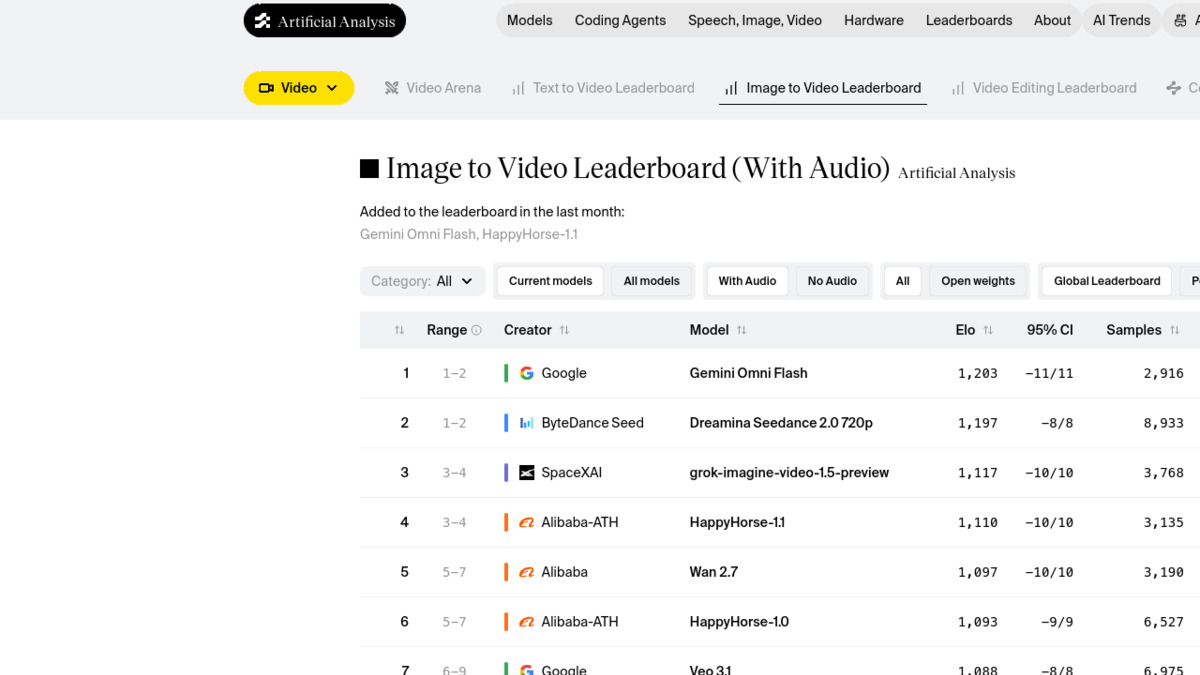 The current Artificial Analysis Image-to-Video leaderboard. Hailuo 02 no longer appears among the ranked entries - a sign of how fast the video-generation field has moved since its June 2025 launch.
Source: artificialanalysis.ai
The current Artificial Analysis Image-to-Video leaderboard. Hailuo 02 no longer appears among the ranked entries - a sign of how fast the video-generation field has moved since its June 2025 launch.
Source: artificialanalysis.ai
Because there's no MMLU or GPQA equivalent for video models, the metrics that actually matter here are resolution ceiling, clip length, generation speed, and physics/motion fidelity as judged by human voters - not synthetic scores, and we haven't fabricated any to fill the gap.
Key Capabilities
Physics-grounded motion
NCR's defining pitch was training compute allocated by scene "noise" - simpler, low-motion frames get compressed while complex, high-motion sequences (falling objects, fluid interactions, articulated human movement) get more capacity. In practice that showed up as noticeably fewer limb-merging and object-clipping artifacts than the 2024-era field, which is why MiniMax's gymnastics-routine demos became the model's calling card. Later reporting attributes the more rigorous physics benchmark win (WorldModelBench "Physics Champion") to the follow-up Hailuo 2.3 rather than 02 itself, but 02 is where the architecture debuted.
Fast, cheap iteration
Where Hailuo 02 still earns its keep is turnaround speed and cost per clip. A 6-second 768p Standard generation runs in the range of $0.27-$0.28 - roughly a tenth of what Google charged for a comparable 8-second 1080p Veo 3 clip at the time, per The Decoder's reporting. That price-to-speed ratio is why the model shows up in tool roundups like our best AI video generation tools guide as the volume option inside multi-model platforms such as Hedra.
Character action scenes
Independent side-by-side testing consistently describes Hailuo 02 as strongest on character-driven action - smooth pans, consistent expressions across a shot, lighting that reads like a real camera rig rather than a filter. The tradeoff is motion blur during fast movement, which is the main knock reviewers bring up against it for pure action sequences, where Kling 3.0's camera control and motion brush tools tend to win head-to-head comparisons.
Pricing and Availability
Hailuo 02 is sold two ways: a consumer subscription through the Hailuo AI app, and metered API access via third-party inference providers (MiniMax doesn't publish a first-party developer API price card the way Google or OpenAI do).
API pricing (third-party providers, current as of July 2026):
| Provider | Tier | Price | Notes |
|---|---|---|---|
| fal.ai | Standard (768p) | $0.045/s | 6s clip ≈ $0.27 |
| fal.ai | Pro (1080p) | $0.08/s | 6s clip ≈ $0.48, ~8 min generation time |
| Segmind | Standard | $0.3375/video | Flat per-generation rate |
| Segmind | Pro (1080p) | $0.60/video | Flat per-generation rate |
Consumer subscription (Hailuo AI app, hailuoai.video):
| Plan | Monthly Price | Credits | Notes |
|---|---|---|---|
| Free Trial | $0 | 200 (3-day expiry) | Watermarked, ~16 clips at 512p/6s |
| Standard | $7.99 | 1,000 | Watermark-free, commercial use |
| Pro | $27.99 | 4,500 | |
| Master | $63.99 | 10,500 | |
| Max | $199.99 | 20,000 | Includes unlimited Relax-mode access to Hailuo 2.0/2.3 and Hailuo 1.0 |
A single 512p/6-second render costs 12 credits at the base tier; premium 1080p/cinematic renders run 50-80 credits. List pricing on the higher consumer tiers has moved around between sources - some report $54.99/$119.99 for the Pro/Master steps rather than $27.99/$63.99 - which is typical for promotional-versus-standard billing on this platform, so treat the exact middle tiers as approximate and check hailuoai.video/subscribe before budgeting a campaign around them.
There's no first-party audio track: pair Hailuo 02 output with a separate TTS or sound-design pass if you need synchronized dialogue or foley, unlike audio-native competitors such as Seedance 2.0 or Veo 3.1.
Strengths and Weaknesses
Strengths
- Among the cheapest per-second video generation rates of any commercially available model, at both API and consumer tiers
- Physics-aware NCR architecture handles complex human motion (gymnastics, fast action) with fewer artifacts than same-era competitors
- Fast generation turnaround relative to output quality
- Both T2V and I2V supported from the same checkpoint
- Consumer plans bundle access to the newer 2.3 checkpoint under one credit pool, so subscribers aren't locked to the older model
Weaknesses
- No native audio - requires a separate generation or dubbing step for sound
- No longer tracked on Artificial Analysis's current leaderboards; independently verifiable current-generation benchmark data doesn't exist
- 6-10 second max clip length is short next to Kling 3.0's 15 seconds or Seedance 2.0's multi-shot 15-second sequences
- Motion blur during fast action is a recurring complaint in side-by-side reviews
- Superseded within MiniMax's own lineup by Hailuo 2.3, which now holds the physics-benchmark crown Hailuo 02 built its reputation on
- No official parameter count or architecture paper published - efficiency and scale claims come from MiniMax's own announcement, not third-party verification
Related Coverage
- AI Video Generation Pricing - April 2026 - cross-vendor per-second rate comparison including Hailuo 02
- Video Generation Benchmarks Leaderboard 2026 - where Hailuo 02 ranks today against current-generation models
- Best AI Video Generation Tools in 2026 - platforms like Hedra that bundle MiniMax Hailuo with Kling and Veo
- Kling 3.0 - the cinematic-camera-control competitor
- Veo 3.1 - the native-audio, 4K competitor
- Dreamina Seedance 2.0 - the current Artificial Analysis leaderboard leader
- MiniMax M2.5 - MiniMax's separate flagship text/agentic model line
FAQ
Is Hailuo 02 still the best MiniMax video model?
No. MiniMax released Hailuo 2.3 in October 2025 with better physics fidelity (it holds the WorldModelBench "Physics Champion" title), stronger character consistency, and a Fast variant. Hailuo 02 remains available as the cheaper, older tier.
Does Hailuo 02 generate audio?
No. Hailuo 02 is video-only. Pair it with a separate text-to-speech or sound-design tool for synchronized dialogue or effects, unlike audio-native models such as Seedance 2.0 or Veo 3.1.
How much does Hailuo 02 cost per video?
Via third-party APIs, roughly $0.045/s Standard (768p) to $0.08/s Pro (1080p) - a 6-second clip runs about $0.27-$0.48. Consumer plans start at $7.99/month for 1,000 credits through the Hailuo AI app.
How does Hailuo 02 compare to Kling 3.0 and Veo 3.1?
Hailuo 02 is cheaper and faster but caps out at 1080p/10 seconds with no native audio. Kling 3.0 leads on native 4K, camera control, and multi-shot storyboarding; Veo 3.1 leads on native audio and 4K. Hailuo's niche is low-cost, fast character-action generation.
Why doesn't Hailuo 02 appear on the Artificial Analysis leaderboard anymore?
It launched at #2 on the Image-to-Video Arena in June 2025 but hasn't been resubmitted for re-scoring as the arena has cycled through newer Seedance, Kling, Veo, and Gemini checkpoints. Its historical Elo (~1,332) is a launch-era result, not a current ranking.
Sources
- MiniMax Hailuo 02, World-Class Quality, Record-Breaking Cost Efficiency - MiniMax News
- MiniMax Hailuo 2.3: A New Level of Complex Video Performance & Media Agent - MiniMax News
- MiniMax's Hailuo 02 tops Google Veo 3 in user benchmarks at much lower video costs - The Decoder
- Minimax Hailuo 2 Pricing - Segmind
- MiniMax Hailuo-02 Pro: Premium Text-to-Video API - fal.ai
- Hailuo 2 - Replicate
- Hailuo AI Pricing 2026: Cost Per Video & Best Value Plans - AtlasCloud
- Hailuo AI Pricing & Plans
- Artificial Analysis: Image-to-Video Leaderboard
- Artificial Analysis on X: Hailuo 02 launches at rank #2 Image-to-Video Leaderboard
✓ Last verified July 20, 2026

