
Gemini 3.6 Flash
Google DeepMind's workhorse Flash model cuts output tokens 17% versus Gemini 3.5 Flash, drops output pricing to $7.50/M, and cuts DeepSWE task tokens by 65% while trailing GPT-5.6 Luna and Grok 4.5 on raw coding scores.
 9 min read
Gemini 3.6 Flash is Google DeepMind's latest workhorse model, released July 21, 2026 with two siblings: Gemini 3.5 Flash-Lite, a high-throughput budget model, and Gemini 3.5 Flash Cyber, a vulnerability-hunting model restricted to governments and select partners. The announcement, published under Tulsee Doshi's byline as Senior Director of Product Management for Gemini, frames 3.6 Flash as the successor to Gemini 3.5 Flash rather than a new architecture. According to the official model card, 3.6 Flash "is based on Gemini 3.5 Flash" and inherits its entire stack, tuned instead for precision and token efficiency.
TL;DR
- Cuts output token usage 17% versus Gemini 3.5 Flash on the Artificial Analysis Index, with a 65% drop on DeepSWE agentic coding tasks (276K to 97K tokens per task)
- 1M-token context, $1.50/M input tokens, output price down from $9.00 to $7.50/M
- Leads on computer use (83.0% OSWorld-Verified) and long-context retrieval, but trails GPT-5.6 Luna and Grok 4.5 on raw coding benchmarks like DeepSWE and Terminal-Bench 2.1
That efficiency framing is the whole pitch. Google isn't claiming a leap in raw intelligence here. It's claiming the model does the same agentic and coding work in fewer tokens, with fewer wasted turns. The company says 3.6 Flash shows less "action bias" (it's less likely to edit files nobody asked it to touch) and less "execution loop spiraling," the pattern where a model second-guesses its own tool calls and burns tokens re-verifying work it already finished. Whether that translates into cheaper real-world agent runs, not just cheaper benchmark runs, is the open question for teams building on it.
Google also used the launch to manage expectations elsewhere in the lineup. Gemini 3.5 Pro, teased in May, still isn't broadly available; Doshi's post says it remains in partner testing with a promise to ship "as soon as it's ready." The same post confirms Google has started its "most ambitious pre-training run yet" for Gemini 4. Neither of those change what 3.6 Flash is: a mid-cycle refinement of the Flash line, not a frontier jump.
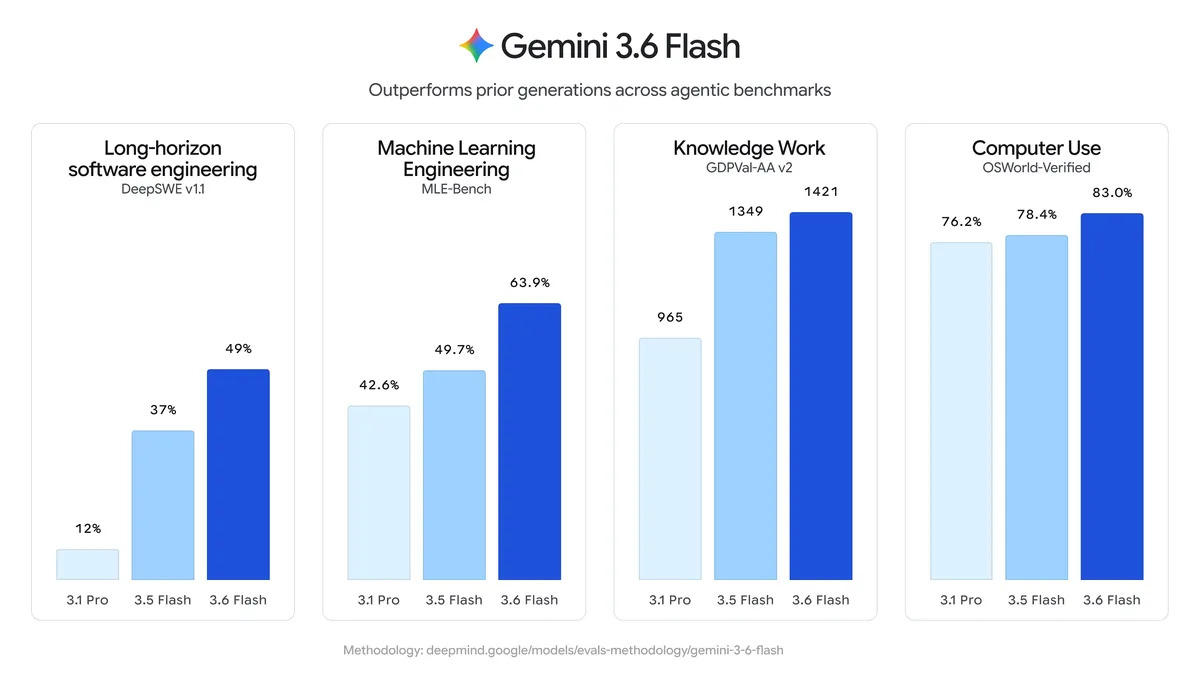 Google's own evaluation chart showing Gemini 3.6 Flash's gains over Gemini 3.5 Flash and Gemini 3.1 Pro on long-horizon coding, ML engineering, knowledge work, and computer use.
Source: blog.google
Google's own evaluation chart showing Gemini 3.6 Flash's gains over Gemini 3.5 Flash and Gemini 3.1 Pro on long-horizon coding, ML engineering, knowledge work, and computer use.
Source: blog.google
Key Specifications
| Specification | Details |
|---|---|
| Provider | Google DeepMind |
| Model Family | Gemini |
| Parameters | Not disclosed |
| Context Window | 1,048,576 input tokens / 65,536 output tokens |
| Input Modalities | Text, image, audio, video, PDF |
| Output Modalities | Text |
| Knowledge Cutoff | March 2026 |
| Input Price | $1.50 / M tokens |
| Output Price | $7.50 / M tokens |
| Release Date | July 21, 2026 |
| License | Proprietary |
Benchmark Performance
Every number below comes from Google DeepMind's official Gemini 3.6 Flash model card, published with the launch. The competitor scores in the same table are Google's own, sourced from its internal evaluation harness rather than independent labs, so treat cross-vendor comparisons as directional.
| Benchmark | Gemini 3.6 Flash | Gemini 3.5 Flash | GPT-5.6 Luna | Grok 4.5 | Claude Sonnet 5 |
|---|---|---|---|---|---|
| SWE-Bench Pro (Public) | 58.7% | 55.1% | 62.7% | 64.7% | 63.2% |
| DeepSWE v1.1 | 49% | 37% | 67% | 54% | 54% |
| Terminal-Bench 2.1 | 78.0% | 76.2% | 84.7% | 83.3% | 80.4% |
| MLE-Bench | 63.9% | 49.7% | 47.6% | 43.2% | 66.9% |
| GDPVal-AA v2 (Elo) | 1421 | 1349 | 1584 | 1535 | 1607 |
| OSWorld-Verified (computer use) | 83.0% | 78.4% | 72.6% | n/a | 81.2% |
| GDM-MRCR v2 (128K, avg) | 91.8% | 77.3% | 74.8% | 81.4% | 71.6% |
| GDM-MRCR v2 (1M, pointwise) | 54.0% | 26.6% | n/a | n/a | n/a |
The pattern holds across every independent write-up that has picked this table apart since launch. Gemini 3.6 Flash gains real ground on its own predecessor everywhere, most visibly on DeepSWE (12 points) and MLE-Bench (14.2 points), and it wins outright on computer use and long-context retrieval. But it doesn't close the gap to GPT-5.6 Luna or Grok 4.5 on coding-specific tests like Terminal-Bench 2.1 and DeepSWE, where both rivals still score higher. For teams choosing a model purely on SWE-Bench Pro or DeepSWE, 3.6 Flash isn't the pick. For teams running long agent sessions that touch documents, screenshots, and terminals in the same task, the long-context and computer-use numbers matter more, and that's where it leads.
Check the coding benchmarks leaderboard and agentic AI benchmarks leaderboard for how these scores stack up as more third-party evaluations land.
Key Capabilities
Token Efficiency and Agent Loops
The headline change isn't a new benchmark record, it's fewer tokens spent getting to the same result. On DeepSWE, average output per task fell from 276,000 tokens with Gemini 3.5 Flash to 97,000 with 3.6 Flash, a 65% reduction. On the Artificial Analysis Intelligence Index, the drop is a more modest 17%, from 28,000 to 23,000 tokens per task on average. Google attributes this to reduced "execution loop spiraling" and lower "action bias," engineering language for a model that stops re-checking its own work and stops touching files outside the scope of the request. For agentic pipelines billed by the token, that's a direct cost lever independent of the per-token price cut.
Computer Use and Multimodal Work
OSWorld-Verified, the benchmark for autonomous desktop and browser control, went from 78.4% with 3.5 Flash to 83.0%, the best score in Google's own comparison table, ahead of GPT-5.6 Luna's 72.6%. Combined with the 1M-token context window and native image, audio, video, and PDF input support, this is where enterprise customers are pointing the model. Figma described the release as "a step forward in both cost and quality" for its use case; Harvey and Hebbia both cited gains on multimodal document parsing, chart reading, and report drafting, the kind of long, mixed-media agent tasks OSWorld and GDM-MRCR are built to test.
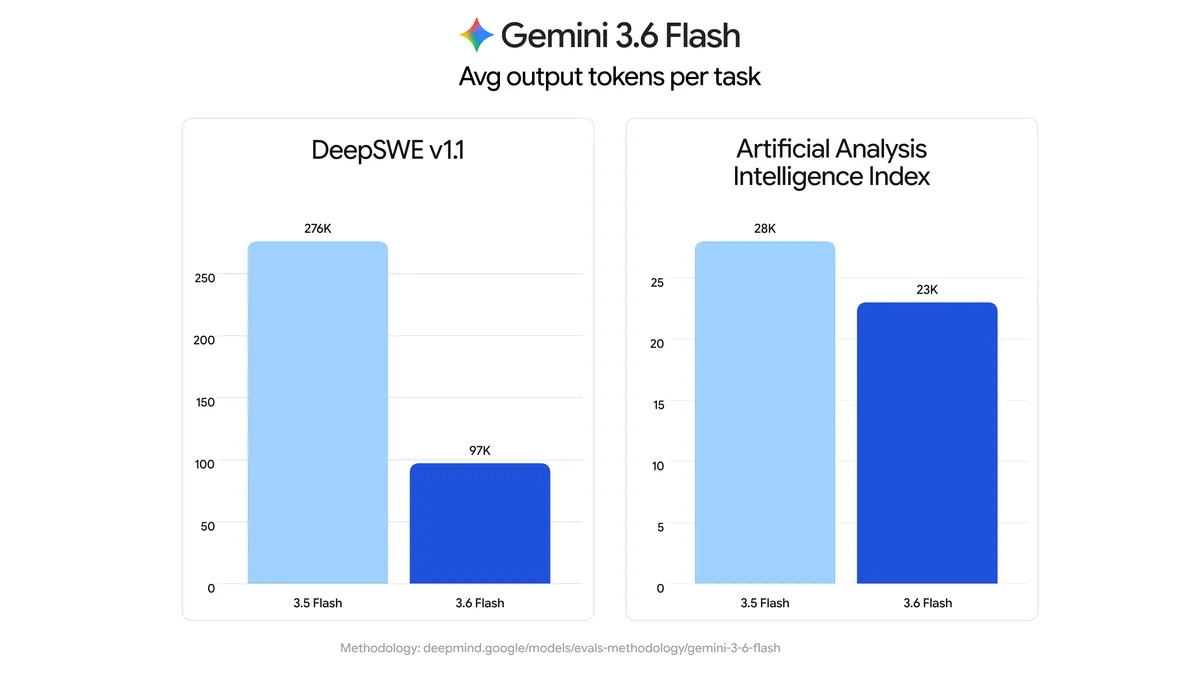 Google's efficiency chart: DeepSWE output tokens per task fall from 276K to 97K, and Artificial Analysis Index tokens fall from 28K to 23K.
Source: blog.google
Google's efficiency chart: DeepSWE output tokens per task fall from 276K to 97K, and Artificial Analysis Index tokens fall from 28K to 23K.
Source: blog.google
Long Context
GDM-MRCR v2 at 128K tokens jumped to 91.8% from 77.3%, and at the full 1M-token window it more than doubled, from 26.6% to 54.0%. That's still a meaningful drop-off at the extreme end of the context window, a pattern every long-context model shows, but the improvement over the previous generation is the largest single gain in the whole benchmark table. For retrieval-augmented pipelines that push close to the 1M-token ceiling, this is the number that matters more than any coding score.
Pricing and Availability
Standard pricing: $1.50 per million input tokens, $7.50 per million output tokens, with a 90% cache-hit discount bringing cached input down to $0.15 per million. That's a $1.50 cut on output pricing from Gemini 3.5 Flash's $9.00, while input pricing hasn't moved.
Against the competitors in the benchmark table:
- GPT-5.6 Luna: $1.00 / $6.00 per million tokens, cheaper on both ends but scores higher on coding-specific benchmarks
- Grok 4.5: $2.00 / $6.00 per million tokens, higher input cost but the top SWE-Bench Pro and DeepSWE scores in this comparison
- Claude Sonnet 5: $3.00 / $15.00 per million tokens at full price ($2.00 / $10.00 through an introductory discount), the most expensive of the four but leads on MLE-Bench and GDPVal-AA
Gemini 3.6 Flash sits in the middle of that range on price and wins on efficiency rather than the sticker number alone: fewer tokens per task offsets some of the gap against Luna's lower per-token rate. The model is live now via the Gemini API, Google AI Studio, Android Studio, Google Antigravity, the Gemini Enterprise Agent Platform, and the Gemini app, with no separate waitlist reported at launch.
Gemini 3.6 Flash "is our workhorse model that delivers better coding, knowledge work, and multimodal performance, while providing better token-efficiency than Gemini 3.5 Flash." - Google DeepMind model card, July 2026
Enterprise adopters named at launch include Figma, Harvey, Hebbia, and JetBrains for 3.6 Flash itself, with Ashler, Palo Alto Networks, and Ramp cited as early users of the cheaper Gemini 3.5 Flash-Lite sibling. Gemini 3.5 Flash Cyber, the third model in the announcement, stays gated behind a "governments and trusted partners" pilot through Google's CodeMender program and isn't broadly purchasable. On CyberGym, Google's internal vulnerability-detection benchmark, that gated model scores 83.2% with a five-call budget, roughly in line with GPT-5.6 Sol (83.6%) and Anthropic's Mythos 5 (83.8%) running in their respective agent harnesses.
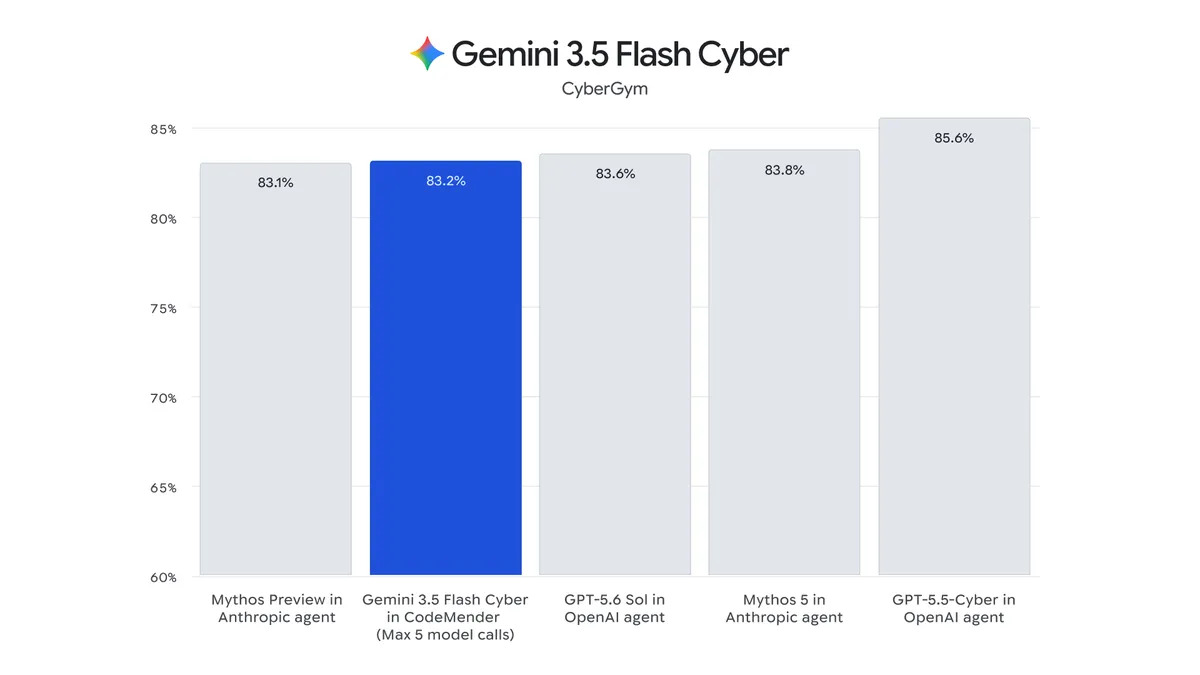 Gemini 3.5 Flash Cyber's CyberGym score of 83.2%, released the same day as Gemini 3.6 Flash, sits close to GPT-5.6 Sol and Claude Mythos 5.
Source: blog.google
Gemini 3.5 Flash Cyber's CyberGym score of 83.2%, released the same day as Gemini 3.6 Flash, sits close to GPT-5.6 Sol and Claude Mythos 5.
Source: blog.google
Strengths and Weaknesses
Strengths
- Token efficiency: 17% fewer output tokens on average, up to 65% fewer on long-horizon coding tasks
- Computer use: 83.0% on OSWorld-Verified, ahead of GPT-5.6 Luna in Google's own comparison
- Long context: GDM-MRCR v2 at 1M tokens jumps to 54.0% from the predecessor's 26.6%
- Lower output pricing than Gemini 3.5 Flash at the same input price
- Broad day-one availability across the Gemini app, API, AI Studio, and Antigravity
Weaknesses
- Trails GPT-5.6 Luna and Grok 4.5 on DeepSWE and Terminal-Bench 2.1, the benchmarks that matter most for pure coding work
- GPT-5.6 Luna is cheaper on both input and output tokens
- Benchmark comparisons against competitors come from Google's own harness, not a neutral third party
- No image or audio output, text generation only
- Parameter count still undisclosed, standard for the Gemini line but limits architectural comparison
Related Coverage
- Gemini 3.5 Flash - the predecessor this model replaces as Google's default Flash tier
- Gemini 3.5 Pro - still in partner testing as of this launch, expected to ship "soon"
- Gemini 3 Deep Think - Google's reasoning-first mode for tasks where speed matters less than depth
- Agentic AI Benchmarks Leaderboard - live rankings across GAIA, MCP Atlas, and BFCL
- Coding Benchmarks Leaderboard - SWE-Bench and Terminal-Bench standings as independent evaluations come in
FAQ
What is Gemini 3.6 Flash?
Google DeepMind's workhorse Flash model, released July 21, 2026 as the successor to Gemini 3.5 Flash. It targets better coding, multimodal, and agentic performance at lower token cost per task.
How much does Gemini 3.6 Flash cost?
$1.50 per million input tokens and $7.50 per million output tokens, down from $9.00 output pricing on Gemini 3.5 Flash. Cached input costs $0.15 per million tokens.
Is Gemini 3.6 Flash better than GPT-5.6 Luna?
It depends on the task. GPT-5.6 Luna scores higher on DeepSWE (67% vs 49%) and Terminal-Bench 2.1 (84.7% vs 78.0%) and is cheaper per token. Gemini 3.6 Flash leads on computer use (83.0% vs 72.6% OSWorld-Verified) and long-context retrieval.
What is the context window for Gemini 3.6 Flash?
1,048,576 input tokens (about 1M) with a 65,536-token output limit. Long-context retrieval performance at the full 1M window improved substantially over Gemini 3.5 Flash, from 26.6% to 54.0% on GDM-MRCR v2.
Is Gemini 3.5 Pro available yet?
No. As of the Gemini 3.6 Flash launch, Gemini 3.5 Pro remains in partner testing. Google says it will become broadly available once ready but hasn't given a date.
What is Gemini 3.5 Flash Cyber?
A specialized security model released the same day as Gemini 3.6 Flash, built for finding and fixing vulnerabilities through Google's CodeMender program. It's currently limited to governments and select partners, not generally available.
Sources:
- Introducing Gemini 3.6 Flash, 3.5 Flash-Lite, and 3.5 Flash Cyber - Google Blog
- Gemini 3.6 Flash Model Card - Google DeepMind
- Gemini 3.6 Flash - Google DeepMind
- Google releases three new Gemini models, but no 3.5 Pro - TechCrunch
- Google launches Gemini 3.6 Flash and 3.5 Flash-Lite, teases Gemini 4 - 9to5Google
- Google expands Gemini 3.5 line with trio of new models - Android Authority
- Google launches Gemini 3.6 Flash, 3.5 Flash-Lite, and 3.5 Flash Cyber - GSMArena
- Gemini 3.6 Flash - Intelligence, Performance & Price Analysis - Artificial Analysis
✓ Last verified July 22, 2026

