
Gemini 3.5 Flash-Lite
Google DeepMind's cheapest paid Gemini tier prices input at $0.30/M and output at $2.50/M tokens, more than doubling OSWorld-Verified and Terminal-Bench 2.1 scores over Gemini 3.1 Flash-Lite while trailing GPT-5.4 mini on raw coding benchmarks.
 Updated
8 min read
Updated
8 min read
Gemini 3.5 Flash-Lite is Google DeepMind's cheapest paid model, released July 21, 2026 with Gemini 3.6 Flash and a gated security variant, Gemini 3.5 Flash Cyber. Google's own copy calls it "the most cost-effective model in the class," and the pricing backs that up: $0.30 per million input tokens and $2.50 per million output tokens, undercutting both GPT-5.4 mini and Claude Haiku 4.5 on input price. The model card lists its architecture as built on Gemini 3.1 Flash-Lite, the preview-only budget model Google shipped in March 2026, rather than a fresh design.
TL;DR
- Prices at $0.30/M input and $2.50/M output tokens, the cheapest paid tier in the Gemini 3 line
- 1M-token context window; OSWorld-Verified jumps to 74.0% and Terminal-Bench 2.1 to 54.0%, both roughly double Gemini 3.1 Flash-Lite's scores
- Beats GPT-5.4 mini on computer use and long-context retrieval, loses to it on Terminal-Bench 2.1 and knowledge-work Elo
Google is positioning Flash-Lite as the layer beneath Gemini 3.6 Flash rather than a competitor to it: 3.6 Flash for complex agent work, 3.5 Flash-Lite for the high-volume, latency-sensitive jobs that make up most production traffic, agentic search, document processing, translation, classification. It's already rolling out inside Google Search's AI Mode and shipped with named early adopters Ashler, Palo Alto Networks, and Ramp, all cited for using it to scale agentic pipelines where per-call cost adds up fast.
The generational story is more complicated than a single launch date suggests. Google's own deprecation schedule still lists Gemini 3.1 Flash-Lite, not 3.5, as the named migration target for Gemini 2.5 Flash-Lite, which shuts down October 16, 2026. But 3.1 Flash-Lite never left preview status and was superseded just four months after it shipped, so any team migrating off 2.5 Flash-Lite today lands on 3.5 Flash-Lite as the current cheapest stable option in the Gemini 3 family.
Key Specifications
| Specification | Details |
|---|---|
| Provider | Google DeepMind |
| Model Family | Gemini |
| Parameters | Not disclosed |
| Context Window | 1,048,576 input tokens / 65,536 output tokens |
| Input Modalities | Text, image, audio, video |
| Output Modalities | Text |
| Knowledge Cutoff | March 2026 (some domains limited to January 2025) |
| Input Price | $0.30 / M tokens (standard) |
| Output Price | $2.50 / M tokens (standard) |
| Release Date | July 21, 2026 |
| License | Proprietary |
Benchmark Performance
Every number below comes from Google DeepMind's official Gemini 3.5 Flash-Lite model card, which publishes GPT-5.4 mini and Claude Haiku 4.5 scores from its own evaluation harness with the Gemini figures. Treat the cross-vendor columns as directional rather than neutral, the same caveat that applies to every vendor-published comparison.
| Benchmark | Gemini 3.5 Flash-Lite | Gemini 3.1 Flash-Lite | GPT-5.4 mini | Claude Haiku 4.5 |
|---|---|---|---|---|
| SWE-Bench Pro (Public) | 54.2% | 38.3% | 54.4% | 39.5% |
| Terminal-Bench 2.1 | 54.0% | 31.0% | 59.2% | 44.2% |
| MLE-Bench | 39.2% | 22.0% | n/a | n/a |
| GDPVal-AA v2 (Elo) | 1140 | 642 | 1171 | 907 |
| OSWorld-Verified (computer use) | 74.0% | 54.3% | 72.1% | 50.7% |
| GDM-MRCR v2 (128K, avg) | 72.2% | 60.1% | 42.7% | 35.3% |
| GDM-MRCR v2 (1M, pointwise) | 21.3% | 12.3% | n/a | n/a |
The jump over Gemini 3.1 Flash-Lite is the headline: SWE-Bench Pro nearly closes a 16-point gap in one generation, and OSWorld-Verified climbs almost 20 points. Against outside competitors the picture splits by task. GPT-5.4 mini still wins on Terminal-Bench 2.1 and GDPVal-AA v2, the benchmarks that reward sustained multi-step reasoning, and edges out Gemini narrowly on SWE-Bench Pro. Gemini 3.5 Flash-Lite pulls well ahead on OSWorld-Verified and by a wide margin on long-context retrieval, where GPT-5.4 mini's 128K score sits 30 points behind. For teams choosing a budget model purely on coding benchmarks, GPT-5.4 mini remains the stronger pick. For document-heavy or long-session agent work, the context numbers favor Gemini. Check the cost efficiency leaderboard for how this stacks up against other budget models as more independent runs come in.
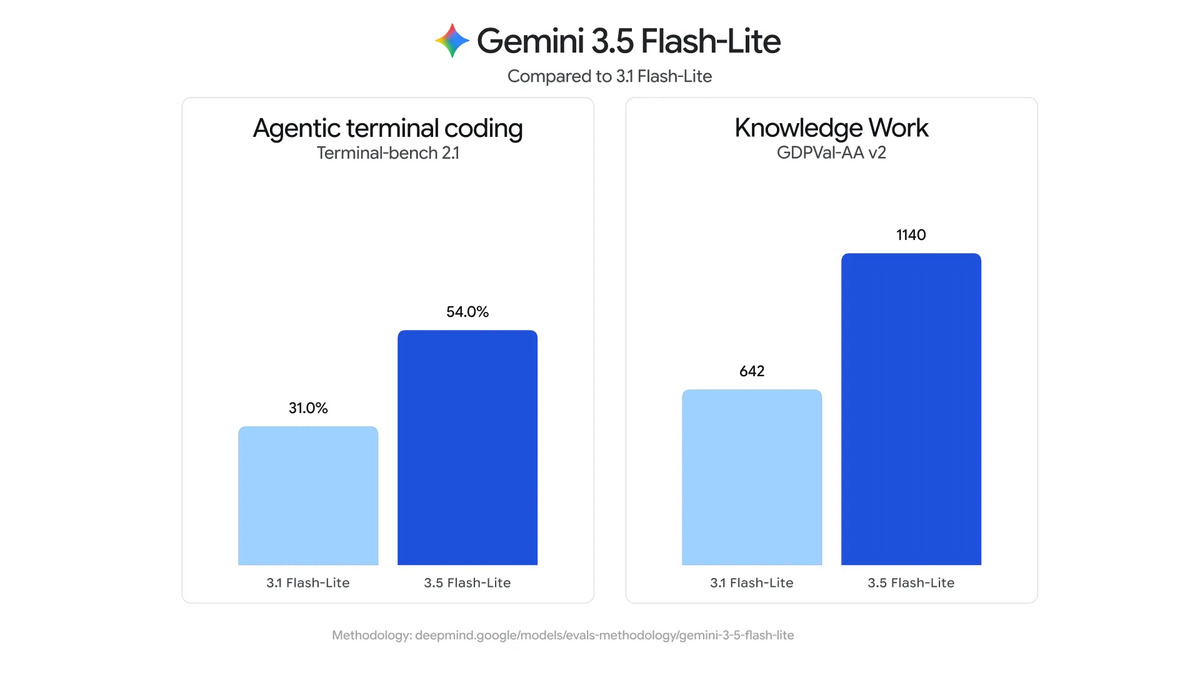 Google's own evaluation chart: Terminal-Bench 2.1 rises from 31.0% to 54.0%, and GDPVal-AA v2 Elo nearly doubles from 642 to 1140.
Source: blog.google
Google's own evaluation chart: Terminal-Bench 2.1 rises from 31.0% to 54.0%, and GDPVal-AA v2 Elo nearly doubles from 642 to 1140.
Source: blog.google
Key Capabilities
Configurable Thinking for Subagent Work
Flash-Lite ships with three thinking levels, minimal, low, and higher, that developers set per request rather than per deployment. Minimal favors raw throughput for classification and routing; higher spends more compute on multi-step subagent tasks inside larger agent pipelines. That flexibility is the point of a "Lite" model in 2026: it's built to be the cheap worker a bigger orchestrator model dispatches narrow jobs to, not a standalone chat model competing on general intelligence.
Computer Use and Long Context
OSWorld-Verified, Google's benchmark for autonomous desktop and browser control, reached 74.0%, ahead of both GPT-5.4 mini and Claude Haiku 4.5 in the vendor's comparison. Paired with the 1M-token context window, that's the combination pushing Flash-Lite into agentic search and document-heavy workflows. GDM-MRCR v2 at 128K tokens hit 72.2%, more than double GPT-5.4 mini's 42.7%, though the 1M-token score of 21.3% shows the familiar drop-off every long-context model shows at the extreme end of its window.
"Gemini 3.5 Flash-Lite landed on the Pareto frontier in our receipt extraction benchmark, offering one of the best tradeoffs we've tested between accuracy, latency, and cost." - Veeral Patel, Head of Applied AI, Ramp
Multimodal Input at Volume
Text, image, audio, and video inputs run through the same endpoint at the same per-token price, which matters for the workloads Google is targeting: parsing scanned receipts, transcribing calls, reading charts embedded in reports. Palo Alto Networks' Ashwin Kannan, principal AI engineer, described the jump from Gemini 3.1 Flash-Lite as unlocking "a highly responsive option they can choose on demand for smooth, uninterrupted execution," language that lines up with the benchmark table: same price tier, meaningfully higher scores across almost every category.
Pricing and Availability
Standard pricing is $0.30 per million input tokens and $2.50 per million output tokens, confirmed against Google's Gemini API pricing page. Three other tiers apply depending on latency and reliability needs:
- Batch and Flex: $0.15/M input, $1.25/M output, half the standard rate for asynchronous or best-effort jobs
- Priority: $0.54/M input, $4.50/M output, for guaranteed low-latency serving
- Context caching: $0.03/M tokens per cache hit on the standard tier, plus $1.00/M tokens per hour for cache storage
Against the competitors in the benchmark table, GPT-5.4 mini costs $0.75/M input and $4.50/M output, 2.5x Gemini's input price, while Claude Haiku 4.5 runs $1.00/M input and $5.00/M output, more than 3x Gemini's input rate. Gemini 3.5 Flash-Lite is the cheapest of the three on paper and it wins the benchmarks that matter most for high-volume, document-heavy pipelines, but GPT-5.4 mini's lead on Terminal-Bench 2.1 and GDPVal-AA v2 means the cheapest option isn't automatically the best one for agentic coding work.
The model is live now through the Gemini API, Google AI Studio, Android Studio, and the Gemini Enterprise Agent Platform, and is rolling out inside Google Search's AI Mode. No separate waitlist was reported at launch.
Strengths
- Cheapest paid tier in the Gemini 3 lineup at $0.30/$2.50 per million tokens
- Leads GPT-5.4 mini and Claude Haiku 4.5 on OSWorld-Verified computer use and GDM-MRCR long-context retrieval
- 1M-token context window with native text, image, audio, and video input
- Configurable thinking levels let one model cover both throughput-first and reasoning-heavier subagent tasks
- Broad day-one availability, already rolling out in Google Search AI Mode
Weaknesses
- Trails GPT-5.4 mini on Terminal-Bench 2.1 (54.0% vs 59.2%) and GDPVal-AA v2 Elo (1140 vs 1171)
- Long-context performance at the full 1M-token window drops to 21.3%, the same falloff pattern seen across the Gemini line
- Google's own deprecation page still names Gemini 3.1 Flash-Lite, not this model, as the official migration target from Gemini 2.5 Flash-Lite
- Parameter count undisclosed, standard for Gemini but limits architectural comparison
- Text-only output, no image or audio generation
Related Coverage
- Gemini 3.6 Flash - the heavier sibling released the same day, for complex agentic and coding work
- Gemini 2.5 Flash-Lite - the prior-generation budget tier retiring October 16, 2026
- Gemini 3.1 Flash-Lite Review - our hands-on test of the preview-only model this one builds on
- GPT-5.4 mini - OpenAI's closest price-tier competitor, ahead on coding benchmarks
- Claude Haiku 4.5 - Anthropic's budget model, priced higher on both input and output
- Cost Efficiency Leaderboard - live rankings of performance per dollar across budget and frontier models
FAQ
What is Gemini 3.5 Flash-Lite?
Google DeepMind's cheapest paid Gemini model, released July 21, 2026. It's built for high-volume, latency-sensitive tasks like document processing, translation, and agentic search rather than peak reasoning.
How much does Gemini 3.5 Flash-Lite cost?
$0.30 per million input tokens and $2.50 per million output tokens at standard pricing. Batch and Flex tiers drop to $0.15/$1.25, while Priority tier costs $0.54/$4.50 for guaranteed low-latency serving.
Is Gemini 3.5 Flash-Lite better than GPT-5.4 mini?
It depends on the task. GPT-5.4 mini scores higher on Terminal-Bench 2.1 (59.2% vs 54.0%) and GDPVal-AA v2 Elo (1171 vs 1140). Gemini 3.5 Flash-Lite leads on OSWorld-Verified computer use (74.0% vs 72.1%) and long-context retrieval, and costs less on both input and output tokens.
What is the context window for Gemini 3.5 Flash-Lite?
1,048,576 input tokens (about 1M) with a 65,536-token output limit. Retrieval accuracy is strong at 128K tokens (72.2%) but drops to 21.3% at the full 1M window.
Does Gemini 3.5 Flash-Lite replace Gemini 2.5 Flash-Lite?
In practice, yes, since Gemini 2.5 Flash-Lite retires October 16, 2026. Google's official deprecation page still names Gemini 3.1 Flash-Lite as the migration target, but that model was superseded by 3.5 Flash-Lite four months after its own launch.
Sources:
- Introducing Gemini 3.6 Flash, 3.5 Flash-Lite, and 3.5 Flash Cyber - Google Blog
- Gemini 3.5 Flash-Lite Model Card - Google DeepMind
- Gemini 3.5 Flash-Lite - Google DeepMind
- Gemini Developer API Pricing - Google AI for Developers
- Gemini API Deprecations - Google AI for Developers
- Gemini 3.5 Flash-Lite - Intelligence, Performance & Price Analysis - Artificial Analysis
- Google releases three new Gemini models, but no 3.5 Pro - TechCrunch
- Google launches Gemini 3.6 Flash and 3.5 Flash-Lite, teases Gemini 4 - 9to5Google
- Google Ships Three Gemini Flash Models as Its Flagship Slips - Unite.AI
- Gemini 3.5 Flash Lite - API Pricing & Benchmarks - OpenRouter
Last updated
✓ Last verified July 27, 2026

