
Gemini 2.5 Flash
Google's hybrid reasoning workhorse pairs a 1M-token context window with $0.30/$2.50 per million token pricing and a toggleable 0-24,576 token thinking budget, now heading toward an October 2026 shutdown.
 7 min read
Gemini 2.5 Flash is Google DeepMind's mid-tier workhorse model, the one built to sit between the cheap-and-fast Flash-Lite and the reasoning-heavy Gemini 2.5 Pro. Google shipped it as a preview on April 17, 2025, promoted it to general availability on June 17, 2025, and pushed a quality-and-efficiency refresh in September 2025. It was Google's first fully hybrid reasoning model: developers can switch its internal "thinking" process on or off per request, or cap it at a specific token budget, rather than getting a single fixed reasoning mode baked into the model.
TL;DR
- Hybrid reasoning model with a toggleable 0 to 24,576 token thinking budget for tuning cost against quality
- 1M-token input context, 64K-token output, $0.30/M input and $2.50/M output tokens
- Scores 82.8% on GPQA Diamond and 60.4% on SWE-bench Verified, trailing Claude Sonnet 4.6 on coding but beating it on science and math
 Google's own launch graphic for Gemini 2.5 Flash, built around the AI Studio developer console.
Source: developers.googleblog.com
Google's own launch graphic for Gemini 2.5 Flash, built around the AI Studio developer console.
Source: developers.googleblog.com
Architecturally, Gemini 2.5 Flash is a sparse mixture-of-experts transformer with native multimodal support, meaning it takes text, images, video, and audio as input without routing to a separate vision or audio model. Google trained it with a January 2025 knowledge cutoff. The pitch has always been price-to-performance: at launch, Google's own pareto-frontier chart plotted Flash-Preview-04-17 above every other model in its price range on the LMArena leaderboard, undercutting GPT-4.5 Preview and Claude 3.7 Sonnet by a wide margin on cost while staying competitive on quality.
That pitch now comes with an expiration date. Google's deprecation schedule lists gemini-2.5-flash for shutdown on October 16, 2026, with Gemini 3.5 Flash as the designated replacement. Anyone building on this model today is working against roughly a three-month runway from this writing.
Key Specifications
| Specification | Details |
|---|---|
| Provider | Google DeepMind |
| Model Family | Gemini 2.5 |
| Architecture | Sparse mixture-of-experts transformer, native multimodal |
| Parameters | Not disclosed |
| Context Window | 1,048,576 tokens input / 65,536 tokens output |
| Input Modalities | Text, images, video, audio |
| Output Modality | Text |
| Thinking Mode | Hybrid, toggleable, 0-24,576 token budget or dynamic (-1) |
| Knowledge Cutoff | January 2025 |
| Input Price | $0.30/M tokens (text/image/video); $1.00/M tokens (audio) |
| Output Price | $2.50/M tokens |
| Release Date | April 17, 2025 (preview); June 17, 2025 (GA) |
| License | Proprietary (hosted API only) |
| Availability | Google AI Studio, Gemini API, Vertex AI |
| Deprecation | October 16, 2026 (replaced by Gemini 3.5 Flash) |
Benchmark Performance
The numbers below come from Google's official Gemini 2.5 Flash model card, last updated December 2025, using the current stable (GA) build in thinking mode with single-attempt pass@1 scoring. For competitive context, they're set against two models developers commonly weigh Flash against today: Claude Sonnet 4.6 at the mid tier, and GPT-4o mini at the budget tier.
| Benchmark | Gemini 2.5 Flash | Claude Sonnet 4.6 | GPT-4o mini | Gemini 2.5 Flash-Lite |
|---|---|---|---|---|
| GPQA Diamond (science) | 82.8% | 74.1% | 40.2% | 64.6% |
| SWE-bench Verified (coding) | 60.4% | 79.6% | Not published | 31.6% |
| AIME 2025 (math) | 72.0% | Not published | Not published | 49.8% |
| MMMU (visual reasoning) | 79.7% | Not published | Not published | 72.9% |
| Global MMLU Lite (multilingual) | 88.4% | Not published | 82.0% (MMLU) | 81.1% |
Flash's split personality is obvious here. It beats Sonnet 4.6 by nearly nine points on GPQA Diamond, a graduate-level science benchmark, and posts strong numbers on math and multilingual reasoning too. Against GPT-4o mini, the gap is not close at all: more than double on GPQA Diamond. That reflects a real architectural advantage Flash inherited from the Gemini 2.5 family's reasoning-first training.
Coding tells the opposite story. SWE-bench Verified measures a model's ability to resolve real GitHub issues with actual patches, and Flash's 60.4% sits nearly 20 points behind Sonnet 4.6's 79.6%. Google's own scaffolding note explains part of the gap: Flash's score uses multiple trajectories re-scored by the model's own judgment, and it still lands well short. For agentic software engineering work, see the coding benchmarks leaderboard and the SWE-bench coding agent leaderboard for where Flash sits against the field.
Key Capabilities
The thinking budget is the feature that defines how Flash gets used in production. Setting it to 0 disables reasoning entirely and returns something close to Gemini 2.0 Flash-level speed. Setting it to -1 hands control to the model, which decides how many tokens to spend thinking based on how hard the request looks. Google's own scaling data shows this isn't a cosmetic dial: GPQA Diamond climbs from roughly 74% at a 0K budget to over 80% at 24K, and LiveCodeBench nearly doubles across the same range.
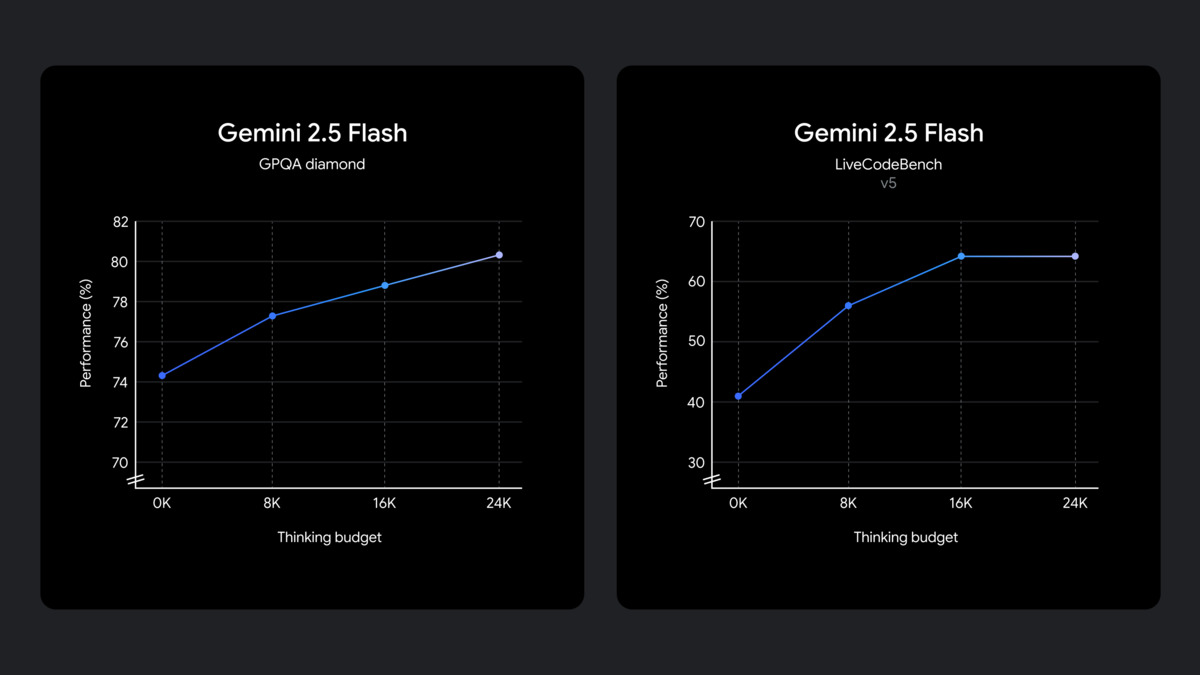 Google's own benchmark data showing how GPQA Diamond and LiveCodeBench scores climb as the thinking budget increases from 0 to 24,576 tokens.
Source: developers.googleblog.com
Google's own benchmark data showing how GPQA Diamond and LiveCodeBench scores climb as the thinking budget increases from 0 to 24,576 tokens.
Source: developers.googleblog.com
The 1M-token context window pairs with genuine long-context retrieval. On MRCR v2, an eight-needle needle-in-haystack test, Flash scores 74% at 128K tokens and 32% at the full 1M pointwise mark. That drop-off at full context length is worth flagging: it means the headline 1M window is usable for retrieval, but accuracy degrades well before you hit the ceiling, a pattern the long-context benchmarks leaderboard tracks across the field.
Native multimodal input is the other differentiator against text-first competitors like Sonnet 4.6. Flash accepts images, video, and audio directly, which matters for transcription pipelines, video summarization, and document extraction workloads that would otherwise need a separate model. Combined with function calling, code execution, and Google Search grounding, it's built as much for agentic tool-calling pipelines as for chat.
Pricing and Availability
Flash is available through Google AI Studio's free tier for experimentation, the paid Gemini API, and Vertex AI for enterprise deployments with SLA guarantees.
| Tier | Input (text/image/video) | Input (audio) | Output |
|---|---|---|---|
| Standard | $0.30/M | $1.00/M | $2.50/M |
| Batch | $0.15/M | $0.50/M | $1.25/M |
| Context caching | $0.03/M | $0.10/M | Storage: $1.00/M tokens/hour |
There's no separate charge for thinking tokens; they're billed as standard output, which simplifies cost forecasting compared to providers that meter reasoning tokens separately. Against Gemini 2.5 Flash-Lite at $0.10/$0.40 per million, Flash costs 3x on input and 6.25x on output for the jump in reasoning quality. Against Gemini 2.5 Pro at $1.25/$10.00 for sub-200K prompts, Flash is roughly a quarter of the price. For a head-to-head against a non-Google competitor at similar positioning, our Gemini 2.5 Flash vs Claude Sonnet 4.6 comparison breaks down the full cost-versus-quality tradeoff.
The catch is the shutdown date. gemini-2.5-flash is scheduled to stop serving requests on October 16, 2026, with Google steering new and existing traffic toward Gemini 3.5 Flash. Teams starting a new integration this late in the model's life should weigh whether it's worth building against a model with a fixed end date rather than migrating straight to its replacement.
Strengths
- Leads its own model card's comparison set on GPQA Diamond (82.8%), AIME 2025 (72.0%), and Global MMLU Lite (88.4%)
- Thinking budget gives fine-grained, per-request control over the cost-versus-quality tradeoff, from 0 to 24,576 tokens
- Native multimodal input across text, images, video, and audio in one endpoint
- No separate pricing tier for reasoning tokens, unlike providers that meter thinking output separately
- 1M-token context window with usable (if imperfect) retrieval at full length
Weaknesses
- SWE-bench Verified score of 60.4% trails Claude Sonnet 4.6's 79.6% by nearly 20 points on real coding tasks
- Scheduled for shutdown on October 16, 2026, with Gemini 3.5 Flash as the mandated replacement
- MRCR v2 long-context accuracy falls from 74% at 128K to 32% at the full 1M-token mark
- Parameters and training details undisclosed, ruling out self-hosting or independent architecture audits
- Audio input tokens price at more than 3x text and image tokens, which adds up for voice-heavy pipelines
Related Coverage
- Gemini 2.5 Flash-Lite - the budget sibling in the same family, at a third of the price
- Gemini 2.5 Pro - the reasoning-focused flagship this model sits below
- Gemini 3.5 Flash - Google's designated replacement once 2.5 Flash shuts down
- Gemini 2.5 Flash vs Claude Sonnet 4.6: Cost vs Code - full head-to-head against Anthropic's mid-tier model
- Coding Benchmarks Leaderboard - where Flash ranks against dedicated coding models
Sources
- Continuing to bring you our latest models, with an improved Gemini 2.5 Flash and Flash-Lite release - Google Developers Blog
- Start building with Gemini 2.5 Flash - Google Developers Blog
- Gemini 2.5 Flash and Pro GA on Vertex AI - Google Cloud Blog
- Gemini 2.5 Flash - Google AI for Developers
- Gemini Developer API pricing - Google AI for Developers
- Gemini API deprecations - Google AI for Developers
- Gemini 2.5 Flash Model Card (PDF) - Google DeepMind
- Gemini 2.5 Flash Intelligence & Performance Analysis - Artificial Analysis
✓ Last verified July 13, 2026

