
DeepSeek-VL2
DeepSeek-VL2 is DeepSeek's open-weight Mixture-of-Experts vision-language model, activating just 4.5B of its 27B parameters to hit 93.3% on DocVQA and beat GPT-4o on OCRBench.
 7 min read
TL;DR
- Open-weight Mixture-of-Experts vision-language model that activates only 4.5B of 27B total parameters, scoring 93.3% on DocVQA and 811 on OCRBench
- Ships in three sizes (Tiny, Small, base) so you can trade accuracy for VRAM - the 1B-active Tiny variant still hits 88.9% DocVQA
- Beats GPT-4o on OCRBench (811 vs 736) and TextVQA, but trails Qwen2-VL-7B on DocVQA and falls well behind on MMMU general reasoning (51.1% vs GPT-4o's 69.1%)
Overview
DeepSeek-VL2 is a vision-language model family that DeepSeek released on December 13, 2024, and it's easy to lose track of amid the company's louder headlines. DeepSeek-V3.2 and DeepSeek-V4 are text-only reasoning and coding models built on separate architectures released months later. VL2 is a different lineage: it takes still-images and text together, and its whole design pitch is doing that cheaply.
The model comes in three sizes built around the same DeepSeekMoE backbone: DeepSeek-VL2-Tiny (3B total, 1.0B activated), DeepSeek-VL2-Small (16B total, 2.8B activated), and the base DeepSeek-VL2 (27B total, 4.5B activated), according to the arXiv paper and the models' Hugging Face configuration files. Only a fraction of each model's weights fire on any given forward pass, which is the entire point of a Mixture-of-Experts design: near-dense-model accuracy at a slice of the inference cost.
It landed in a crowded field. Qwen2-VL and InternVL2 were putting out competitive open-weight vision models around the same window, and GPT-4o was the proprietary benchmark everyone measured against. DeepSeek-VL2's argument wasn't "we're the best on every axis." It was "we get close on document and OCR tasks while activating a fraction of the parameters you'd need elsewhere."
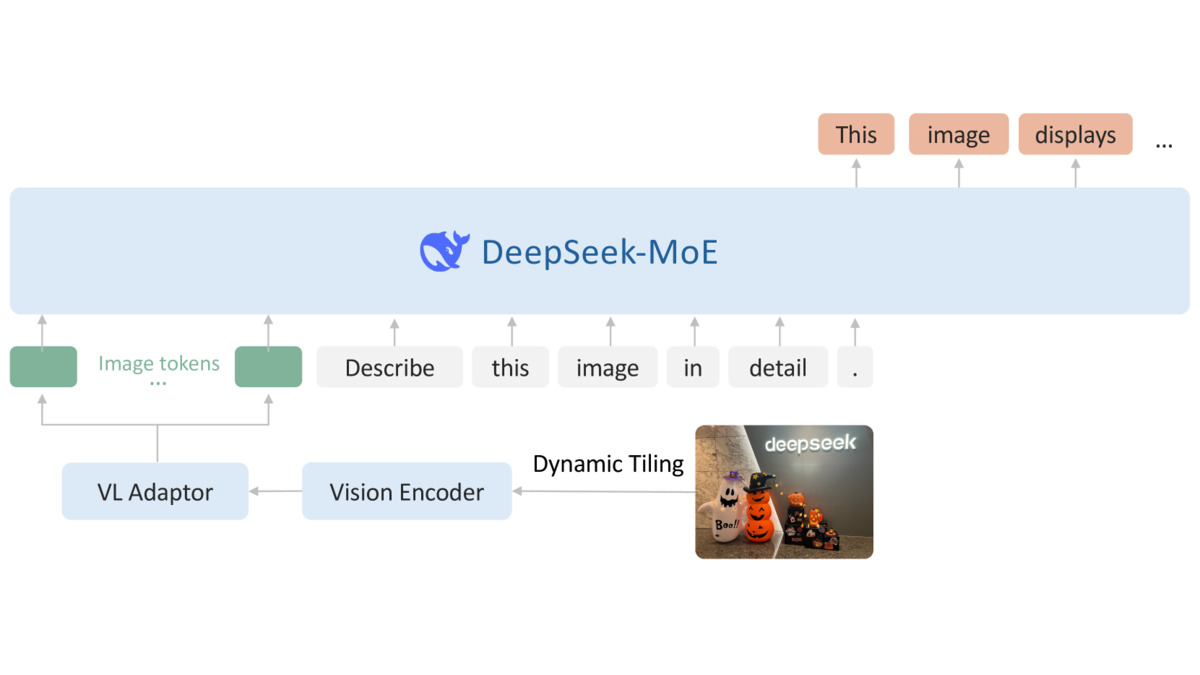 The DeepSeek-VL2 pipeline: high-resolution images pass through dynamic tiling and a shared SigLIP encoder, get compressed by a VL adaptor, then feed into the DeepSeekMoE language backbone with the text tokens.
Source: arxiv.org
The DeepSeek-VL2 pipeline: high-resolution images pass through dynamic tiling and a shared SigLIP encoder, get compressed by a VL adaptor, then feed into the DeepSeekMoE language backbone with the text tokens.
Source: arxiv.org
Key Specifications
| Specification | Details |
|---|---|
| Provider | DeepSeek |
| Model Family | DeepSeek-VL2 (Tiny / Small / base) |
| Parameters | 27B total / 4.5B active (base); 16B total / 2.8B active (Small); 3B total / 1.0B active (Tiny) |
| Vision Encoder | SigLIP-SO400M-384, shared across all three variants |
| MoE Routing | 72 routed experts + 2 shared experts, 6 experts active per token |
| Context Window | 4,096 tokens |
| Input Price | Free (self-hosted); pay-per-run on third-party inference hosts |
| Output Price | Free (self-hosted); pay-per-run on third-party inference hosts |
| Release Date | December 13, 2024 |
| License | DeepSeek Model License (custom, commercial use permitted) |
Benchmark Performance
| Benchmark | DeepSeek-VL2 | DeepSeek-VL2-Small | DeepSeek-VL2-Tiny | Qwen2-VL-7B | GPT-4o |
|---|---|---|---|---|---|
| DocVQA | 93.3% | 92.3% | 88.9% | 94.5% | 92.8% |
| ChartQA | 86.0% | 84.5% | 81.0% | 83.0% | 85.7% |
| OCRBench | 811 | 834 | 809 | 845 | 736 |
| TextVQA | 84.2% | 83.4% | 80.7% | 84.3% | 77.4% |
| InfoVQA | 78.1% | 75.8% | 66.1% | 76.5% | 79.2% |
| MMMU | 51.1% | 48.0% | 40.7% | 54.1% | 69.1% |
Scores come from the arXiv paper's evaluation tables, cross-checked against LLM Stats' DocVQA leaderboard. Two things stand out. First, the base model doesn't sweep every OCR metric even within its own family - DeepSeek-VL2-Small actually edges out the full model on raw OCRBench (834 vs 811), a reminder that bigger isn't automatically better on every narrow task inside a benchmark suite. Second, the MMMU gap is the real story: at 51.1%, DeepSeek-VL2 trails GPT-4o's 69.1% by 18 points. OCR and document extraction are pattern-matching heavy tasks that reward a strong vision encoder; MMMU tests broader multi-discipline reasoning across college-level subjects, and that's where the parameter-efficiency tradeoff shows its limits. For a fuller field comparison including current-generation models, see our vision-language benchmarks leaderboard and OCR and document AI leaderboard.
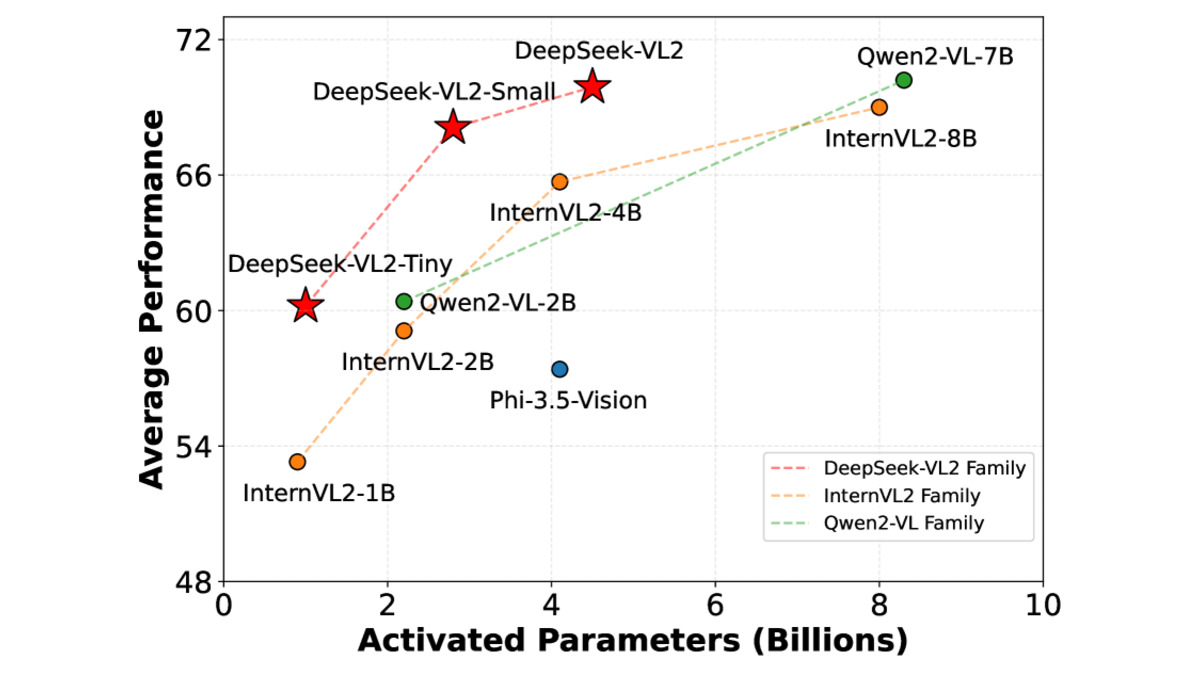 DeepSeek-VL2's efficiency claim in one chart: all three variants (red stars) sit above the InternVL2 and Qwen2-VL trend lines at equivalent activated-parameter counts.
Source: arxiv.org
DeepSeek-VL2's efficiency claim in one chart: all three variants (red stars) sit above the InternVL2 and Qwen2-VL trend lines at equivalent activated-parameter counts.
Source: arxiv.org
Key Capabilities
The architecture is what makes the benchmark numbers interesting rather than just competitive. A dynamic tiling scheme splits high-resolution input images into 384x384 tiles plus one global thumbnail tile, all processed by a shared SigLIP-SO400M-384 vision encoder before a two-layer MLP projects the compressed visual tokens into the language model's embedding space. That tiling approach is why the model holds up on dense scanned documents and multi-column layouts instead of degrading the way fixed-resolution encoders do on anything larger than their training crop.
On the language side, DeepSeekMoE routes each token through 6 of 72 possible experts plus 2 always-on shared experts, paired with Multi-head Latent Attention (MLA) that compresses the KV cache into latent vectors for cheaper inference. This is the same MLA mechanism DeepSeek later scaled up in DeepSeek V3.2 and DeepSeek-R1, so VL2 functions as an early proof of concept for techniques that ended up defining the company's later, more famous releases.
Where the model earns its keep in practice is invoice and receipt parsing, form field extraction, and structured table reading - the workhorse tasks behind document-processing pipelines rather than open-ended visual reasoning. The paper also reports strong visual grounding results (95.1% on RefCOCO validation, 96.7% on testA), meaning the model can point to and localize specific objects or regions in an image, not just describe them in prose.
"DeepSeek-VL2 achieves competitive or state-of-the-art performance with similar or fewer activated parameters compared to existing open-source dense and MoE-based models," the DeepSeek research team wrote in the model's technical report.
Pricing and Availability
There's no official DeepSeek-hosted API for VL2. Unlike the text-only DeepSeek chat and reasoning models, VL2's weights are distributed for self-hosting or through third-party inference platforms. All three variants download directly from Hugging Face - deepseek-vl2, deepseek-vl2-small, and deepseek-vl2-tiny - and the GitHub repository ships inference code for the transformers library, vLLM, and SGLang.
For teams that don't want to manage GPU infrastructure, Replicate hosts the base model on Nvidia A100 (80GB) hardware at $0.0035 per run, or about 285 runs per dollar, with predictions typically completing in around 3 seconds. That's request-based pricing rather than the per-token metering you'd get from a text API, which makes direct cost comparison to models like Llama 4 Maverick or Qwen2.5-VL awkward - it depends completely on your image volume and resolution mix.
Self-hosting cost scales with which variant you pick. The Tiny model's 1.0B activated parameters run comfortably on a single consumer GPU with quantization, similar to how the smaller Qwen VL models fit modest hardware budgets. The base 4.5B-active model needs meaningfully more VRAM headroom, though nowhere near what a 27B dense model would demand since only a sliver of it activates per token.
Strengths and Weaknesses
Strengths
- Strong OCR and document extraction accuracy (811 OCRBench, 93.3% DocVQA) despite activating only 4.5B parameters
- Three size tiers let you match hardware budget to accuracy needs, from edge-deployable Tiny to the full base model
- MIT-licensed code plus a commercially permissive model license, unlike some Chinese open-weight releases that restrict competitive use
- Solid visual grounding (95%+ on RefCOCO), useful for tasks that need bounding-box localization rather than just description
Weaknesses
- 4,096-token context window is small next to modern vision-language models that handle 128K+ tokens and multi-page documents in one pass
- MMMU score (51.1%) trails GPT-4o by 18 points - general multi-discipline visual reasoning isn't this model's strength
- No official hosted API from DeepSeek; deployment means self-hosting or trusting a third-party inference provider
- Superseded on raw OCR leaderboard rankings by newer open-weight releases like Qwen2.5-VL, which our document understanding rankings track separately
Related Coverage
We haven't published a dedicated hands-on review of DeepSeek-VL2, but it appears in our OCR and document AI leaderboard and document understanding capability rankings, where it's tracked with Claude Opus 4.6, Qwen2.5-VL, and other current-generation document models. See also our open-source vs proprietary AI guide for how MoE efficiency plays into the self-hosting cost calculus, and our coverage of DeepSeek V3.2 and DeepSeek-R1 for the separate text-only model lineage that shares VL2's MLA attention mechanism.
Sources
- DeepSeek-VL2: Mixture-of-Experts Vision-Language Models for Advanced Multimodal Understanding - arXiv
- deepseek-ai/deepseek-vl2 - Hugging Face
- deepseek-ai/deepseek-vl2-small - Hugging Face
- deepseek-ai/deepseek-vl2-tiny - Hugging Face
- DeepSeek-VL2 - GitHub
- DeepSeek Model License - GitHub
- DocVQA Benchmark Leaderboard - LLM Stats
- DeepSeek VL2 - LLM Stats
- deepseek-ai/deepseek-vl2 - Replicate
- DeepSeek-AI Open Sourced DeepSeek-VL2 Series - MarkTechPost
✓ Last verified July 22, 2026

