
DeepSeek-R1
DeepSeek-R1 is the 671B-parameter open-weight reasoning model that matched OpenAI o1 on math and coding benchmarks and triggered a $589 billion single-day drop in Nvidia's market cap in January 2025.
 Updated
8 min read
Updated
8 min read
Illustrative image. Source: Pexels
TL;DR
- First open-weight model to match OpenAI o1 on hard reasoning benchmarks - 79.8% on AIME 2024, 97.3% on MATH-500, trained with reinforcement learning and no supervised fine-tuning
- 671B-parameter MoE, 37B active per token, 128K context, MIT license covering weights, code, and distillation rights
- Triggered the single largest one-day market cap loss in stock market history when Nvidia shed $589 billion on January 27, 2025
- Superseded on DeepSeek's own API by V4-Flash - the
deepseek-reasoneralias stops pointing at real R1 weights after July 24, 2026
Overview
DeepSeek-R1 is the reasoning-focused large language model that DeepSeek, a Hangzhou-based lab backed by the quant fund High-Flyer, released on January 20, 2025. It shipped as three things at once: DeepSeek-R1-Zero, a proof of concept trained with pure reinforcement learning and no human-labeled reasoning data; DeepSeek-R1 itself, which adds a small cold-start fine-tuning stage on top of that RL process; and six distilled models from 1.5B to 70B parameters, built by fine-tuning Qwen and Llama checkpoints on reasoning traces R1 generated. All of it shipped under the MIT license, with commercial use and distillation explicitly permitted.
The model is built on the DeepSeek V3 base architecture: a 671-billion-parameter Mixture-of-Experts transformer that activates only 37 billion parameters per token, using Multi-head Latent Attention to keep inference costs down. The architecture wasn't the story, though. The training method was. DeepSeek's research team, with CEO Liang Wenfeng as corresponding author, showed that a model could learn to reason, catching its own mistakes mid-chain and backtracking, purely from reinforcement learning rewards tied to answer correctness. No supervised chain-of-thought examples required. That paper was later published in Nature in September 2025, with DeepSeek disclosing a training cost of roughly $294,000 for the R1-specific RL stage.
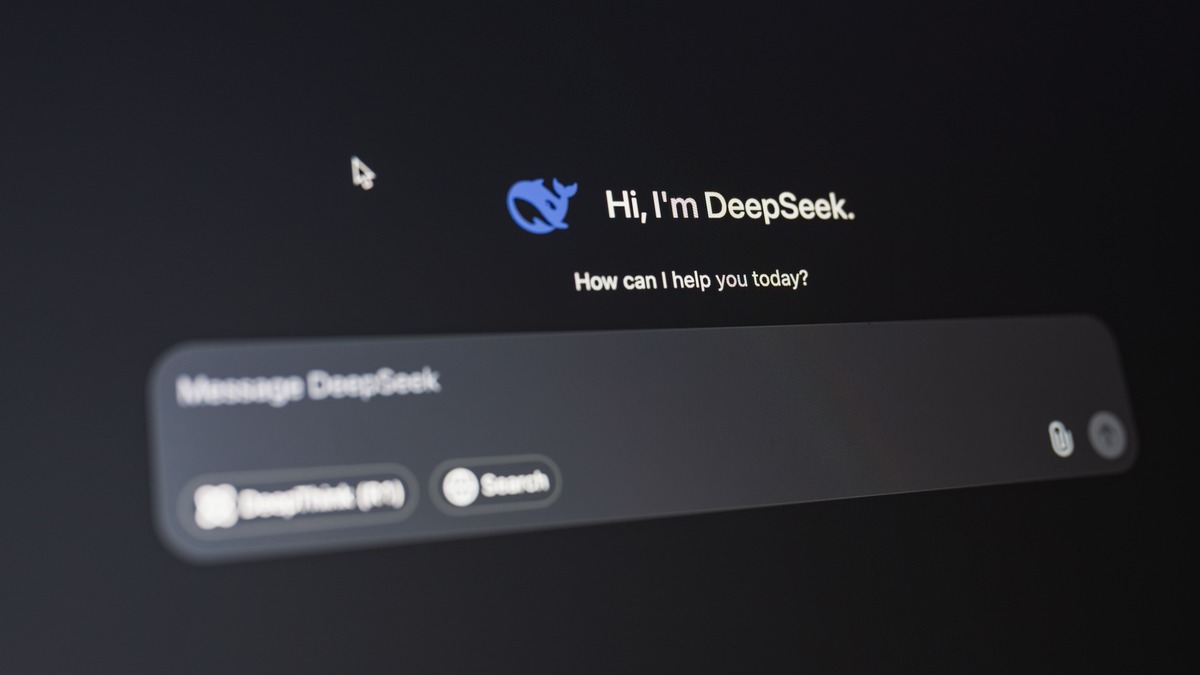
The DeepSeek chat interface, where R1's "DeepThink" reasoning mode became a default option for millions of new users within days of the January 2025 launch. Source: pexels.com
The DeepSeek Moment
R1's launch did something no open-weight release had done before: it moved the stock market. DeepSeek's app hit number one on the US Apple App Store on January 26, 2025, and topped Google Play the next day, pushing ChatGPT to second place. On Monday, January 27, Nvidia's share price fell nearly 17%, wiping out $589 billion in market value in a single session - the largest one-day loss for any company in stock market history. The trigger was simple: R1 matched a paid frontier reasoning model, was free to download and run, and reportedly cost a fraction of what OpenAI spent training GPT-4. Investors read that as a threat to the assumption that AI progress required ever-larger GPU orders.
Key Specifications
| Specification | Details |
|---|---|
| Provider | DeepSeek |
| Model Family | DeepSeek R1 |
| Architecture | Transformer MoE with Multi-head Latent Attention (MLA) |
| Total Parameters | 671B |
| Active Parameters | 37B per token |
| Context Window | 128,000 tokens |
| Max Generation Length | 32,768 tokens |
| Input Price (original) | $0.55/M tokens (cache miss); $0.14/M tokens (cache hit) |
| Output Price (original) | $2.19/M tokens |
| Release Date | January 20, 2025 |
| License | MIT (weights and code) |
| Input Modalities | Text |
| Output Modality | Text |
| Distilled Variants | 1.5B, 7B, 8B, 14B, 32B, 70B (Qwen and Llama bases) |
Benchmark Performance
| Benchmark | DeepSeek-R1 | OpenAI o1-1217 | DeepSeek V3.2 (2025) |
|---|---|---|---|
| AIME 2024 (competition math) | 79.8% | 79.2% | N/A (93.1% on AIME 2025) |
| MATH-500 | 97.3% | 96.4% | Not directly reported |
| Codeforces | 96.3 percentile | 96.6 percentile | 2,386 rating |
| MMLU | 90.8% | 91.8% | Not directly reported |
| MMLU-Pro | 84.0% | Not reported | 85.0% |
| GPQA Diamond | 71.5% | 75.7% | 82.4% |
| SWE-bench Verified | 49.2% | 48.9% | 73.1% |
At launch, R1 traded blows with o1-1217 almost evenly: ahead on AIME 2024, MATH-500, and SWE-bench Verified, behind on GPQA Diamond and MMLU, tied on Codeforces. None of that mattered as much as the fact that R1's weights, training code, and reasoning traces were public and o1's were not.
The third column tells a different story. DeepSeek's own V3.2, released in September 2025, beats R1's GPQA Diamond score by 11 points and its SWE-bench Verified score by nearly 24 points, without needing a dedicated reasoning mode at all. See our reasoning benchmarks leaderboard for the current field. Eighteen months of scaling moved DeepSeek further past R1 than R1 ever moved past o1 - worth remembering before treating any benchmark table as a permanent verdict.
Key Capabilities
Transparent chain-of-thought. R1 exposes its full reasoning trace in the API response rather than hiding it behind a summary, a meaningful difference from o1's approach at the time. Developers could read exactly how the model reached an answer, inspect where it second-guessed itself, and reuse those traces as training data for other models. That's why R1 became the default source model for reasoning-focused distillation across the open-source ecosystem through 2025.
Distillation into small dense models. DeepSeek fine-tuned Qwen (1.5B, 7B, 14B, 32B) and Llama (8B, 70B) checkpoints on 800,000 reasoning samples R1 generated, using supervised fine-tuning with no additional RL stage. DeepSeek-R1-Distill-Qwen-32B outperformed OpenAI's o1-mini on several math and coding benchmarks at a fraction of the size, kicking off a wave of "distill everything into something you can run locally" projects. Our guide to finetuning and distillation covers the technique in depth.
Pure RL reasoning, no supervised chain-of-thought. R1-Zero, the rougher sibling in the same release, demonstrated something the field assumed required curated human demonstrations: multi-step reasoning and self-verification emerging purely from an RL reward signal on final-answer correctness. Our guide to reasoning models breaks down how this differs from standard instruction tuning.
Pricing and Availability
A stock ticker board. Nvidia's $589 billion single-day loss on January 27, 2025 remains the largest in market history, and R1's release is the reason analysts point to. Source: pexels.com
DeepSeek's original API pricing for R1 was $0.55 per million input tokens on a cache miss ($0.14 on a cache hit) and $2.19 per million output tokens, roughly 27 times cheaper than o1's list price at the time. That pricing is now historical. The deepseek-reasoner alias, which used to route to actual R1 weights, has pointed at the thinking mode of DeepSeek V4-Flash since that model's April 2026 launch, and DeepSeek confirmed the legacy alias stops working entirely after July 24, 2026. Nobody has been able to call true R1 through DeepSeek's first-party endpoint for months.
The weights themselves remain downloadable from Hugging Face under the MIT license, and third-party providers still serve the original checkpoint. OpenRouter lists it at roughly $0.70 per million input tokens and $2.50 per million output tokens with a 164K context window, a modest markup over DeepSeek's original rate. Self-hosting the full 671B model needs a multi-GPU node with enough combined VRAM for the MoE weights, out of reach for most individual developers; the distilled 32B and 70B variants are the realistic option, running on a single high-end workstation GPU or a small multi-GPU rig.
Strengths
- First open-weight model to match a frontier proprietary reasoning model on hard math and coding benchmarks
- MIT license permits unrestricted commercial use, modification, and distillation
- Fully visible reasoning traces, useful for research, auditing, and generating training data for smaller models
- Distilled variants (32B, 70B) deliver strong reasoning performance on hardware a single workstation can run
- Training methodology published in detail, including failed approaches, in a peer-reviewed Nature paper
Weaknesses
- No longer served as true R1 through DeepSeek's own API - the official alias now routes to V4-Flash
- Superseded on nearly every benchmark by DeepSeek's own later models, V3.2 and V4
- Text-only, no multimodal input support
- Subject to Chinese content moderation on politically sensitive topics, a documented limitation for enterprise deployments with global user bases
- 128K context window is modest next to the 1M-token windows current-generation models offer
Related Coverage
- DeepSeek V3.2 Model Profile - The direct successor that beats R1 on most reasoning and coding benchmarks
- DeepSeek V4 Model Profile - The current flagship, including the V4-Flash variant that inherited R1's API alias
- DeepSeek V3.2 Review - Hands-on testing of R1's replacement
- What Are AI Reasoning Models? - A plain-English explainer on chain-of-thought and thinking modes
- A Developer's Guide to Finetuning and Distilling Language Models - Covers the distillation technique R1 popularized
- Reasoning Benchmarks Leaderboard - Current rankings across AIME, GPQA, and Humanity's Last Exam
- Claude Sonnet 4.6 Identifies Itself as DeepSeek - Our coverage of the training-data contamination story that followed later distillation disputes
FAQ
Is DeepSeek-R1 still available today?
The open weights remain on Hugging Face under the MIT license and are served by third-party providers like OpenRouter. DeepSeek's own API no longer routes to true R1; the legacy alias was reassigned to V4-Flash and retires completely on July 24, 2026.
How does DeepSeek-R1 compare to OpenAI o1?
At launch, R1 edged ahead on AIME 2024 (79.8% vs 79.2%), MATH-500 (97.3% vs 96.4%), and SWE-bench Verified (49.2% vs 48.9%), while o1 led on GPQA Diamond (75.7% vs 71.5%) and MMLU. The gap was small either way.
Why did DeepSeek-R1 crash Nvidia's stock?
R1 matched a paid frontier reasoning model while being free, open-weight, and reportedly far cheaper to train. On January 27, 2025, that triggered a $589 billion single-day loss in Nvidia's market cap.
Can I run DeepSeek-R1 on my own hardware?
The full 671B model needs a multi-GPU server node. The distilled variants are practical: DeepSeek-R1-Distill-Qwen-32B and DeepSeek-R1-Distill-Llama-70B run on a single high-end workstation GPU or a small multi-GPU rig.
Sources
- DeepSeek-R1: Incentivizing Reasoning Capability in LLMs via Reinforcement Learning - arXiv
- DeepSeek-R1 incentivizes reasoning in LLMs through reinforcement learning - Nature
- DeepSeek-R1 Release announcement - DeepSeek API Docs
- deepseek-ai/DeepSeek-R1 - Hugging Face model card
- DeepSeek R1 - API Pricing & Benchmarks - OpenRouter
- Nvidia sheds almost $600 billion in market cap, biggest drop ever - CNBC
- DeepSeek reaches No. 1 on US Play Store - TechCrunch
- DeepSeek's Jul 24 API Cutoff: The Alias Migration Playbook
Last updated
✓ Last verified July 21, 2026

