
Claude Opus 5
Anthropic's July 2026 release prices near-Fable-5 coding and agentic performance at Opus 4.8 rates, doubling Frontier-Bench scores and landing within 0.5 points of Fable 5 on CursorBench at half the cost.
 Updated
9 min read
Updated
9 min read
Overview
Anthropic released Claude Opus 5 on July 24, 2026, and the pitch is unusually direct for a flagship launch: this isn't a new smartest-model claim. Anthropic says Claude Fable 5, released in June, remains its most capable system. Opus 5's job is to get close to Fable 5's coding and agentic scores while billing at Claude Opus 4.8's rate - $5 per million input tokens, $25 per million output tokens, unchanged since May.
TL;DR
- Near-Fable-5 coding and agentic scores at Opus 4.8 pricing - $5/M input tokens, $25/M output tokens
- More than doubles Opus 4.8's Frontier-Bench v0.1 score (43.3% vs 18.7%) and lands within 0.5 points of Fable 5 on CursorBench at roughly half the cost
- Scores 2.3 on Anthropic's automated behavioral audit, the lowest misalignment reading of any recent Claude model, though it still trails Claude Mythos 5 on cybersecurity exploitation tasks
A model briefly surfaced in Cursor's model picker on July 9 under the internal codename "Honeycomb EAP" before disappearing within hours. The same spec profile, a 1M token context window and an "xhigh" reasoning effort tier above the existing high setting, carried through to the July 24 rollout. Opus 5 is live on Claude.ai, Claude Code, Claude Cowork, and the Claude API (model ID claude-opus-5), and it's now the default model on Claude Max and the strongest model available to Claude Pro subscribers.
Anthropic's own comparison table frames the tradeoff plainly: Opus 5 and Fable 5 share the same 1M token context window and 128K max output, but Fable 5 keeps its 2x price premium ($10/$50 per million tokens) and its lead on the hardest evaluations. Opus 5 is the model for teams that want most of that capability without paying for all of it.
Key Specifications
| Specification | Details |
|---|---|
| Provider | Anthropic |
| Model Family | Claude |
| Model ID | claude-opus-5 |
| Parameters | Not disclosed |
| Context Window | 1M tokens |
| Max Output | 128K tokens |
| Input Price (standard) | $5.00/M tokens |
| Output Price (standard) | $25.00/M tokens |
| Input Price (fast mode) | $10.00/M tokens (2x base) |
| Output Price (fast mode) | $50.00/M tokens (2x base) |
| Release Date | July 24, 2026 |
| Training Data Cutoff | May 2026 |
| License | Proprietary |
Fast mode runs at roughly 2.5x the throughput of standard mode for double the base price - a straightforward latency-for-cost trade rather than a separate capability tier. Effort defaults to high on the Claude API and Claude Code, a narrower default scope than Opus 4.8, which defaults to high across every surface including claude.ai.
Benchmark Performance
Numbers below come from Anthropic's own release charts and are cross-checked against MacRumors and officechai's coverage of the same disclosures. Opus 4.8 figures are pulled from the Claude Opus 4.8 model card.
| Benchmark | Claude Opus 5 | Claude Fable 5 | Claude Opus 4.8 |
|---|---|---|---|
| Frontier-Bench v0.1 (max effort) | 43.3% | 33.7% | 18.7% |
| CursorBench 3.2 (max effort) | 70.0% | 70.5% | 62.3% |
| ARC-AGI-3 (high effort) | ~30% | Not tested | ~1.5% |
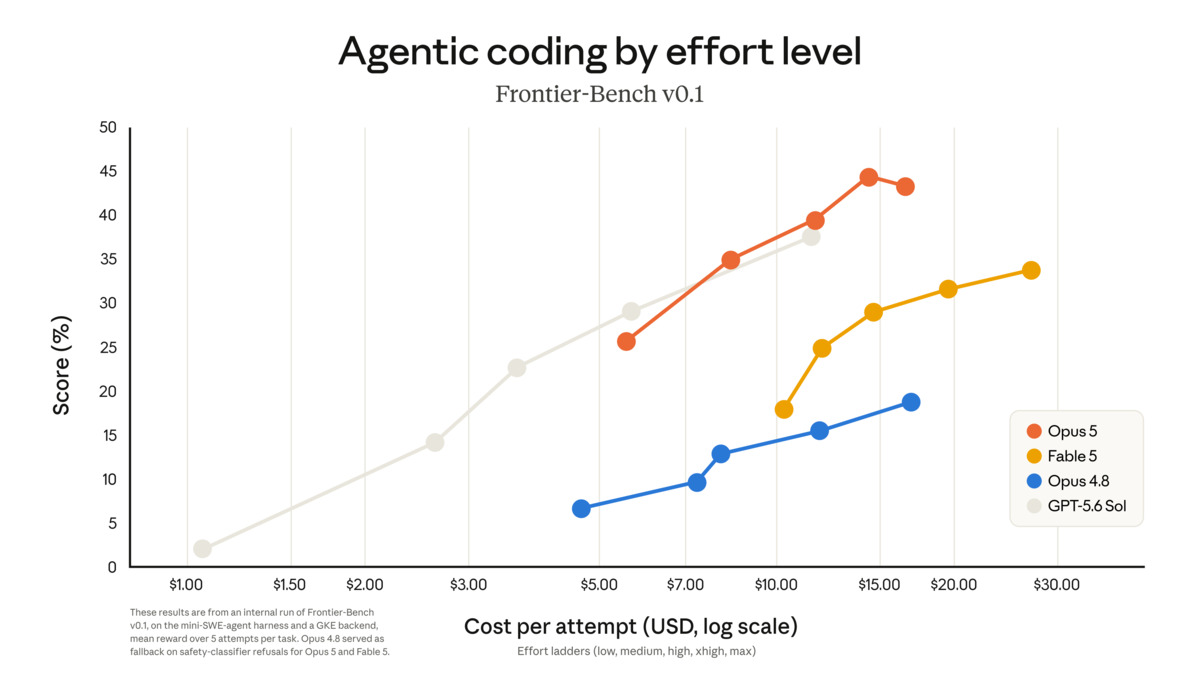 Agentic coding score against cost per attempt on Frontier-Bench v0.1. Opus 5 sits above both Fable 5 and GPT-5.6 Sol at every price point Anthropic tested, while Opus 4.8 trails all three.
Source: anthropic.com
Agentic coding score against cost per attempt on Frontier-Bench v0.1. Opus 5 sits above both Fable 5 and GPT-5.6 Sol at every price point Anthropic tested, while Opus 4.8 trails all three.
Source: anthropic.com
Frontier-Bench v0.1 is the cleanest illustration of the pitch. At max effort, Opus 5's 43.3% is more than double Opus 4.8's 18.7% and beats Fable 5's 33.7% outright, at a lower dollar cost per attempt than either. CursorBench tells a tighter story: Opus 5's peak score of 70.0% lands within half a point of Fable 5's 70.5%, but Anthropic's own chart shows Opus 5 reaching that score at under half of Fable 5's cost per task. ARC-AGI-3, a novel problem-solving evaluation, is the outlier worth noting: Opus 5 didn't just beat the field, it scored roughly 3x higher than the next-best model tested, GPT-5.6 Sol, and Fable 5 wasn't included in that particular comparison at all.
Two more evaluations round out the release without clean percentage scores. On Zapier's AutomationBench, which measures whether an agent can complete a business workflow end to end, Opus 5's pass rate runs about 1.5x the next-closest model at matching cost, and it hit 100% on a churn-prevention workflow (flagging at-risk accounts, alerting the right owner, summarizing for retention teams) that earlier models failed outright. On OSWorld 2.0, a computer-use benchmark, Opus 5 clears Fable 5's peak score at roughly a third of the cost. Life sciences evaluations show the same pattern against Opus 4.8 specifically: +10.2 percentage points on organic chemistry tasks like reading molecular structure from spectroscopy data, and +7.7 points on protein-function prediction tasks. For broader context on how these scores stack up against the rest of the field, see the coding benchmarks leaderboard and the agentic AI benchmarks leaderboard.
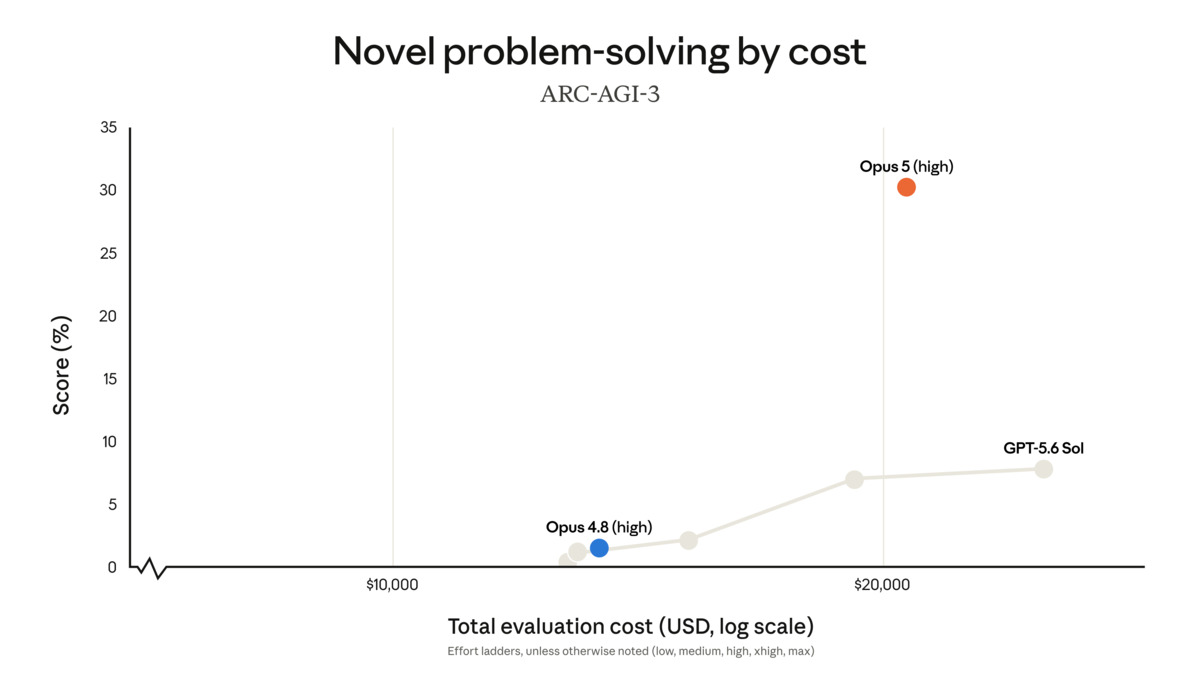 Novel problem-solving score against total evaluation cost on ARC-AGI-3. Opus 5 (high effort) scores roughly 30%, well clear of GPT-5.6 Sol's mid-single digits and Opus 4.8's near-zero result at the same effort tier.
Source: anthropic.com
Novel problem-solving score against total evaluation cost on ARC-AGI-3. Opus 5 (high effort) scores roughly 30%, well clear of GPT-5.6 Sol's mid-single digits and Opus 4.8's near-zero result at the same effort tier.
Source: anthropic.com
Key Capabilities
Agentic Coding at Opus 4.8 Prices
The core sell is coding and agentic work at a price point teams already budget for. Cursor co-founder Sualeh Asif put it in terms his own users would recognize:
"Claude Opus 5 delivers near Fable 5 intelligence at Opus speed and cost."
That framing matches the CursorBench data: near-parity with Fable 5's ceiling, without Fable 5's per-token bill. For teams running high-volume agentic pipelines, where the same task gets attempted multiple times across an effort ladder, the cost delta compounds fast.
Consistency Over Raw Capability Gains
Lovable co-founder Fabian Hedin flagged a different axis than pure benchmark movement. Opus 5 improved 22% over Opus 4.7 on agentic coding tasks specifically, but Hedin emphasized run-to-run variance dropping with the score:
It isn't just better on the hardest agentic coding tasks. It's steadier, with far less variance run to run.
He also pointed to consistent, clean refusal of unsafe requests as a quality that doesn't show up on a leaderboard but matters for consumer-facing deployments: "a model that knows when to say no is just as important as one that knows how to build."
Alignment and Cybersecurity Position
Opus 5 posted a 2.3 on Anthropic's automated behavioral audit, the lowest misaligned-behavior score of any recent Claude release, ahead of Opus 4.8, Sonnet 5, and Fable 5 on adherence to Anthropic's Constitution and resistance to being tricked into misuse. That result sits alongside a more specific limitation: on cybersecurity tasks, Opus 5 approaches Mythos 5's performance on vulnerability identification but stays substantially behind Mythos 5 on exploitation techniques. Mythos 5, Anthropic's restricted-access model for Project Glasswing partners, remains the harder ceiling on offensive security work by design.
Pricing and Availability
Opus 5 launched at $5 per million input tokens and $25 per million output tokens, identical to Opus 4.8's pricing and half of Fable 5's $10/$50 rate. Fast mode adds 2.5x throughput for 2x the base price ($10/$50), matching the input/output rate of Fable 5's standard tier by coincidence rather than by design.
| Model | Input | Output | Context | Access |
|---|---|---|---|---|
| Claude Opus 5 | $5.00/M | $25.00/M | 1M tokens | Claude.ai, Claude Code, Claude Cowork, API, Pro, Max |
| Claude Opus 4.8 | $5.00/M | $25.00/M | 1M tokens | Claude API, Bedrock, Vertex AI |
| Claude Sonnet 5 | $3.00/M | $15.00/M | 1M tokens | Claude API, Bedrock, Vertex AI, Foundry |
| Claude Fable 5 | $10.00/M | $50.00/M | 1M tokens | Claude API, Bedrock, Vertex AI, Foundry |
The model is available through the Claude API, Amazon Bedrock, Google Cloud, and Microsoft Foundry, alongside first-party access in Claude.ai, Claude Code, and Claude Cowork. Anthropic is retiring the older Claude Opus 4.1 on August 5, 2026, and is pointing existing Opus 4.1 customers toward Opus 5 as the migration target rather than Opus 4.8.
Strengths and Weaknesses
Strengths
- Frontier-Bench v0.1 score more than doubles Opus 4.8's at a lower cost per attempt
- Within 0.5 points of Fable 5's CursorBench ceiling at roughly half the cost per task
- Lowest behavioral-audit misalignment score (2.3) of any current Claude model
- Default model on Claude Max and the strongest option on Claude Pro at no price increase
- Reduced run-to-run variance on agentic coding tasks, per independent partner feedback from Lovable
Weaknesses
- Anthropic explicitly positions Fable 5 as the smarter model - Opus 5 is a cost play, not a new capability ceiling
- Substantially behind Mythos 5 on cybersecurity exploitation tasks, despite closing the gap on vulnerability identification
- Parameter count and architecture details remain undisclosed, consistent with the rest of the Claude 5-generation lineup
- No review yet published independently verifying Anthropic's benchmark charts against a third-party harness
Related Coverage
- Claude Opus 4.8 - the predecessor Opus 5 replaces at identical pricing
- Claude Fable 5 - the flagship Opus 5 is measured against, and still trails on hardest-eval capability
- Claude Mythos 5 - the restricted cybersecurity-focused model Opus 5 still trails on exploitation tasks
- Claude Sonnet 5 - the mid-tier option below Opus 5 in the current lineup
- Claude Opus 4.8 Review - our hands-on review of the predecessor model
- Coding Benchmarks Leaderboard - full rankings context for SWE-bench and related evaluations
- Agentic AI Benchmarks Leaderboard - GAIA, WebArena, and other agentic task rankings
FAQ
Is Claude Opus 5 smarter than Claude Fable 5?
No. Anthropic positions Fable 5 as its most capable model. Opus 5 comes within about half a point of Fable 5's CursorBench ceiling at roughly half the cost, but Fable 5 still leads on the hardest evaluations.
How much does Claude Opus 5 cost?
$5 per million input tokens and $25 per million output tokens, the same as Opus 4.8. Fast mode runs about 2.5x faster for double the base price ($10/$50 per million tokens).
Is Claude Opus 5 available on Claude Pro?
Yes. It's the strongest model available to Claude Pro subscribers and the new default model on Claude Max.
What is Claude Opus 5's context window?
1M tokens with a 128K max output limit, unchanged from Opus 4.8 and Fable 5.
Does Opus 5 replace Opus 4.8?
For most workloads, yes, at identical pricing. Anthropic is retiring the older Claude Opus 4.1 on August 5, 2026, and directing those customers to migrate to Opus 5.
How does Opus 5 compare to Mythos 5 on security tasks?
It approaches Mythos 5 on vulnerability identification but stays substantially behind on exploitation techniques, per Anthropic's own cybersecurity evaluations.
Sources:
- Introducing Claude Opus 5 - Anthropic
- Claude models overview - Claude Platform Docs
- Anthropic's Claude Opus 5 AI model rivals Fable 5 and is cheaper - CNBC
- Anthropic's New Claude Opus 5 Nearly Matches Flagship Fable 5 at Half the Cost - MacRumors
- Anthropic Releases Claude Opus 5, Beats Fable On Many Benchmarks At Half The Price - officechai
- Anthropic releases Claude Opus 5: Here's how it's different than what's already out there - Fortune
Last updated
✓ Last verified July 24, 2026

