
AWS Trainium2 - Amazon's Cloud Training Chip
AWS Trainium2 is Amazon's second-generation custom AI training chip, powering EC2 Trn2 instances with 96GB HBM2e per chip and tight integration with the AWS Neuron SDK and SageMaker ecosystem.
 15 min read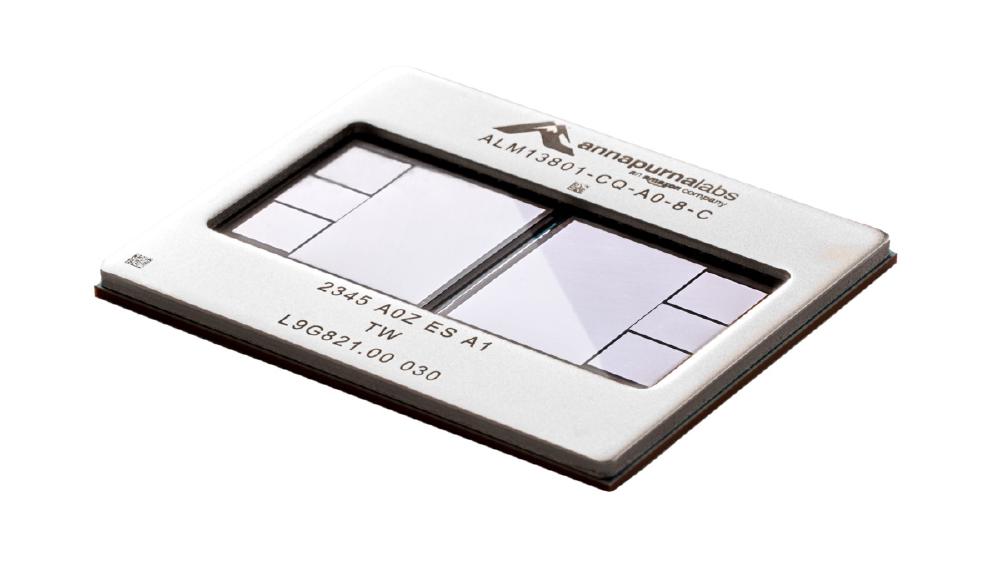
TL;DR
- Amazon's second-generation custom silicon for AI training, available exclusively through EC2 Trn2 instances
- 96GB HBM2e per chip with an estimated 2,400 GB/s memory bandwidth
- Trn2 instances pack 16 Trainium2 chips per node (1.5TB total memory) connected via NeuronLink
- Cloud-only availability with no hardware sales - positioned 30-50% cheaper than equivalent H100 instances
- Built for tight integration with AWS Neuron SDK, SageMaker, and the broader AWS ecosystem
Overview
AWS Trainium2 is Amazon's bet that the future of AI training hardware is vertically integrated cloud silicon. Rather than selling chips or licensing designs, Amazon builds Trainium2 exclusively for its own EC2 fleet, prices it below NVIDIA GPU instances, and counts on the AWS ecosystem lock-in to drive adoption. It is the same strategic playbook that Apple used with M-series silicon and that Google used with TPUs - design custom chips optimized for your own software stack, offer them at a price that commodity hardware cannot match, and let the economics do the selling.
Trainium2 is the second generation of Amazon's training accelerator line, following the original Trainium chip that launched in 2022. The original Trainium had a rough start - limited model support, immature software, and performance that rarely matched Amazon's marketing claims. Trainium2 is the course correction. The generational improvements are substantial: 96GB of HBM2e per chip (up from 32GB on the original Trainium), an estimated 2,400 GB/s memory bandwidth, and multi-chip connectivity via NeuronLink that allows 16 Trainium2 chips within a single Trn2 instance to communicate at high bandwidth.
Amazon has not disclosed the process node, TDP, or raw FLOPS numbers, which makes direct hardware-level comparisons with competitors essentially impossible. What Amazon does disclose is pricing - and on a cost-per-training-hour basis, Trn2 instances are positioned to be 30-50% cheaper than equivalent NVIDIA-based P5 (H100) instances on EC2.
The trade-off is familiar: lower prices in exchange for a less mature software ecosystem and absolute vendor lock-in to AWS. The Neuron SDK supports PyTorch and JAX, but the operator coverage, debugging tools, and community resources are a generation behind CUDA. For teams already running on AWS and willing to invest engineering time in the integration, Trainium2 can deliver meaningful cost savings on large training runs. For teams that need to run on multiple clouds, on-premises, or with minimal migration effort, Trainium2 is simply not an option.
Key Specifications
| Specification | Details |
|---|---|
| Manufacturer | AWS (Amazon Annapurna Labs) |
| Product Family | Trainium (2nd generation) |
| Chip Type | ASIC |
| Process Node | Not disclosed |
| HBM Memory | 96GB HBM2e per chip |
| Memory Bandwidth | ~2,400 GB/s per chip (estimated) |
| FP8 Performance | Not disclosed |
| BF16 Performance | Not disclosed |
| TDP | Not disclosed |
| Chips per Trn2 Instance | 16 |
| Chips per Trn2 UltraServer | 64 |
| Total Memory (Trn2) | 1.5TB (16 chips x 96GB) |
| Total Memory (UltraServer) | 6TB (64 chips x 96GB) |
| Intra-Node Interconnect | NeuronLink |
| Inter-Node Interconnect | EFA v2 (Elastic Fabric Adapter) |
| Software Stack | AWS Neuron SDK (PyTorch, JAX) |
| Target Workload | Training (primary), Inference (secondary) |
| Availability | EC2 Trn2 instances only (AWS regions) |
| Release | Q4 2024 |
Performance Benchmarks
| Metric | AWS Trn2 (16x Trainium2) | AWS P5 (8x H100) | AWS P4d (8x A100) | Google TPU v5p |
|---|---|---|---|---|
| Total Memory per Instance | 1.5TB | 640GB | 640GB | Varies by slice |
| Memory per Chip | 96GB | 80GB | 80GB | 95GB |
| Chips per Instance | 16 | 8 | 8 | Varies |
| Est. FP8 per Instance | Not disclosed | 31.6 PFLOPS | N/A | Not comparable |
| On-Demand Price (est.) | ~$22-28/hr | ~$98/hr | ~$33/hr | ~$12-25/hr/chip |
| LLM Training Cost (70B, rel.) | ~0.5-0.7x P5 | 1.0x (baseline) | ~1.5-2x | ~0.6-0.9x |
| Framework Support | PyTorch, JAX | Full CUDA | Full CUDA | JAX (primary) |
| Multi-Node Scaling | EFA v2 | EFA v2 | EFA v1 | ICI |
Direct performance comparisons are hampered by Amazon's refusal to publish raw FLOPS numbers. The company has disclosed training throughput claims on specific model architectures but not the underlying hardware specifications that would allow independent analysis. This makes Trainium2 the least transparent accelerator on this list from a hardware evaluation standpoint.
What we can compare is cost efficiency. Amazon's own benchmarks claim that Trn2 instances deliver up to 50% better price-performance than P5 (H100) instances for training workloads like Llama 2 70B and GPT-3 class models. Independent benchmarks have generally confirmed savings in the 30-50% range for well-supported model architectures, though the savings diminish significantly for models that require custom Neuron operator implementations.
Memory and Scaling Advantage
The 16-chip configuration of the Trn2 instance is one of its strongest selling points. With 1.5TB of total HBM2e across 16 Trainium2 chips connected via NeuronLink, a single Trn2 instance has more than double the memory of a P5 instance (8x H100 with 640GB total).
This has several significant practical implications:
Larger models per instance. A 70B parameter model in BF16 requires 140GB of parameter storage plus KV cache and activation memory. On a P5 instance, this requires careful memory management and may require tensor parallelism across multiple GPUs. On a Trn2 with 1.5TB of total memory, there is more than sufficient headroom for the model, generous KV cache budgets, and large micro-batch sizes.
Fewer instances for very large models. Training a 405B parameter model requires distributing across multiple instances regardless of hardware. But the Trn2's 1.5TB per instance means you need fewer total instances for the same model, which reduces inter-instance network communication and improves scaling efficiency. A model that needs 4 P5 instances might need only 2 Trn2 instances.
Larger batch sizes. More memory per instance allows larger micro-batch sizes during data-parallel training, which improves gradient estimation quality and can reduce the total number of optimization steps needed for convergence. This translates directly to faster wall-clock training time and lower total cost.
The Trn2 UltraServer configuration scales further to 64 chips with 6TB of total memory, enabling very large models to be trained within a single server boundary. For context, 6TB of HBM is enough to hold a dense 3-trillion-parameter model in FP16 - well beyond current frontier model sizes.
The Opacity Problem
Amazon's decision not to disclose FLOPS, TDP, or process node creates a meaningful evaluation problem for anyone trying to do serious hardware analysis.
When NVIDIA releases a new GPU, independent reviewers can calculate theoretical peak performance, measure actual utilization rates, compare roofline models across workloads, and determine exactly where the hardware is leaving performance on the table. With Trainium2, none of this analysis is possible. The buyer must trust Amazon's cost-efficiency claims without the ability to independently verify the underlying hardware performance.
This opacity is not accidental. Amazon wants customers to evaluate Trainium2 on cost-per-training-hour rather than FLOPS-per-dollar. The cloud pricing model allows Amazon to set margins that make Trainium2 look attractive regardless of the raw hardware performance. If Trainium2 delivers 60% of an H100's performance at 40% of the price, the cost-efficiency claim holds even though the hardware is significantly less capable per chip.
For customers who are purely optimizing cloud training costs and do not need hardware-level transparency, this is perfectly fine - the relevant metric is the training bill, not the chip's TFLOPS.
For customers who want to understand what they are buying, compare architectures, or make long-term infrastructure planning decisions, the opacity is a legitimate concern. You are making a multi-million dollar commitment to a platform without knowing the fundamental capabilities of the underlying hardware.
Comparison with Google TPUs
Trainium2's closest competitor is not NVIDIA's GPU lineup but Google's TPU v5p. Both are custom ASICs built by hyperscalers for their own cloud platforms, both are available only through their respective cloud services, and both are positioned as cost-effective alternatives to NVIDIA GPUs.
The key differences:
- Ecosystem maturity: Google TPUs have been in production since 2016 (TPU v1). JAX, Google's primary TPU framework, has a large and active developer community. AWS Neuron is significantly younger and has a smaller community.
- Framework support: TPUs are optimized for JAX, with PyTorch support through torch-xla. Trainium2 is optimized for PyTorch through torch-neuronx, with JAX as a secondary framework. Teams that use PyTorch may find Trainium2's integration more natural.
- Pricing: Both platforms offer competitive pricing versus NVIDIA GPU instances. Direct comparison is difficult because TPU pricing is per-chip-hour while Trn2 pricing is per-instance-hour with 16 chips.
- Multi-chip scaling: TPU v5p uses ICI (Inter-Chip Interconnect) within pods, while Trn2 uses NeuronLink within instances and EFA between instances. Google's pod-based architecture allows thousands of TPUs to communicate at high bandwidth; AWS's instance-based architecture requires EFA for inter-instance communication.
For organizations choosing between Trainium2 and TPU v5p, the decision often comes down to which cloud platform they are already using. Moving from AWS to GCP (or vice versa) to access a different AI accelerator rarely makes economic sense once you account for the cost of migrating data, infrastructure, and engineering workflows.
Key Capabilities
NeuronLink Intra-Node Interconnect. The 16 Trainium2 chips within a Trn2 instance are connected via NeuronLink, Amazon's proprietary high-bandwidth interconnect. While Amazon has not published NeuronLink bandwidth specifications, the system is designed to enable tensor parallelism, pipeline parallelism, and data parallelism across all 16 chips without the bandwidth constraints that typically limit multi-accelerator training.
For comparison, NVIDIA's NVLink in a DGX H100 connects 8 GPUs at 900 GB/s per GPU bidirectional. NeuronLink connects 16 chips, which means it must provide at minimum comparable per-chip bandwidth to avoid becoming a bottleneck for collective operations like all-reduce.
The training throughput numbers Amazon has published for 16-chip configurations suggest NeuronLink delivers sufficient bandwidth for efficient distributed training, but without published specifications, independent verification is not possible. This is another manifestation of the opacity problem.
The UltraServer configuration extends NeuronLink to 64 chips within a single server. This is architecturally significant because it eliminates the need for network-based communication (EFA) for models that fit within 64 chips. Intra-server interconnects are typically 5-10x faster and lower-latency than network interconnects, so keeping the entire training job within a single UltraServer can meaningfully improve scaling efficiency for models in the 100B-1T parameter range.
AWS Neuron SDK. The Neuron SDK is the software layer that makes Trainium2 accessible to ML developers. The stack includes several key components:
- torch-neuronx: A PyTorch integration layer that replaces CUDA device calls with Neuron device calls, allowing many PyTorch models to run on Trainium2 with minimal code changes
- Neuron Compiler (neuronx-cc): A graph compiler that optimizes and compiles computation graphs for the Trainium2 architecture, handling operator fusion, mixed-precision conversion, and memory management
- NeuronX Distributed: A distributed training library that handles tensor parallelism, pipeline parallelism, and data parallelism across multiple Trainium2 chips and instances
- Neuron Profiler: Performance debugging tools for identifying bottlenecks, measuring utilization, and optimizing throughput
- Model Reference Library: Pre-validated configurations for popular architectures including Llama 2/3, GPT-NeoX, Mixtral, Stable Diffusion, and BERT
For supported model architectures, the porting effort from CUDA is relatively straightforward. Amazon publishes migration guides that walk through the typical changes:
- Replace
torch.device('cuda')withtorch.device('xla')(Neuron uses the XLA backend) - Update the distributed strategy configuration for 16-chip NeuronLink topology
- Adjust data loading for S3 streaming or SageMaker data channels
- Run the Neuron compiler to optimize the computation graph
Amazon reports that many customers complete initial porting within days for well-supported models. However, "initial porting" and "fully optimized production training" are different things. Achieving the claimed 30-50% cost savings typically requires additional optimization work: tuning batch sizes for the 16-chip configuration, adjusting gradient accumulation steps, optimizing data loading pipelines, and working with the Neuron compiler team on any performance regressions.
For models with novel operators not in the Neuron compiler - custom attention mechanisms, exotic activation functions, or domain-specific layers - the porting effort scales significantly. Each custom CUDA kernel must be reimplemented using the Neuron SDK's custom operator API. The documentation for custom operators is less comprehensive than CUDA's, and community examples are sparse.
Deep AWS Ecosystem Integration. Trainium2's strategic advantage is not the chip itself but the ecosystem surrounding it. Trn2 instances plug directly into the full AWS ML stack:
Amazon SageMaker: Managed training workflows with automatic distributed training configuration, hyperparameter tuning, and experiment tracking. SageMaker handles the orchestration of multi-node Trn2 training jobs, including checkpoint management and failure recovery.
Amazon S3: High-throughput data loading via SageMaker data channels or direct S3 streaming. AWS has optimized the S3-to-Trn2 data path to minimize data loading bottlenecks during training.
AWS ParallelCluster: Multi-node cluster orchestration for distributed training jobs that span hundreds of Trn2 instances. ParallelCluster handles node provisioning, Slurm scheduling, and network configuration automatically.
Amazon CloudWatch: Monitoring and observability for training metrics, hardware utilization, and cost tracking. Custom Neuron metrics are published to CloudWatch for real-time training monitoring.
AWS Savings Plans and Reserved Instances: Cost optimization mechanisms that can reduce Trn2 pricing by 30-60% compared to on-demand rates.
For organizations that have already built their ML infrastructure on AWS, Trainium2 slots into existing workflows with minimal architectural changes. The training pipeline - data in S3, orchestration through SageMaker or ParallelCluster, monitoring through CloudWatch, model artifacts back to S3 - remains the same. Only the compute instance type changes.
This integration stickiness is by design and is arguably the most important factor in Trainium2 adoption. The cost of migrating from AWS to another cloud provider is measured not just in engineering hours but in the loss of all these integrated services.
Pricing and Availability
Trainium2 is available exclusively through EC2 Trn2 instances. Amazon does not sell Trainium2 chips or systems to external customers. All pricing is per-instance-hour, following standard EC2 pricing models.
| Instance Type | Chips | Total Memory | On-Demand (est.) | Notes |
|---|---|---|---|---|
| trn2.48xlarge | 16 | 1.5TB | ~$22-28/hr | Standard Trn2 instance |
| trn2u.48xlarge | 64 | 6TB | ~$88-112/hr | UltraServer configuration |
| p5.48xlarge (H100) | 8 GPUs | 640GB | ~$98/hr | NVIDIA comparison baseline |
| p4d.24xlarge (A100) | 8 GPUs | 320GB | ~$33/hr | Previous-gen NVIDIA baseline |
The headline cost advantage: a Trn2 instance with 16 chips and 1.5TB memory costs roughly 25-30% of a P5 instance with 8 H100s and 640GB memory. Even if the per-chip performance of Trainium2 is lower than an H100, the economics are compelling for workloads that can efficiently use 16 chips.
Training Cost Comparison
For a concrete example, consider training a Llama 2 70B model to convergence:
| Platform | Instance Cost | Estimated Training Time | Total Estimated Cost |
|---|---|---|---|
| Trn2 (16x Trainium2) | ~$25/hr | ~15,000-20,000 hrs | ~$375K-500K |
| P5 (8x H100) | ~$98/hr | ~8,000-12,000 hrs | ~$784K-1,176K |
| P4d (8x A100) | ~$33/hr | ~25,000-35,000 hrs | ~$825K-1,155K |
The Trn2 instance takes longer per training hour (fewer FLOPS per chip), but the lower hourly rate more than compensates. The total training bill is roughly 40-55% less than P5 instances. At the scale of frontier model training - where runs can cost tens of millions of dollars - even a 30% savings represents millions in reduced spend.
Cost Optimization Strategies
The real savings on Trainium2 come from layering AWS cost optimization mechanisms:
- Savings Plans: Commit to 1 or 3 years of Trn2 usage for 30-40% discounts over on-demand pricing
- Reserved Instances: Even deeper discounts (up to 50-60%) for guaranteed capacity commitments
- Spot Instances: 60-70% discounts over on-demand for interruptible workloads with checkpointing
A training team using Trn2 spot instances with a robust checkpointing strategy could achieve 80-90% cost reduction compared to P5 on-demand instances. That is a 5-10x reduction in cloud training costs, which can fundamentally change the economics of what models an organization can afford to train.
Notable Customers
Amazon has stated that customers including Anthropic, Databricks, and several AI startups are using Trn2 instances for production training. Anthropic's use is particularly notable given that Claude models are among the most capable proprietary models in the market - a strong signal that Trainium2 delivers sufficient performance for frontier-scale training when combined with the right engineering effort.
Regional Availability
Trn2 instances are available in select AWS regions:
- US East (N. Virginia): Available
- US West (Oregon): Available
- Additional regions: Expanding throughout 2025-2026
Capacity remains more constrained than NVIDIA GPU instances, which are available across most AWS regions. Organizations planning large-scale Trn2 deployments should work with their AWS account team to secure capacity reservations in advance. Wait times for large allocations can be weeks to months, compared to near-instant availability for on-demand GPU instances in most regions.
Who Should Consider Trainium2
Strong fit:
- Organizations already running ML infrastructure on AWS with significant S3/SageMaker investment
- Teams training well-supported model architectures (Llama, GPT, Mixtral, Stable Diffusion)
- Cost-sensitive training workloads where 30-50% savings justify the migration effort
- Large-scale training jobs (100B+ parameters) that benefit from 1.5TB per-instance memory
- Fault-tolerant training pipelines that can leverage spot instance pricing
Weak fit:
- Teams that need multi-cloud or on-premises deployment flexibility
- Research labs running novel architectures with custom CUDA kernels
- Organizations that require hardware-level transparency for infrastructure planning
- Inference-heavy workloads where Groq LPU or GPU solutions offer better economics
- Small training jobs where the engineering investment to port from CUDA is not justified by savings
Strengths
- 30-50% lower training cost than H100-based EC2 instances for supported model architectures
- 96GB HBM2e per chip and 1.5TB per instance enables training large models without multi-instance overhead
- 16-chip NeuronLink configuration provides 2x more accelerators per instance than any GPU-based EC2 option
- Deep integration with AWS ecosystem (SageMaker, S3, ParallelCluster) minimizes infrastructure engineering
- Neuron SDK supports PyTorch and JAX with pre-validated configurations for major model architectures
- UltraServer scales to 64 chips and 6TB HBM in a single logical instance
- Spot pricing can reduce already-low costs by an additional 60-70% for fault-tolerant workloads
Weaknesses
- Cloud-only on AWS - no option for on-premises, multi-cloud, or non-AWS deployment
- Amazon refuses to disclose raw FLOPS, TDP, or process node - prevents independent hardware evaluation
- Neuron SDK operator coverage is incomplete - custom model architectures may require weeks of porting
- CUDA-to-Neuron migration requires engineering investment even for well-supported models
- Inference is not the primary optimization target - Groq LPU and GPU-based solutions offer better inference economics
- Debugging and profiling tools are less mature than NVIDIA's Nsight and CUDA profiler ecosystem
- Vendor lock-in is absolute - switching from Trainium2 means rewriting all Neuron-specific code
Related Coverage
- Groq LPU - A cloud-only inference accelerator with a similar vendor lock-in model but targeting a different workload
- Cerebras WSE-3 - Wafer-scale training hardware for organizations that want to own their compute infrastructure
- Intel Gaudi 3 - An NVIDIA alternative available as purchasable hardware, not limited to a single cloud provider
Sources
