
AMD Instinct MI430X - Dual-Precision CDNA 5 Accelerator
The AMD Instinct MI430X is AMD's CDNA 5 HPC accelerator with 432GB HBM4, full FP64 support, and 19.6 TB/s bandwidth - designed for sovereign AI and scientific supercomputing alongside the MI455X AI GPU.
 6 min read
TL;DR
- AMD's HPC-focused chip in the MI400 series: full FP64/FP32 support alongside FP8/FP4 for AI
- 432GB HBM4 at 19.6 TB/s - 50% more memory than NVIDIA's Vera Rubin GPU, same bandwidth
- Estimated ~211 TFLOPS FP64 vector performance (derived from Alice Recoque supercomputer specs)
- Powers Discovery at Oak Ridge National Lab and Alice Recoque in France; ships H2 2026
Overview
AMD's MI400 series for 2026 splits into three distinct products: the MI455X for AI training and inference, the MI440X for enterprise AI, and the MI430X for high-performance computing and sovereign AI. The MI430X isn't mostly an AI accelerator in the deep learning sense. It's what AMD builds for the customers who still need to run physics simulations, climate models, and molecular dynamics in FP64 - workloads that GPUs have always been capable of but that AI chips increasingly deprioritize.
The distinction matters practically. The AMD MI455X and MI440X squeeze performance by focusing compute resources on FP8 and FP4 precision, where modern AI training and inference operate. The MI430X trades some of that low-precision density for dedicated high-precision compute paths. It runs FP64 and FP32 without software emulation, making it compatible with legacy HPC code that hasn't been and won't be ported to lower precision.
AMD announced the MI430X at CES 2026 with the full Helios rack architecture. It's bound for two high-profile deployments: Discovery at Oak Ridge National Laboratory in the United States and Alice Recoque in France. Both are major scientific computing facilities that need the HPC precision the MI455X doesn't offer, while still wanting the memory capacity and bandwidth to run large AI workloads side by side.
Key Specifications
| Specification | Details |
|---|---|
| Manufacturer | AMD |
| Product Family | Instinct MI400 (CDNA 5) |
| Chip Type | GPU |
| Process Node | TSMC N2 (2nm, compute chiplets) + N3P (3nm, IO) |
| Memory | 432GB HBM4 |
| Memory Bandwidth | 19.6 TB/s |
| FP64 Performance | ~211 TFLOPS (estimated, Chips and Cheese analysis) |
| FP8 Performance | Not officially disclosed |
| FP4 Performance | Not officially disclosed |
| FP64 Support | Yes (native hardware) |
| FP32 Support | Yes (native hardware) |
| TDP | Not disclosed |
| Interconnect | Infinity Fabric + UALink |
| Target | HPC, Sovereign AI, Mixed Precision |
| Release Date | H2 2026 |
| Pricing | Not disclosed |
Performance Benchmarks
AMD hasn't published official FP64 numbers for the MI430X. The best available estimate comes from Chips and Cheese analysis of the Alice Recoque supercomputer: using the facility's announced 1 Exaflop HPL target and expected GPU count, the MI430X is estimated at around 211 TFLOPS FP64 vector performance. That's a major jump from the MI355X's 77 TFLOPS FP64, reflecting the architectural changes in CDNA 5 that increase the FP64 compute ratios.
| Metric | AMD MI430X | AMD MI455X | NVIDIA Vera Rubin (est.) | AMD MI300X |
|---|---|---|---|---|
| FP64 TFLOPS | ~211 (est.) | Not primary | ~45 (est.) | 163.4 |
| HBM Capacity | 432GB HBM4 | 432GB HBM4 | 288GB HBM | 192GB HBM3 |
| Memory Bandwidth | 19.6 TB/s | 19.6 TB/s | 22 TB/s | 5.3 TB/s |
| FP8 Performance | Not focus | 20,000 TFLOPS | ~50,000 TFLOPS | 5,220 TFLOPS |
| Process Node | TSMC N2 | TSMC N2 | TSMC N2 | TSMC N5 |
| Target | HPC + AI | AI Training/Inference | AI Training/Inference | AI/HPC |
The MI430X has more memory than NVIDIA's Vera Rubin GPU - 432GB versus 288GB - at similar bandwidth. For scientific applications where entire datasets need to fit in a single GPU's memory to avoid inter-node communication, this capacity advantage matters. For AI training, the MI455X is the better AMD option; for HPC, the MI430X is the only AMD option with full FP64 support in the current lineup.
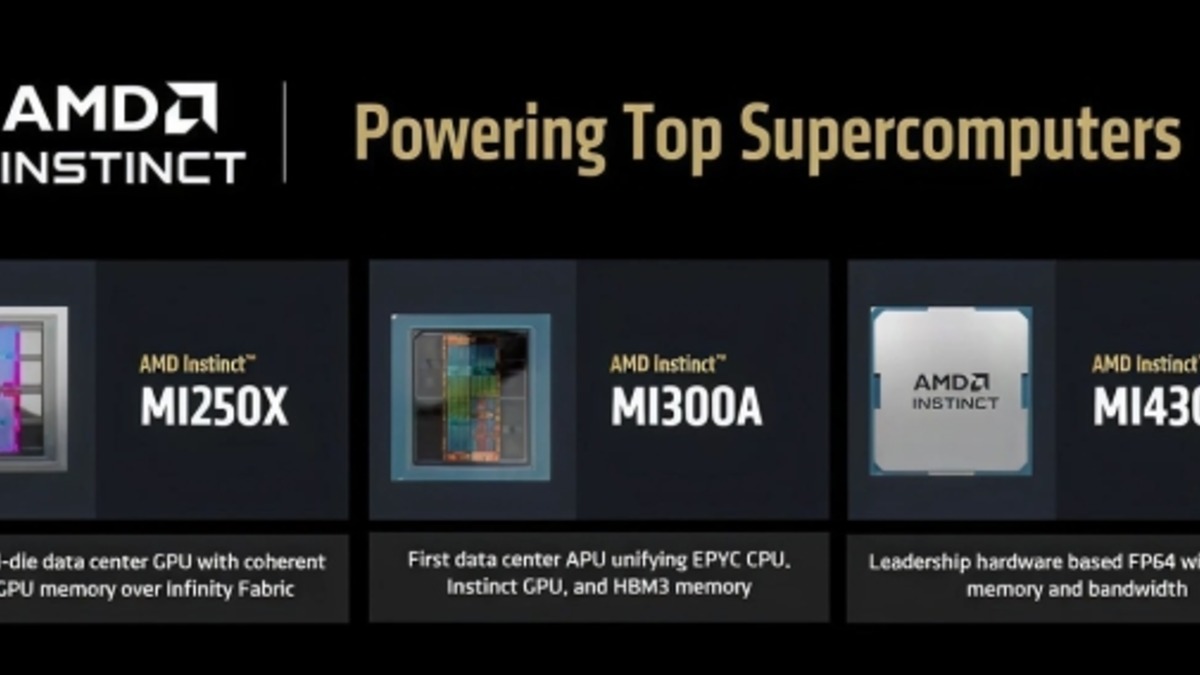 AMD's MI430X GPU in the system configuration bound for Oak Ridge's Discovery supercomputer - pairing CDNA 5 compute with EPYC Venice CPUs on HPE Cray GX5000 nodes.
Source: TweakTown / AMD
AMD's MI430X GPU in the system configuration bound for Oak Ridge's Discovery supercomputer - pairing CDNA 5 compute with EPYC Venice CPUs on HPE Cray GX5000 nodes.
Source: TweakTown / AMD
Key Capabilities
The defining feature of the MI430X is the chiplet design. AMD uses CDNA 5 compute chiplets on TSMC N2 - the same 2nm-class node as the MI455X - but builds the MI430X with a different chiplet mix. The MI455X and MI440X focus on AI tensor cores for FP4/FP8 operations. The MI430X allocates die area for full-width FP64 compute paths, which are expensive in silicon area but necessary for scientific accuracy.
This "dual-precision" design is what AMD means by flexibility: the same chip can run FP64 for an atmospheric modeling code in the morning and FP8 for a language model fine-tuning job in the afternoon. Neither mode requires software tricks or precision emulation. The flexibility comes at a cost - the MI430X won't match the MI455X on pure AI training throughput because some die area went to FP64 logic that AI workloads don't use.
Both Infinity Fabric for scale-up connectivity and UALink for rack-scale interconnects are supported, putting the MI430X in AMD's Helios rack architecture alongside the MI455X. This matters for institutions like Oak Ridge that need to run heterogeneous workloads across the same physical infrastructure without separate GPU pools for science and AI.
Software Stack
AMD's ROCm software stack supports the MI430X across PyTorch, TensorFlow, and JAX for AI workloads, and AMD supports standard HPC libraries including OpenMP offloading and HIP for CUDA-like programming. The MI430X should be compatible with the HPC code that MI300X users have already ported, though AMD hasn't published detailed migration guidance.
For HPC codes that rely on NVIDIA's CUDA ecosystem, the situation is unchanged from prior AMD generations: porting effort is required. Discovery at Oak Ridge will be one of the largest MI430X deployments and AMD's most visible test of whether CDNA 5 can sustain complex scientific workloads at scale.
Pricing and Availability
No pricing has been disclosed. The MI430X is slated for H2 2026 availability, which aligns with the Discovery supercomputer installation timeline. For context, MI300X systems from cloud providers run $6-10/hour for a 8-GPU node; MI430X cloud pricing, if offered, would likely be in a similar range.
The primary channel for the MI430X is institutional procurement through AMD's OEM partners (HPE Cray, Lenovo, Dell), not direct data center orders. Individual cloud instances haven't been announced for this chip, given its HPC positioning.
Strengths
- Full native FP64 and FP32 support - critical for scientific computing codes
- 432GB HBM4 capacity exceeds NVIDIA Vera Rubin GPU by 50% (288GB)
- Same memory bandwidth as Vera Rubin (19.6 TB/s)
- Dual-precision flexibility - runs both HPC and AI workloads on one chip
- CDNA 5 chiplet design on TSMC N2 (same advanced node as MI455X)
- Part of AMD Helios rack architecture with UALink scale-out
Weaknesses
- FP8/FP4 AI performance won't match MI455X - die area is split with FP64 compute paths
- No confirmed FP8 TFLOPS published; hard to benchmark against pure AI chips
- H2 2026 availability - not shipping yet
- Primary channel is institutional procurement, not general availability
- ROCm ecosystem still lags CUDA in third-party framework support depth
Related Coverage
- AMD Instinct MI455X - the AI training flagship in the same MI400 family
- AMD Instinct MI440X - the enterprise AI variant
- AMD MI300X - the prior-generation HPC/AI chip the MI430X succeeds
- NVIDIA Vera Rubin NVL144 - the primary NVIDIA competition for the supercomputer market
Sources
- AMD: Instinct MI430X powering the next wave of AI and science (blog)
- Chips and Cheese: Estimating AMD's MI430X FP64 and Discovery Supercomputer
- HPCwire: AMD hints at big FP64 increases in MI430X
- Tom's Hardware: AMD touts Instinct MI430X at CES
- TweakTown: AMD reveals Instinct MI430X AI GPU with HBM4
- The Register: Unpacking AMD's latest datacenter GPU announcements
✓ Last verified April 15, 2026

