
Best AI for Document Understanding - July 2026
Qwen3-VL-235B-A22B and Qwen2.5-VL-72B lead DocVQA above 96%, but the bigger story in July 2026 is that frontier labs have quietly stopped publishing comparable scores for their newest models.
 13 min read
TL;DR
- Qwen3-VL-235B-A22B posts the highest verified DocVQA score at 96.5%, with Qwen2.5-VL-72B (96.4%) and Claude Opus 4.6 (96.1%) close behind
- Every model released since March - Opus 4.7, Opus 4.8, GPT-5.5, GPT-5.6, Gemini 3.5 and 3.6 - has shipped without a comparable DocVQA or ChartQA number, so the ranking table below hasn't actually changed leaders in four months
- Mistral OCR 4 is the one clear new specialized-OCR entrant, though independent tracking puts two smaller open models, Infinity-Parser2-Pro and Chandra OCR 2, ahead of it on OlmOCRBench
The best general-purpose model for document understanding in July 2026 is still a three-way photo finish at the top of DocVQA: Qwen3-VL-235B-A22B at 96.5%, Qwen2.5-VL-72B at 96.4%, and Claude Opus 4.6 at 96.1%. If you need an open-weight model you can self-host, either Qwen entry works. If you're staying inside a hosted API and want the strongest combined document-and-chart score, Opus 4.6 remains the pick, with GPT-5.4 close behind on ChartQA specifically.
What's changed since our last update in March isn't the ranking. It's that almost nothing has been able to challenge it, because the labs that shipped newer flagships in the interim stopped reporting the numbers that would let anyone compare. That's worth unpacking before the table, because it changes what the table actually tells you.
Where the Newer Models Went
Four Claude releases, two GPT releases, and two Gemini releases have shipped since Opus 4.6, GPT-5.4, and Gemini 3.1 Pro set the March baseline. None of them published a DocVQA or ChartQA percentage.
Anthropic's Claude Opus 4.7 announcement increases maximum image input from 1,568 pixels on the long edge to 2,576 pixels, a 3.3x jump in resolution that should help with dense scans and small print. But the only quantified vision claim in the release is a third-party "visual-acuity" benchmark score (98.5% versus 54.5% for the prior version) that has nothing to do with DocVQA or ChartQA. Opus 4.8 followed in May with no vision benchmark disclosure at all. OpenAI's GPT-5.5 and GPT-5.6 (the Sol/Terra/Luna tier split that shipped July 9) both went the same direction: coding and agentic benchmarks in the announcement, nothing on document extraction. Google shipped Gemini 3.6 Flash on July 21 and still hasn't released a Gemini 3.5 Pro at all, according to reporting from 9to5Google - the flagship successor to 3.1 Pro remains in partner testing.
None of this means the newer models got worse at reading documents. Opus 4.7's resolution increase, in particular, should help on dense scientific charts and small-print forms. It means the benchmark that used to be a reliable comparison point has become optional marketing, and once it's optional, most labs skip it for numbers that make their newest release look better relative to competitors. If your evaluation criteria are DocVQA and ChartQA specifically, the verified leaderboard genuinely hasn't moved since March. If you're willing to trust qualitative resolution and acuity claims, Opus 4.7 and 4.8 may already be ahead of Opus 4.6 - there's just no published number to confirm it.
A few other names circulating in July are worth ruling out completely rather than benchmarking. GLM-5.1 and GLM-5.2 are confirmed text-only with no image input, so they don't belong in a document-understanding comparison at all. DeepSeek V4 shipped as a text-only model in April with no vision variant. Kimi K2.6, Kimi K3, and MiniMax M3 all market "native multimodal" capability, but none has a published DocVQA, ChartQA, or OCRBench score today - if you find one, verify it against the model's own technical report before trusting it, since several SEO-farm sites are circulating numbers for these models that don't trace back to any primary source and, in at least one case, would represent Claude Opus 4.7 regressing relative to Opus 4.6.
Rankings Table
Scores below are DocVQA and ChartQA as reported in each model's own technical report, model card, or developer documentation, cross-checked against llm-stats.com's DocVQA leaderboard where the model appears there. Every model in this table shipped its comparable benchmark before this ranking's cutoff; none of the untested July releases discussed above appear here, on principle - we don't rank what we can't verify.
| Rank | Model | Provider | DocVQA | ChartQA | Price (Input/Output) | Verdict |
|---|---|---|---|---|---|---|
| 1 | Qwen3-VL-235B-A22B | Alibaba | 96.5% | - | ~$0.20/$0.88 per M (hosted) | Top verified DocVQA score, MoE efficiency, open weight |
| 2 | Qwen2.5-VL-72B | Alibaba | 96.4% | 89.5% | $0.25/$0.75 per M (hosted); free to self-host | Dense 72B, the default self-hosted document model for 18 months running |
| 3 | Claude Opus 4.6 | Anthropic | 96.1% | 93.4% | $5/$25 per M | Best combined score for hosted document + chart workloads |
| 4 | GPT-5.4 | OpenAI | 95.0% | 92.5% | $2.50/$15 per M | Strong all-rounder, 1M+ token context for multi-page batches |
| 5 | Mistral Small 3.2 24B | Mistral AI | 94.9% | 87.4% | $0.10/$0.30 per M | Cheapest capable API option, beats larger Gemma 3 on both scores |
| 6 | Llama 4 Maverick | Meta | 94.4% | 90.0% | Open-weight | Competitive open-source entry, weaker ChartQA-to-DocVQA ratio than Qwen |
| 7 | DeepSeek-VL2 | DeepSeek | 93.3% | 86.0% | Open-weight, self-host only | MoE efficiency - only 4.5B of 27B parameters active per pass |
| 8 | Gemini 3.1 Pro | 92.0% | 90.0% | $2/$12 per M | Still Google's best verified document score; 3.5 Pro unreleased | |
| 9 | Gemma 3 27B | 86.6% | - | Open-weight | Budget open option, trails the Qwen and Llama alternatives |
Detailed Analysis
Qwen3-VL-235B-A22B - New Open-Weight Leader
Qwen3-VL-235B-A22B is the first model to edge past Qwen2.5-VL-72B's long-standing DocVQA lead, and it does it with a Mixture-of-Experts architecture that activates roughly a tenth of its total parameters per token. That's the same efficiency argument DeepSeek-VL2 makes at a much smaller scale, applied here to a model that's actually competitive with the frontier rather than trailing it. It also scores 85.8% on MathVista, ahead of every closed-source model in our vision-language benchmarks leaderboard, which matters if your documents include geometry diagrams, statistical tables, or engineering drawings that require calculation, not just reading.
Where it doesn't lead is broad academic reasoning: its 69.3% on MMMU-Pro trails Gemini 3.1 Pro and GPT-5.4 by a wide margin, so a document workflow that leans on general knowledge alongside extraction (interpreting a research paper's argument, not just reading its tables) may still favor a proprietary frontier model.
Qwen2.5-VL-72B - The Incumbent
Eighteen months after release, Qwen2.5-VL-72B is still the model most self-hosting teams reach for first, and its 96.4% DocVQA score is the reason. Its dynamic-resolution vision encoder processes each page at native pixel dimensions instead of forcing a fixed grid, which is exactly the kind of design choice that pays off on scanned invoices and multi-column layouts where resizing loses detail. At roughly $0.25/$0.75 per million tokens on aggregated hosting, or free if you have the GPUs to self-host, it undercuts every proprietary alternative in this table by a wide margin.
 Digitizing paper invoices and forms is the first step in any document-understanding pipeline, long before OCR and layout models take over.
Source: unsplash.com
Digitizing paper invoices and forms is the first step in any document-understanding pipeline, long before OCR and layout models take over.
Source: unsplash.com
Claude Opus 4.6 - The Combined-Score Leader
Opus 4.6 doesn't win DocVQA outright, but its ChartQA score of 93.4% is the highest of any model in this table, and that matters because real document workflows rarely involve pure text extraction. Financial reports mix prose with bar charts. Research papers embed tables inside figures. Anthropic's PDF processing pipeline converts each page to an image paired with extracted text, consuming 1,500 to 3,000 tokens per page - with a 1M token context window, that's 300 to 600 pages per request. At $5/$25 per million tokens it's also the most expensive model here, which is why high-volume teams should weigh Claude Sonnet 4.6 for extraction-heavy pipelines where near-flagship accuracy at lower cost changes the unit economics.
GPT-5.4 - The Developer-Friendly Choice
GPT-5.4 scores 95.0% on DocVQA and 92.5% on ChartQA, and OpenAI's document and multimodal understanding cookbook documents four configuration levers worth knowing about: image detail settings, verbosity controls, reasoning effort, and Code Interpreter for multi-pass inspection. Its detail="original" mode preserves full-resolution page images for handwriting and dense tables where downscaling loses information, and at $2.50/$15 per million tokens it costs roughly half of Opus 4.6 on input. See our multimodal vision API pricing comparison for how that stacks up against per-image cost on other providers.
Gemini 3.1 Pro - Still Waiting on a Successor
Gemini 3.1 Pro sits at 92.0% DocVQA and 90.0% ChartQA, trailing the leaders by 3-4 points, but at $2/$12 per million tokens it delivers most of GPT-5.4's accuracy at a fraction of the cost. It's also still Google's most current verified score in this category - Gemini 3.5 Pro hasn't shipped, and Gemini 3.6 Flash, which did ship on July 21, is a lighter-weight release with no comparable document benchmark disclosed yet.
New Since March: Specialized OCR Tools
General-purpose vision-language models handle document Q&A well, but dedicated OCR pipelines - tools that output structured Markdown, JSON, or HTML rather than answering questions - had a truly active few months. None of these compete on DocVQA or ChartQA; they're scored on OlmOCRBench and OmniDocBench, benchmarks built specifically for extraction quality rather than reasoning.
January 27, 2026 - DeepSeek-OCR-2 launched at 3B parameters, scoring 91.09% on OmniDocBench, a 3.73-point gain over its predecessor.
May 27, 2026 - Surya OCR 2 shipped at just 650M parameters, hitting 83.3% on OlmOCRBench - the strongest sub-3B result tracked at the time.
June 11, 2026 - PaddleOCR PP-OCRv6 released with roughly 5.1% higher recognition accuracy and 4.6% higher detection accuracy than PP-OCRv5.
June 23, 2026 - Mistral OCR 4 launched at $4 per 1,000 pages ($2 on batch), self-reporting 85.20 on OlmOCRBench and 93.07 on OmniDocBench.
Mistral's self-reported OlmOCRBench number is worth a caveat: independent tracking by aggregators including CodeSOTA places two smaller, newer open-weight entrants ahead of it on the same benchmark - Infinity-Parser2-Pro at 87.6 and Chandra OCR 2 at 85.9, both released within weeks of OCR 4. None of the three numbers come from an officially maintained, continuously-updated leaderboard (the canonical AI2 OlmOCR-Bench dataset is a static 2025 snapshot that predates all three models), so treat them as vendor and community self-reports rather than a settled ranking. If structured extraction, not Q&A, is your actual task, benchmark these against your own document set before picking one - see our best AI PDF tools comparison and document processing tools roundup for hands-on coverage of the pipeline products built on top of them.
 Open-weight OCR and document models like the Qwen VL family and DeepSeek-VL2 are built to run on infrastructure you control, not just behind a vendor API.
Source: pexels.com
Open-weight OCR and document models like the Qwen VL family and DeepSeek-VL2 are built to run on infrastructure you control, not just behind a vendor API.
Source: pexels.com
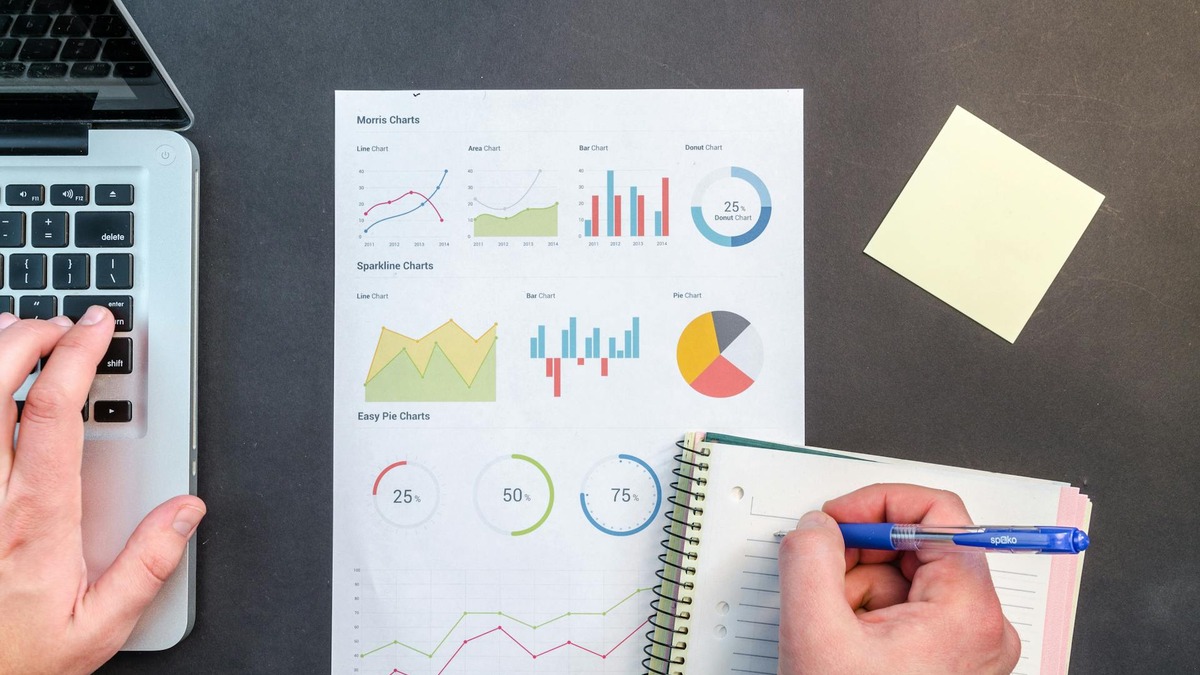 Chart understanding remains one of the harder document analysis tasks, requiring models to interpret visual data representations and perform calculations from graphs.
Source: pexels.com
Chart understanding remains one of the harder document analysis tasks, requiring models to interpret visual data representations and perform calculations from graphs.
Source: pexels.com
Methodology
Rankings rely on two primary benchmarks. DocVQA tests models on 50,000 questions across 12,000+ scanned document images - letters, memos, reports, forms - scored by Average Normalized Levenshtein Similarity. Human performance sits at 94.36%, a bar every model in the top half of this table now clears. ChartQA measures extraction from and reasoning about bar charts, line graphs, and scatter plots, requiring both correct reading and simple calculation.
Both benchmarks are now widely described as near-saturated for frontier models. A June 2026 analysis of evaluation benchmarks puts DocVQA at roughly 96% and ChartQA "approaching ceiling" around 88-93% for top models, and recommends looking elsewhere for differentiation among frontier systems. Two harder successors back that up concretely: on ChartQAPro, Claude 3.5 Sonnet's 90.5% ChartQA score collapses to 55.8%, a 34.7-point drop. On ChartMuseum, which uses real charts pulled from research papers and presentations rather than constructed test cases, the best model tested (Gemini 2.5 Pro) scores just 63.0% against a 93% human baseline, and the best open-weight model (Qwen2.5-VL-72B) manages only 38.5%. A newer benchmark, SynthDocBench, published this July, targets long-context document understanding specifically, where even top single-page performers show meaningfully lower scores once document length and layout complexity are controlled for.
The practical read: DocVQA and ChartQA are still useful for confirming a model clears a competence floor, but they no longer separate the top tier the way they did in 2024. If your workload resembles the messy real-world charts in ChartMuseum more than the clean presentation-style charts in ChartQA, budget for meaningfully lower real-world accuracy than the table above implies. See our guide to understanding AI benchmarks for more on reading benchmark claims skeptically.
Historical Progression
July 2025 - Qwen2-VL-72B pushed DocVQA past 94%, establishing open-weight models as serious competitors in document understanding.
December 2025 - Mistral OCR 3 and DeepSeek-VL2's efficiency-focused MoE approach both shipped, expanding the specialized-OCR field beyond general VLMs.
February 2026 - Claude Opus 4.6 and Qwen2.5-VL-72B both crossed 96% on DocVQA, surpassing the benchmark's human baseline.
April-May 2026 - Qwen3-VL-235B-A22B edged past Qwen2.5-VL-72B on DocVQA using a MoE architecture; Surya OCR 2 pushed sub-billion-parameter OCR to 83.3% OlmOCRBench.
June-July 2026 - PaddleOCR PP-OCRv6, Mistral OCR 4, Infinity-Parser2-Pro, and Chandra OCR 2 all shipped within six weeks of each other on the specialized-OCR side, while general-purpose flagship releases (Opus 4.7, Opus 4.8, GPT-5.5, GPT-5.6, Gemini 3.6 Flash) stopped disclosing DocVQA/ChartQA scores completely.
The rate of published progress on DocVQA has effectively stalled at the frontier, not because models stopped improving but because the labs building them stopped using this specific yardstick to describe the improvement. That's a different problem than benchmark saturation, and it's one worth watching: if the next generation of harder benchmarks (ChartQAPro, ChartMuseum, SynthDocBench) doesn't get the same adoption DocVQA had, document understanding could become one of the least comparable capability areas on this site within a year.
FAQ
What's the best model for analyzing scanned PDFs?
Qwen3-VL-235B-A22B (96.5% DocVQA) and Qwen2.5-VL-72B (96.4%) lead if you can self-host. For a hosted API, Claude Opus 4.6 combines a 96.1% DocVQA score with the highest ChartQA in this table.
Is open-source competitive for document understanding?
Yes, and it's currently ahead. Qwen3-VL-235B-A22B and Qwen2.5-VL-72B hold the top two DocVQA scores of any model with a verified July 2026 number, proprietary or open.
Why haven't the rankings changed since March?
Because the newer flagships released since then - Opus 4.7/4.8, GPT-5.5/5.6, Gemini 3.6 Flash - didn't publish DocVQA or ChartQA scores in their announcements, not because they got worse at reading documents.
What's the cheapest model that still works well?
Mistral Small 3.2 24B at $0.10/$0.30 per million tokens scores 94.9% on DocVQA, beating larger models like Gemma 3 27B on both DocVQA and ChartQA.
Should I use a general model or a dedicated OCR tool?
General models (Opus 4.6, GPT-5.4, the Qwen VL family) suit Q&A and reasoning over documents. Dedicated OCR tools (Mistral OCR 4, Infinity-Parser2-Pro, PaddleOCR PP-OCRv6) suit structured extraction like tables and forms into a fixed output format.
Are DocVQA and ChartQA still useful benchmarks?
Only as a competence floor. Both are described as near-saturated for frontier models as of mid-2026. Harder successors like ChartQAPro and ChartMuseum show 30+ point score drops for the same models, so use those for differentiating top-tier options.
Sources:
- DocVQA Benchmark Leaderboard - LLM Stats
- Claude Opus 4.7 Announcement - Anthropic
- Claude PDF Support Documentation - Anthropic
- GPT-5.4 Document and Multimodal Understanding Tips - OpenAI
- Gemini 3.1 Pro Model Card - Google DeepMind
- Gemini 3.6 Flash Launch - 9to5Google
- GLM-5.2 Overview - Simon Willison
- Qwen2.5-VL Technical Report - arXiv
- Mistral OCR 4 Announcement - Mistral AI
- DeepSeek-OCR-2 Model Card - Hugging Face
- Surya OCR GitHub Repository
- PaddleOCR PP-OCRv6 Documentation
- Infinity-Parser2 Technical Report - arXiv
- OlmOCR-Bench Dataset - Allen Institute for AI
- ChartQAPro Paper - arXiv
- ChartMuseum Paper - arXiv
- SynthDocBench Paper - arXiv
- Frontier AI Model Evaluation Benchmarks Analysis
✓ Last verified July 22, 2026

